Rajya Poshan Mission Phase 2 Launched to Combat Malnutrition in UP
Source:The Hindu ↗
Why It Matters
UPPSC frequently queries state-specific health and nutrition interventions, state-level development projects, and national schemes like the ICDS. Understanding the Rajya Poshan Mission Phase 2 (targeting child development's first 1,000 days) and state infrastructure initiatives (like the Ganga Expressway) is highly relevant for upcoming prelims.
Summary
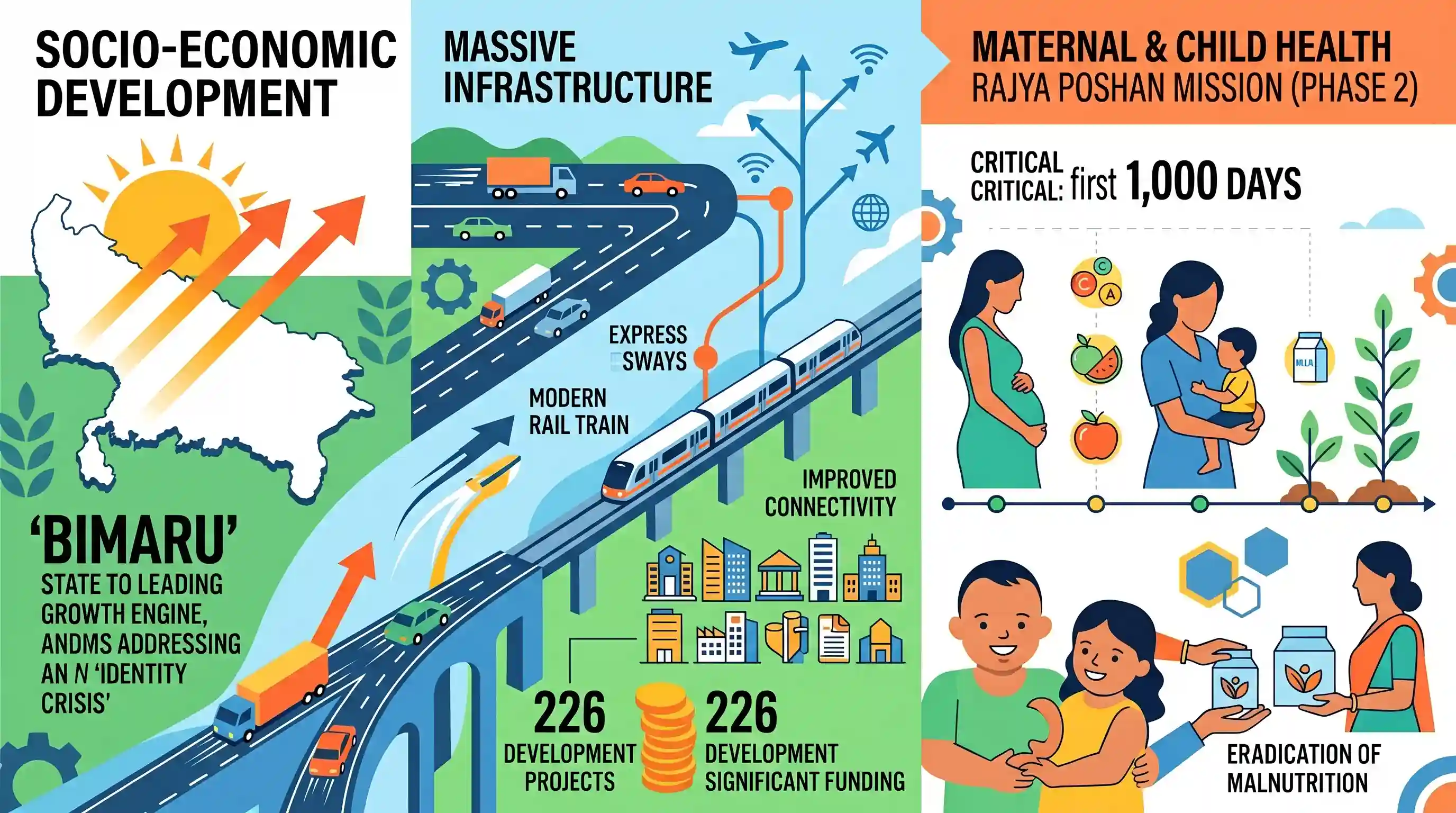
Uttar Pradesh Chief Minister Yogi Adityanath announced a complete transformation in the state's global and national image, addressing the historical 'identity crisis' of its residents. During an event in Gorakhpur, he inaugurated 226 development projects worth ₹926 crore and launched the second phase of the State Nutrition Mission (Rajya Poshan Mission). This phase focuses primarily on the critical 'first 1,000 days' of child development to eradicate malnutrition, distributing nutrition kits to pregnant women and infants. Adityanath highlighted UP's transition from a 'BIMARU' state to India's leading growth engine, driven by massive infrastructure expansion including expressways, metro rail, and improved connectivity.
Key Points
- Chief Minister Yogi Adityanath inaugurated and laid the foundation stones for 226 development projects worth over ₹926 crore in Gorakhpur.
- The Chief Minister officially launched the second phase of the Rajya Poshan Mission (State Nutrition Mission) to combat malnutrition.
- The second phase places a critical emphasis on the 'first 1,000 days' of a child’s life (spanning from conception to age two), which is vital for preventing permanent physical and cognitive underdevelopment.
- Under the mission, nutritional food kits were distributed to pregnant women and healthy children, aiming to reduce infant and maternal mortality and address stunting and anemia.
- Adityanath highlighted Uttar Pradesh's shift from being labeled a 'BIMARU' (lagging) state to becoming a key economic growth engine of India, backed by improved law and order and major infrastructure like expressways, metro rail, and air connectivity.
Important Terms
Rajya Poshan Mission (State Nutrition Mission)

A welfare initiative in Uttar Pradesh aimed at eradicating malnutrition among pregnant women, lactating mothers, and children by ensuring nutrition security and integrating multi-departmental support.
UPSC context
GS Paper II: Welfare schemes for vulnerable sections; tests understanding of state-level social sector initiatives.
First 1,000 Days of Life
The crucial window from conception to a child’s second birthday. Proper nutrition and stimulation during this period are essential to prevent irreversible physical and cognitive developmental damage.
UPSC context
GS Paper II: Issues relating to poverty, hunger, and health; tests awareness of biological milestones in policy.
BIMARU States
An acronym (Bihar, Madhya Pradesh, Rajasthan, Uttar Pradesh) coined by demographer Ashish Bose in 1985 to describe economically backward states with poor health, literacy, and demographic indicators.
UPSC context
GS Paper III: Indian Economy and growth; tests regional disparities, planning, and demographic challenges.
Ganga Expressway
A 594-kilometer, six-lane greenfield expressway connecting Meerut and Prayagraj in Uttar Pradesh, built to enhance high-speed connectivity, transport efficiency, and economic corridor development.
UPSC context
GS Paper III: Infrastructure (Roads); tests understanding of connectivity projects, regional integration, and dual-use logistics.
Integrated Child Development Services (ICDS)
A centrally sponsored flagship scheme launched in 1975 to provide early childhood care, including supplementary nutrition, immunization, and pre-school education, to children and mothers.
UPSC context
GS Paper II: Social Justice; tests understanding of flagship social security and child development schemes.
Prelims Trap
The 'first 1,000 days' of child development under health schemes refers to the period starting from birth up to 1,000 days of age.
The period actually begins from conception (gestation of approx. 270 days) through to the child's second birthday (730 days), rather than starting only at birth.
Static Concepts Connected
What are the six core services provided under the Integrated Child Development Services (ICDS) scheme?
- Supplementary Nutrition: Supplementary nutrition is provided to children under 6 years, pregnant women, and lactating mothers.
- Healthcare Services: Immunization, health check-ups, and referral services are administered through the Anganwadi network.
- Early Education: Non-formal pre-school education is provided to children in the 3-6 years age group to prepare them for school.
- Explicit Exclusions: It explicitly excludes cash transfers, distribution of school books, uniforms, or direct financial aid.
What is the origin and significance of the demographic term 'BIMARU'?
- Historical Origin: Coined by demographer Ashish Bose in the mid-1980s to highlight economic and demographic lagging to PM Rajiv Gandhi.
- Structural Acronym: Stands for Bihar, Madhya Pradesh, Rajasthan, and Uttar Pradesh, representing states with poor human development indices.
- Demographic Criteria: Characterised historically by high population growth, high infant mortality, and low per capita economic output.
Cross-Topic Patterns
Nutrition targets + Federal dynamics
Discrepancies between Central POSHAN Abhiyaan and state-specific missions like Rajya Poshan Mission reflect cooperative federalism where states customise welfare delivery to resolve localized stunting.
SDG 2, 3 + Demographic Dividend
Interventions during the first 1,000 days directly support SDG 2 and 3, preventing permanent cognitive deficits that impair India's future demographic dividend.

Statements on the 'first 1,000 days' timeline and ICDS's six core services will likely test conceptual precision in 2026.
Linked PYQs · 3
Linked PYQs · 3
- 2017UPPSC_PRELIMSGS1
Which among the following services is not provided under Integrated Child Development Services (ICDS) scheme?
- 2020UPPSC_PRELIMSGS1
Which one among the following is NOT covered under Integrated Child Development Programme ?
- 2023UPPSC_PRELIMSGS1
Which of the following Scheme/Programme is not the Central Government Programme and it is Uttar Pradesh Government's Programme?
