UP Chief Minister Launches Second Phase of State Nutrition Mission
Source:The Hindu ↗
Why It Matters
UPPSC regularly tests state-specific governance schemes, nutrition targets (aligning with SDG 2 and SDG 3), and infrastructure milestones. Understanding UP\'s transition out of the 'BIMARU' classification and the operationalization of welfare missions like the State Nutrition Mission is critical for GS Paper-I (Social Sector Schemes & UP Geography/Economy) and UPPSC-specific GS Papers 5 and 6.
Summary
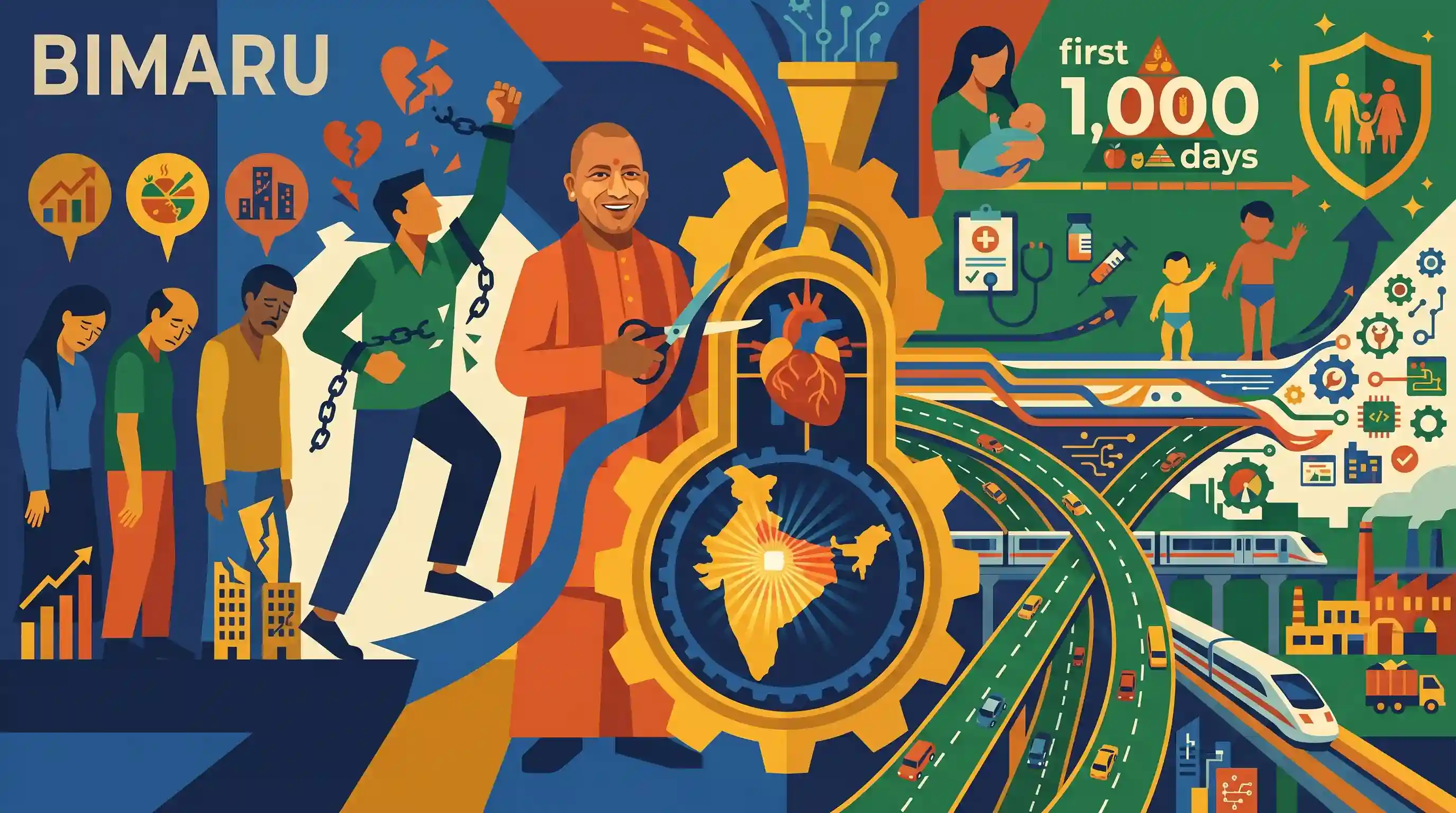
Uttar Pradesh Chief Minister Yogi Adityanath inaugurated 226 development projects worth over ₹926 crore in Gorakhpur and launched the second phase of the UP State Nutrition Mission. During the launch, he emphasized maternal and child health—specifically the significance of the first 1,000 days of a child's life—to eliminate malnutrition. He also asserted that UP has shed its 'BIMARU' status and emerged as a national economic growth engine driven by robust expressway, railway, and metro infrastructure.
Key Points
- Chief Minister Yogi Adityanath inaugurated and laid the foundation stones for 226 development projects worth over ₹926 crore in Gorakhpur.
- Launched the second phase of the UP State Nutrition Mission, stressing that maternal health directly determines child health.
- Highlighted the medical and development importance of the 'First 1,000 Days' of a child\'s life (conception to age two) in laying a lifelong physical and cognitive foundation.
- Stated that Uttar Pradesh has shed its historical 'BIMARU' status (an acronym representing Bihar, Madhya Pradesh, Rajasthan, and Uttar Pradesh coined by demographer Ashish Bose) to emerge as a national economic growth engine.
- Credited massive infrastructure projects, specifically highlighting UP\'s country-leading expressway network, expanding railways, metros, and air connectivity, for the state\'s economic turnaround.
Important Terms
State Nutrition Mission

A multi-sectoral coordinating body established by the Government of Uttar Pradesh, with UNICEF support, to improve nutrition programming, convergence, and outcomes for maternal and child health.
UPSC context
GS Paper 2 (Governance & Social Justice), testing decentralized, convergence-based strategies to address regional malnutrition.
POSHAN Abhiyaan
India's flagship program launched in 2018 to improve nutritional outcomes for children, pregnant/lactating women, and adolescent girls using technology, multi-ministerial convergence, and behavioral change campaigns.
UPSC context
GS Paper 2 (Government Schemes & Social Justice), testing interventions tackling hunger, stunting, and maternal undernutrition.
Integrated Child Development Services (ICDS)
A centrally-sponsored early childhood care and development program launched in 1975 that delivers an integrated package of six health, nutrition, and non-formal education services to vulnerable children and mothers.
UPSC context
GS Paper 2 (Social Sector/Welfare Schemes), testing grassroots delivery mechanisms for maternal-child healthcare and nutrition.
Ganga Expressway
A 594 km, 6-lane access-controlled greenfield expressway connecting Meerut and Prayagraj, developed by UPEIDA to enhance logistics, regional connectivity, and dual-use emergency military airstrip facilities.
UPSC context
GS Paper 3 (Infrastructure & Economic Growth), testing logistics networks, regional development corridors, and connectivity initiatives.
BIMARU States
An acronym coined by demographer Ashish Bose in the 1980s to describe states (Bihar, Madhya Pradesh, Rajasthan, Uttar Pradesh) historically lagging in economic, educational, healthcare, and demographic indicators.
UPSC context
GS Papers 1 & 2 (Population, Demography & Regional Imbalances), testing understanding of regional disparities and demographic transitions.
Prelims Trap
The 'First 1,000 Days' of child development refers to the critical window starting from birth until the child reaches three years of age.
The period actually begins at conception (~270 days) and runs until the child's second birthday (~730 days). It does not start at birth.
Static Concepts Connected
What is the origin and demographic significance of the 'BIMARU' acronym?
- Origin: Coined by demographer Ashish Bose in 1985 to identify Bihar, Madhya Pradesh, Rajasthan, and Uttar Pradesh as lagging in development.
- Demographic drag: Highlighted how high population growth rates and poor healthcare in these states lowered India's overall human development index.
- Policy impact: Shifted planning focus toward targeted regional interventions, eventually leading to the creation of the National Rural Health Mission.
What is the physiological and policy significance of the 'First 1,000 Days' window?
- Chronological span: Covers the period from conception (approx. 270 days) to the child's second birthday (730 days).
- Neurological window: Almost 80% of adult brain development occurs here, making nutritional stunting during this period largely irreversible.
- Policy shift: Moves intervention focus from school-age mid-day meals to prenatal care, maternal health, and infant complementary feeding.
Cross-Topic Patterns
Infrastructure-led demographic transitions
Connecting rural hinterlands via expressways directly reduces maternal mortality by drastically shortening emergency transport times to tertiary healthcare centers.
Federalism in health governance
State-specific nutrition missions demonstrate how decentralized governance and localized, output-based targets complement central schemes like POSHAN Abhiyaan.

Multi-statement Prelims questions will likely target the precise timeline of the 'First 1,000 Days' alongside NFHS-6 nutrition data.
Linked PYQs · 3
Linked PYQs · 3
- 2023UPPSC_PRELIMSGS1
Which of the following Scheme/Programme is not the Central Government Programme and it is Uttar Pradesh Government's Programme?
- 2023UPPSC_PRELIMSGS1
Which of the following scheme/s is/are related to Uttar Pradesh? (1) Anuthee Uphar Scheme (2) Matra Shakti Udyamita Scheme (3) Kaushalya Matritva Scheme (4) Stree Nidhi Scheme Select the 'correct' answer using the code given below -
- 2017UPPSC_PRELIMSGS1
Which among the following services is not provided under Integrated Child Development Services (ICDS) scheme?
