Madrasa Education Row and Political Polarization in Uttar Pradesh
Source:The Hindu ↗
Why It Matters
The issue is highly relevant for UPPSC Prelims as it touches upon constitutional provisions protecting minority educational rights (Article 30), the intersection of state legislation with fundamental rights, and the historical contribution of traditional educational institutions during the Indian freedom struggle.
Summary
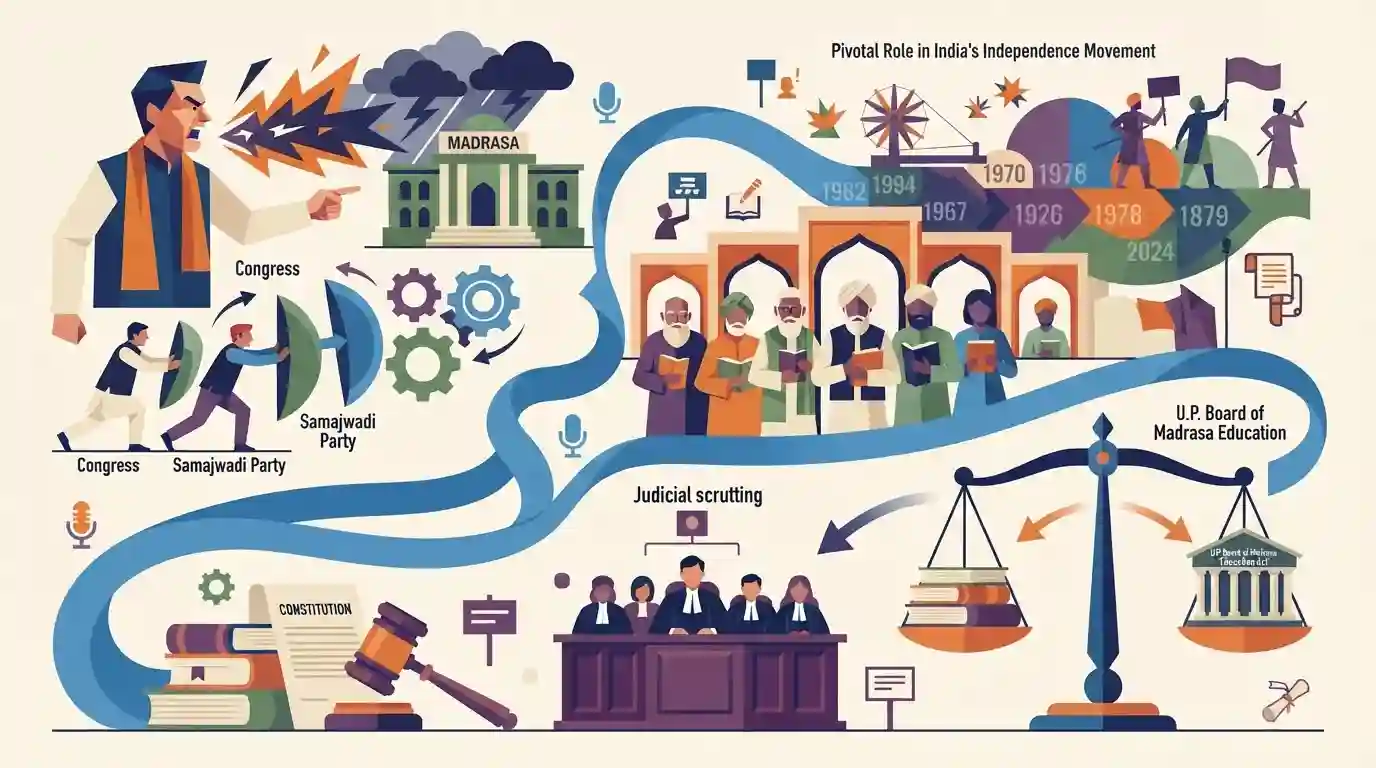
Remarks by Uttar Pradesh Deputy Chief Minister Keshav Prasad Maurya alleging that Madrasa education fosters terrorist mindsets have sparked a major political uproar. Opposition parties, particularly the Congress and Samajwadi Party, accuse the BJP leader of attempting to incite communal polarization to recover lost political ground in the state. Concurrently, Muslim organizations such as Jamiat Ulama-i-Hind defended the legacy of Madrasas, emphasizing their pivotal role in India's independence movement. The political row coincides with judicial scrutiny of minority education frameworks, notably the legal battle concerning the constitutionality of the U.P. Board of Madrasa Education Act.
Key Points
- U.P. Deputy Chief Minister Keshav Prasad Maurya claimed that individuals educated in Madrasas develop anti-national mindsets and avoid chanting national slogans.
- Opposition parties, including the Congress and Samajwadi Party, sharply criticized the remarks, labeling them as desperate attempts at communal polarization following recent electoral defeats in U.P.
- Muslim organizations like Jamiat Ulama-i-Hind condemned the comments, recalling the historical role of Madrasas as key centers during India's freedom struggle.
- The controversy occurs amidst ongoing legal battles over the U.P. Board of Madrasa Education Act, which the Allahabad High Court struck down as unconstitutional, a decision currently stayed by the Supreme Court.
Important Terms
U.P. Board of Madrasa Education Act, 2004

A state law providing a legal framework to recognize, standardize, and regulate Islamic educational institutions (madrasas) in Uttar Pradesh by integrating secular curriculum alongside religious instruction.
UPSC context
Tests GS Paper 2 (Polity) concepts regarding secularism, right to education, and state regulation of minority educational rights.
Jamiat Ulama-i-Hind
A prominent organization of Islamic scholars founded in 1919. It historically championed composite nationalism, actively participated in the Indian independence movement, and strongly opposed the partition of India.
UPSC context
Vital for GS Paper 1 (Modern Indian History) concerning freedom struggle organizations, composite culture, and partition politics.
Supreme Court of India
India's apex judicial body. It recently upheld the U.P. Madrasa Act, clarifying that the state can regulate minority educational institutions to ensure educational standards without violating their constitutional minority character.
UPSC context
Tests GS Paper 2 (Judiciary) topics involving constitutional interpretation, fundamental rights (Article 30), and judicial review.
Allahabad High Court
The constitutional court with jurisdiction over Uttar Pradesh. It previously struck down the U.P. Madrasa Act as unconstitutional for allegedly violating secularism, a decision the Supreme Court later overturned.
UPSC context
Relevant to GS Paper 2 (Polity) for illustrating judicial scrutiny, high court jurisdiction, and debates surrounding the principle of secularism.
U.P. Board of Madrasa Education
A statutory body established under the 2004 Act to supervise and administer madrasas in Uttar Pradesh, tasked with prescribing syllabi, conducting exams, and ensuring educational standards.
UPSC context
Relevant to GS Paper 2 (Governance and Education) regarding statutory regulatory bodies and minority education administration.
Prelims Trap
An ordinary legislative enactment can be declared unconstitutional solely on the ground of violating the basic structure of the Constitution.
The Supreme Court (2024) clarified that statutes cannot be invalidated directly on 'basic structure' grounds without violating specific constitutional provisions or lacking competence.
Static Concepts Connected
Can ordinary statutes be invalidated solely for violating the basic structure doctrine?
- SC clarification: An ordinary statute cannot be declared unconstitutional directly on the ground of violating the abstract basic structure.
- Valid grounds: Laws can only be struck down for violating explicit constitutional provisions (such as Part III) or lacking legislative competence.
- Abstract concepts: Abstract constitutional concepts like secularism must map to concrete provisions to justify statutory invalidation.
What is the regulatory scope of the State over minority institutions under Article 30?
- Regulatory power: The State can regulate academic standards, syllabus, teacher qualifications, and hygiene to safeguard student welfare.
- Autonomy limits: State regulations must not destroy the minority character or render administrative rights illusory.
- Legislative competence: State education laws under Concurrent List Entry 25 cannot override Union higher education standards under List I Entry 66.
Cross-Topic Patterns
List III Entry 25 vs List I Entry 66
How state-level educational laws under Entry 25 of List III must align with Union regulatory standards under Entry 66 of List I.
Composite nationalism vs partition history
Tracing Jamiat Ulama-i-Hind’s historical role in composite nationalism and its impact on modern debates surrounding the identity of Islamic madrasas.

SC's 2024 clarification on basic structure limits for statutes and Article 30 regulatory thresholds is highly testable in GS-2.
Linked PYQs · 2
Linked PYQs · 2
- 1997UPPSC_PRELIMSGS1
Which Article of the Constitution protects the 'Right of minorities to establish and Administer educational institutions of their choice'?
- 2022UPPSC_PRELIMSGS1
Right to Education has been included into the Fundamental Rights by the
