UPNEDA invites bids for rooftop solar on state buildings
Source:solar-quarter ↗
Why It Matters
This initiative highlights Uttar Pradesh's commitment to transitioning its government infrastructure to renewable energy sources, aligning with broader national targets for solar power capacity and energy sustainability.
Summary
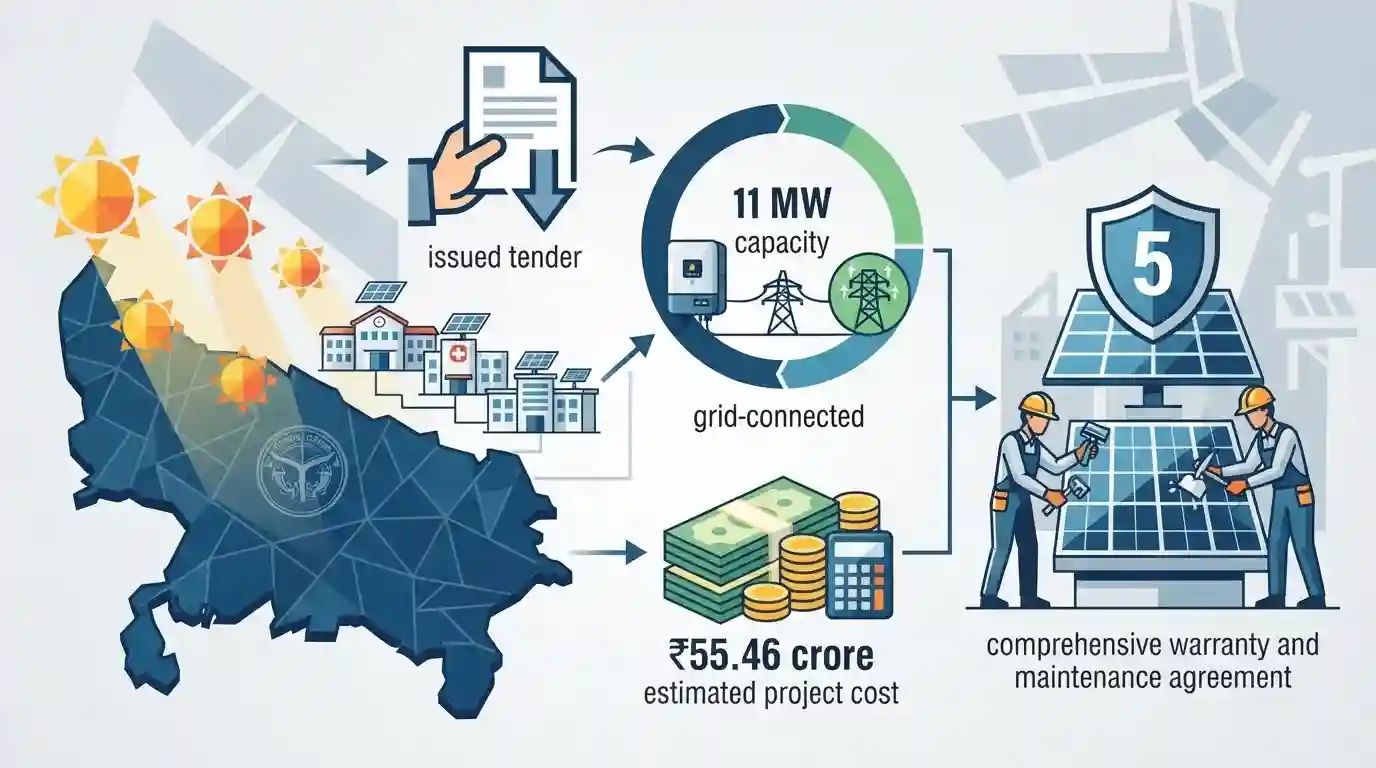
The Uttar Pradesh New and Renewable Energy Development Agency (UPNEDA) has issued a tender for the installation of 11 MW of grid-connected rooftop solar power projects on various government buildings throughout the state. The project, estimated at ₹55.46 crore, aims to bolster the state's renewable energy infrastructure and includes a five-year comprehensive warranty and maintenance agreement.
Key Points
- UPNEDA has invited online bids to develop 11 MW of grid-connected rooftop solar projects on government buildings across Uttar Pradesh.
- The projects are to be executed on a turnkey basis, encompassing design, engineering, supply, installation, testing, and commissioning.
- The contract includes a comprehensive warranty and maintenance provision for a period of five years.
- The total estimated project cost is around ₹55.46 crore, divided into three categories based on capacity (1-10kW, 11-100kW, and 101-500kW).
Important Terms
Grid-connected Rooftop Solar Power Projects

Solar panel systems installed on roofs that operate in synchronization with the local utility grid. They generate electricity for local consumption and feed surplus power back into the grid via net metering.
UPSC context
Highly relevant for UPPSC GS Paper 3 (Energy Security/Environment). Tests knowledge of decentralized renewable energy and net-zero targets.
Uttar Pradesh New and Renewable Energy Development Agency (UPNEDA)
The nodal agency under the UP Government responsible for promoting sustainable energy solutions, administering green energy policies, and executing state and central initiatives like solar parks and rooftop solar schemes.
UPSC context
Crucial for UPPSC GS Paper 5 (UP-specific Government Initiatives & Infrastructure). Tests awareness of state institutional frameworks for climate action.
Renewable Energy Infrastructure
The foundational physical systems and facilities, including solar panels, power inverters, and grid integration networks, required to generate, manage, and distribute clean energy sustainably.
UPSC context
Important for UPPSC GS Paper 3 (Economic Development/Infrastructure). Evaluates understanding of state capital investments transitioning toward a green economy.
Prelims Trap
UPNEDA is a recently established statutory body created under the Uttar Pradesh Solar Energy Policy 2022.
UPNEDA is not a new statutory body. It was established decades ago in 1983 as an autonomous institute (Alternative Energy Development Institute) to promote renewable energy.
Static Concepts Connected
What is the historical background and mandate of UPNEDA?
- Establishment Year: Created in 1983 as the Alternative Energy Development Institute, it operates as an autonomous institution under UP's Department of Additional Energy Sources.
- Nodal Authority: Acts as the primary state agency executing national and state renewable schemes, including the UP Solar Energy Policy 2022.
What are the core mechanisms of a grid-connected rooftop solar (RTS) system?
- Photovoltaic Conversion: Solar panels utilize the photovoltaic effect to convert incident solar radiation directly into direct current (DC) electrical energy.
- Grid Integration: An inverter converts DC to alternating current (AC). Surplus energy is exported to the grid, usually tracked via a net metering arrangement.
Cross-Topic Patterns
Aligning State & Central Solar Schemes
UP's push for rooftop solar on government buildings complements the PM Surya Ghar Yojana's residential focus, highlighting a dual-pronged state-center renewable infrastructure strategy.
Sub-national Climate Commitments
UP's 22 GW solar target by 2026-27 is a critical state-level contributor to India’s updated NDC of 50% cumulative electric power from non-fossil sources by 2030.

Expect UPPSC to test UPNEDA's establishment year (1983) or specific targets of the UP Solar Energy Policy 2022 in a multi-statement MCQ.
Linked PYQs · 2
Linked PYQs · 2
- 2021UPPSC_PRELIMSGS1
A non-renewable source of energy is
- 2022UPPSC_PRELIMSGS1
Solar energy is converted into electric energy through
