NPCI Implements New Unified Payments Interface Rules for Security
Source:Indian Express ↗
Why It Matters
UPI and digital payments are central to India's financial architecture and frequently tested by UPSC. Understanding the regulatory oversight by NPCI and RBI, the technical constraints of scaling digital public infrastructure, and the global recognition by bodies like the IMF provides critical fodder for Mains answers on the digital economy and Prelims questions on payment systems.
Summary
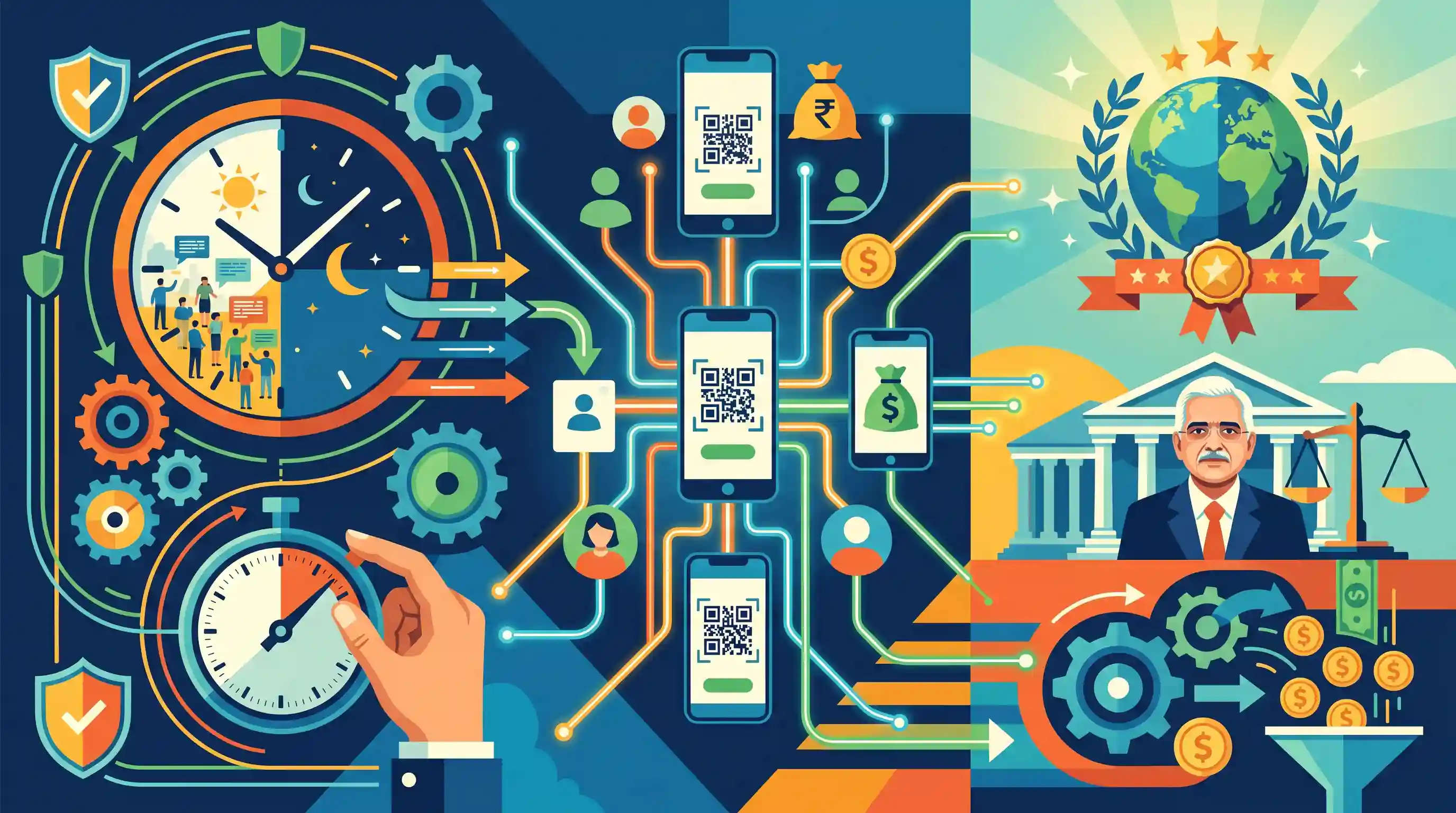
The National Payments Corporation of India (NPCI) has introduced a new set of rules for the Unified Payments Interface (UPI) effective August 1, 2025, primarily to manage system load and enhance security. The regulations limit high-frequency API requests, capping daily balance inquiries at 50 per app and restricting Autopay mandate executions to non-peak hours. These technical adjustments aim to sustain UPI's robust performance, which the International Monetary Fund (IMF) recently praised in a note emphasizing India's global leadership in fast, interoperable retail digital payments. Additionally, comments by RBI Governor Sanjay Malhotra hint at future dialogues regarding the monetization of UPI services to cover operational costs.
Key Points
- The NPCI implemented new UPI rules starting August 1, 2025, to optimize system performance, manage API transactions per second (TPS), and reduce fraud risks.
- Daily limits have been placed on customer-initiated actions: balance inquiries are capped at 50 per app, and 'list account' requests at 25 per app.
- UPI Autopay mandates (for utility bills, subscriptions) can now only be executed during non-peak hours to prevent system overload during peak transaction times.
- The IMF recently highlighted India's global leadership in fast payments, attributing it to the success and interoperability of the UPI.
- RBI Governor Sanjay Malhotra indicated that while the free model of UPI has driven massive adoption, the underlying service costs will need to be addressed in the future.
Important Terms
Unified Payments Interface (UPI)

An indigenous real-time payment system developed by NPCI that enables instant, 24/7 inter-bank fund transfers via mobile devices using a Virtual Payment Address (VPA) for secure, interoperable transactions.
UPSC context
GS Paper III: Indian Economy/Digital Infrastructure. Tests knowledge of fintech innovations, financial inclusion, and the transition to a cashless economy.
National Payments Corporation of India (NPCI)
An umbrella organization founded in 2008 by the RBI and IBA to operate retail payment and settlement systems in India, including UPI, RuPay, and IMPS, as a not-for-profit company.
UPSC context
GS Paper III: Banking and Payment Systems. Relevant for understanding institutional frameworks governing India's Digital Public Infrastructure (DPI).
Reserve Bank of India (RBI)
India's central bank and regulatory authority for the financial system. It oversees payment systems like UPI, focusing on system stability, consumer protection, and the long-term sustainability of digital infrastructure.
UPSC context
GS Paper III: Indian Economy/Banking. Critical for topics on financial regulation, payment system sustainability, and monetary policy.
International Monetary Fund (IMF)
A global organization that monitors economic stability. It recently hailed India's UPI as a global model for fast, interoperable retail digital payments and the world's largest system by transaction volume.
UPSC context
GS Paper II: International Institutions. Examines global recognition of India's indigenous technology and its impact on global financial standards.
Digital Public Infrastructure (DPI)
A set of shared digital systems (such as Aadhaar, UPI, and DigiLocker) that provide essential services at a societal scale, driving financial inclusion and innovation through the 'India Stack.'
UPSC context
GS Paper III: Science & Technology/Economy. Tests understanding of how digital architectures facilitate inclusive economic growth and governance.
Prelims Trap
"The RBI has capped daily UPI transactions at 50 per user and introduced a nominal fee to cover operational costs."
NPCI (not RBI) issued the caps, and they apply to API requests (like balance checks), not financial transfers. Furthermore, UPI currently operates on a zero-MDR model with no fees.
Static Concepts Connected
What is the National Payments Corporation of India (NPCI)?
- Formation: An initiative of the RBI and the Indian Banks' Association (IBA) created under the Payment and Settlement Systems Act, 2007.
- Structure: It is a "Not-for-Profit" Company registered under Section 8 of the Companies Act 2013, designed to build retail payment infrastructure.
- Key Products: Manages systems including UPI, RuPay, FASTag, IMPS, NACH, and the Aadhaar Enabled Payment System (AePS).
What is the Merchant Discount Rate (MDR) in digital payments?
- Definition: The fee that banks charge merchants for processing digital payment services, typically distributed among the issuing bank, payment network, and POS provider.
- Zero MDR Policy: India mandated a zero MDR for UPI and RuPay debit cards to accelerate digital adoption, shifting the infrastructure cost burden to banks and Payment Service Providers.
Cross-Topic Patterns
DPI as diplomatic soft power
The IMF's praise aligns with India's push to export its Digital Public Infrastructure (DPI), integrating UPI with foreign payment systems (e.g., Singapore's PayNow) as a strategic soft-power tool.
Zero MDR vs. Infrastructure Viability
The RBI Governor's hint at monetization highlights a classic welfare-vs-viability debate: zero MDR drives mass financial inclusion but strains bank infrastructure, necessitating load-management limits like API caps.

Expect a multi-statement prelims question in 2026 linking the zero MDR policy, NPCI's ownership structure, and DPI's role in soft power.
Linked PYQs · 5
Linked PYQs · 5
- 2017PrelimsGS1
Which of the following is a most likely consequence of implementing the 'Unified Payments Interface (UPI)'?
- 2018PrelimsGS1
With reference to digital payments, consider the following statements: 1. BHIM app allows the user to transfer money to anyone with a UPI-enabled bank account. 2. While a chip-pin debit card has four factors of authentication, BHIM app has only two factors of authentication. Which of the statements given above is/are correct?
- 2017PrelimsGS1
Consider the following statements: 1. National Payments Corporation of India (NPCI) helps in promoting the financial inclusion in the country. 2. NPCI has launched RuPay, a card payment scheme. Which of the statements given above is/are correct?
- 2025PrelimsGS1
Consider the following countries : I. United Arab Emirates II. France III. Germany IV. Singapore V. Bangladesh How many countries amongst the above are there other than India where international merchant payments are accepted under UPI?
- 2023MainsGS3
What is the status of digitalization in the Indian economy? Examine the problems faced in this regard and suggest improvements.
