Digital public infrastructure for artificial intelligence in MSMEs
Source:Indian Express ↗
Why It Matters
It illustrates India's unique developmental model of using Digital Public Infrastructure (DPI) to address technological divides. For UPSC, it connects the topics of technology adoption (AI) with core economic goals like formalization and growth of the MSME sector.
Summary
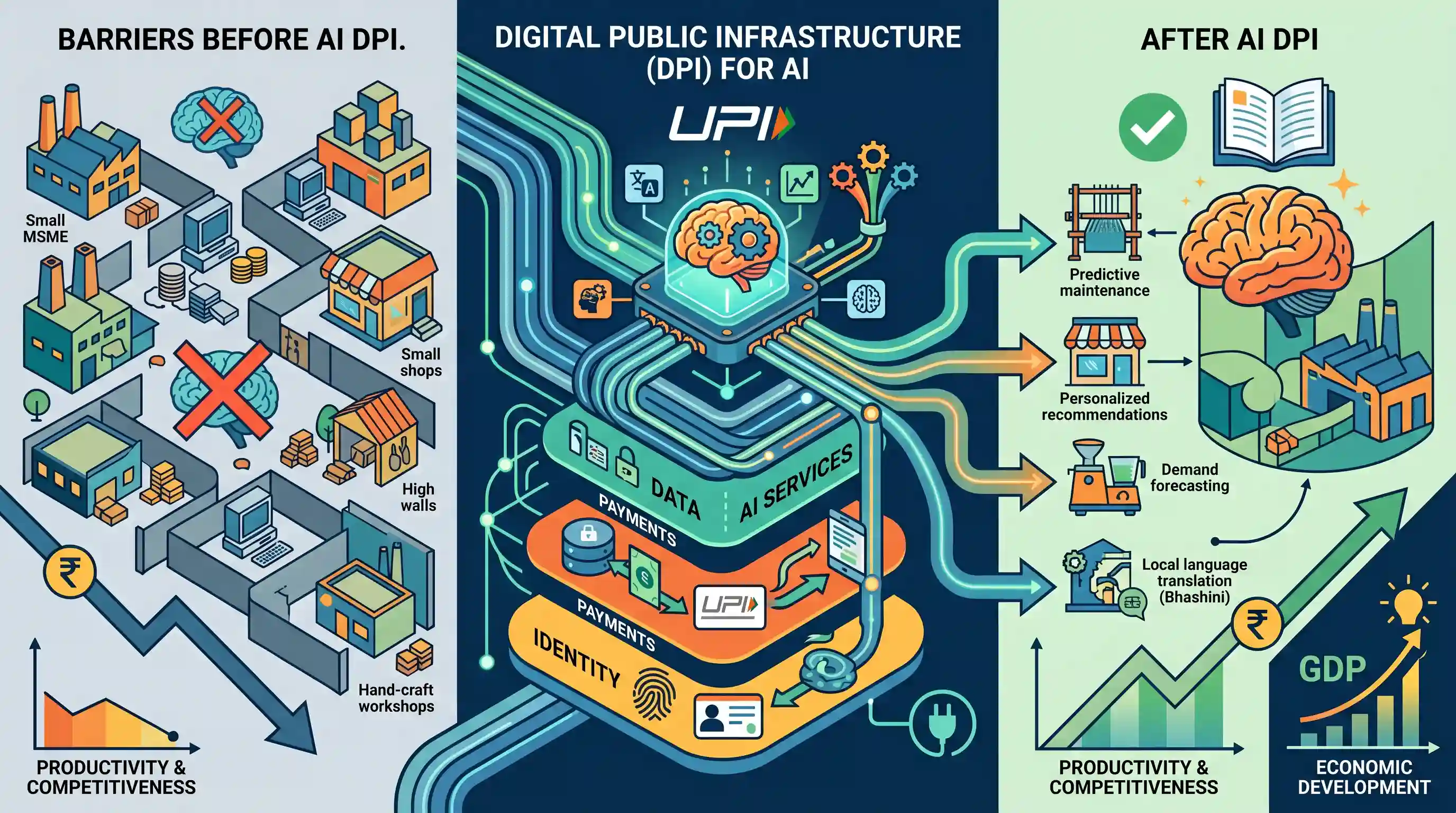
IT Minister Ashwini Vaishnaw announced that India is working on a Digital Public Infrastructure (DPI) for Artificial Intelligence, conceptually similar to the Unified Payments Interface (UPI). The objective is to create a common platform that democratizes access to AI capabilities, particularly for Micro, Small, and Medium Enterprises (MSMEs). This shared infrastructure will enable MSMEs to integrate AI into their operations, improving productivity and competitiveness without the burden of heavy independent capital investment in technology.
Key Points
- The Indian government is developing a Digital Public Infrastructure (DPI) for Artificial Intelligence, aiming to replicate the open-access success of the Unified Payments Interface (UPI).
- The primary goal of this AI platform is to democratize advanced technology access for Micro, Small, and Medium Enterprises (MSMEs).
- By providing a common shared platform, the initiative will allow small businesses to utilize AI tools for tasks like supply chain management and predictive maintenance without prohibitive upfront costs.
- This intervention is designed to enhance the productivity and global competitiveness of Indian MSMEs and increase the manufacturing sector's share in the GDP.
Important Terms
Digital Public Infrastructure (DPI)

Shared digital systems (like Aadhaar and UPI) built on open standards and interoperable protocols to deliver essential public and private services at a societal scale.
UPSC context
GS Paper 2 (E-governance) and GS Paper 3 (IT). Essential for India's digital economy and global leadership in tech frameworks.
MSMEs
Businesses classified by investment and turnover limits under the MSMED Act 2006; they are critical for employment, innovation, and exports in the Indian economy.
UPSC context
GS Paper 3 (Indian Economy). Tests knowledge of industrial growth, inclusive development, and the backbone of India's manufacturing sector.
Unified Payments Interface (UPI)
A real-time payment system developed by the National Payments Corporation of India (NPCI) allowing instant mobile-based fund transfers between bank accounts via a Virtual Payment Address (VPA).
UPSC context
GS Paper 3 (Economy/Banking). Significant for digital financial inclusion and indigenously developed technological infrastructure.
India Stack
The overarching collection of open APIs and digital public goods (identity, payments, data) that enable presence-less, paperless, and cashless service delivery in India.
UPSC context
GS Paper 2 (Governance). Tests understanding of the foundational layers supporting India's digital transformation.
IndiaAI Mission
A national program (outlay ₹10,300 crore) focused on building compute infrastructure, skilling, and indigenous AI models to ensure technology remains affordable and inclusive.
UPSC context
GS Paper 3 (Science & Tech). Relevant for disruptive technologies, sovereign AI, and the "AI for All" strategy.
Prelims Trap
Digital Public Infrastructure (DPI) in India is strictly restricted to identity verification and digital payment ecosystems.
Aspirants often limit DPI to identity and payments. India is actively expanding DPI from transactional systems to capability-enhancing ecosystems like AI compute.
Static Concepts Connected
What are the three foundational layers of the India Stack (DPI)?
- Identity Layer: Presenceless authentication and onboarding via Aadhaar, e-KYC, and eSign.
- Payments Layer: Cashless, interoperable transactions via UPI and the Aadhaar Enabled Payment System (AePS).
- Data Empowerment: Consent-based data sharing infrastructure utilizing Data Empowerment and Protection Architecture (DEPA), Account Aggregators, and DigiLocker.
What is the revised composite classification criteria for MSMEs (2020)?
- Micro: Investment in plant and machinery up to ₹1 crore and annual turnover up to ₹5 crore.
- Small: Investment up to ₹10 crore and annual turnover up to ₹50 crore.
- Medium: Investment up to ₹50 crore and annual turnover up to ₹250 crore.
Cross-Topic Patterns
DPI intersects with IndiaAI Mission
The proposed AI-DPI operationalizes the IndiaAI Mission's mandate to procure 10,000+ GPUs and provide subsidized compute capacity to startups and small businesses.
ONDC and AI-DPI synergy
Just as ONDC breaks e-commerce monopolies for small retailers, the AI-DPI aims to break big-tech computing monopolies to enhance MSME manufacturing competitiveness.

Expect a multi-statement question on India's evolving DPI (India Stack 2.0) combining AI compute, ONDC, and the Account Aggregator.
Linked PYQs · 4
Linked PYQs · 4
- 2023MainsGS3
Faster economic growth requires increased share of the manufacturing sector in GDP, particularly of MSMEs. Comment on the present policies of the Government in this regard.
- 2023MainsGS3
What is the status of digitalization in the Indian economy? Examine the problems faced in this regard and suggest improvements.
- 2023MainsGS3
Introduce the concept of Artificial Intelligence (AI). How does Al help clinical diagnosis? Do you perceive any threat to privacy of the individual in the use of Al in healthcare?
- 2020PrelimsGS1
With the present state of development, Artificial Intelligence can effectively do which of the following? 1. Bring down electricity consumption in industrial units 2. Create meaningful short stories and songs 3. Disease diagnosis 4. Text-to-Speech Conversion 5. Wireless transmission of electrical energy Select the correct answer using the code given below:
