UPI Completes Decade with Massive Surge in Transaction Volume
Source:The Hindu ↗
हे का महत्त्वाचे आहे
UPI is a prime example of India's successful Digital Public Infrastructure (DPI), critical for GS3 Economy and GS2 Governance. Understanding its growth, structural framework (NPCI/RBI), and global expansion is highly relevant for Prelims (banking technology) and Mains (financial inclusion, digital economy, technological diplomacy).
सारांश
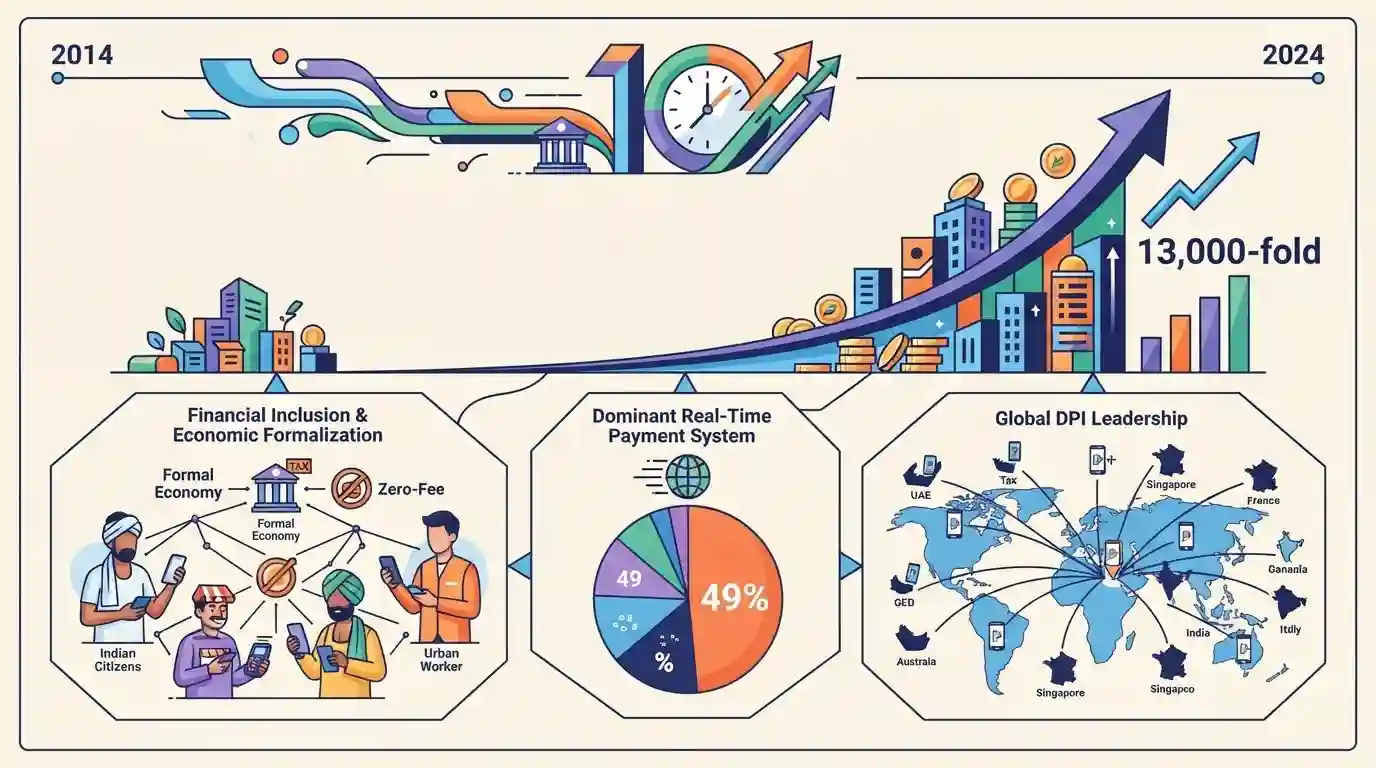
The Unified Payments Interface (UPI), developed by the National Payments Corporation of India (NPCI), has completed a decade of operation, marking a transformative impact on India's digital payments landscape. Transaction volumes have surged nearly 13,000-fold since its launch, making it the dominant real-time payment system globally (accounting for 49% of global volume per the IMF). UPI has driven financial inclusion and economic formalisation by providing secure, interoperable, and zero-fee instant transactions. Furthermore, its global adoption is expanding rapidly, with acceptance in 11 countries, underscoring India's leadership in developing scalable Digital Public Infrastructure (DPI).
मुख्य मुद्दे
- UPI has completed 10 years, witnessing a nearly 13,000-fold increase in transaction volumes (from 1.78 crore in FY17 to projected 24,162 crore in FY26).
- According to the IMF, India's UPI system now accounts for roughly 49% of the world's real-time payment transaction volumes.
- UPI has significantly advanced India's financial inclusion and formalisation of the economy through innovations like QR code scanning, interoperability, and zero Merchant Discount Rate (MDR).
- The platform has successfully expanded its footprint globally, currently being accepted in 11 countries, including the UAE, France, Singapore, and Sri Lanka.
- Upcoming features and expansions include credit line on UPI, offline transactions, and further integration with global digital payment ecosystems.
महत्त्वाच्या संज्ञा
Unified Payments Interface (UPI)

An instant, real-time payment system developed by NPCI that facilitates inter-bank peer-to-peer and person-to-merchant transactions using mobile devices. It offers interoperability and secure, zero-fee instant transactions.
UPSC context
Vital for GS-3 (Economy); illustrates financial inclusion, formalization of the digital economy, and India's soft power globally.
National Payments Corporation of India (NPCI)
An umbrella organization initiated by the RBI and Indian Banks' Association to operate retail payments and settlement systems in India, including platforms like UPI, RuPay, and IMPS.
UPSC context
Essential for GS-3 (Economy); highlights institutional backing for India's digital payment ecosystem and associated regulatory frameworks.
Reserve Bank of India (RBI)
India's central bank and primary regulatory body, responsible for formulating monetary policy, issuing currency, and regulating the nation's banking and payment systems to ensure overall financial stability.
UPSC context
Central to GS-3 (Economy); tested frequently on monetary policy, inflation targeting, and regulatory oversight of digital payment innovations.
International Monetary Fund (IMF)
An international financial institution of 190 countries that fosters global monetary cooperation, secures financial stability, facilitates international trade, and provides financial assistance to nations facing balance-of-payments crises.
UPSC context
Key for GS-2 (International Organizations); tests focus on its lending functions, reports, voting quotas, and comparisons with the World Bank.
Digital Public Infrastructure (DPI)
A set of shared digital systems built on open standards—such as digital identity, payment networks, and data exchanges—that securely facilitate the societal-scale delivery of public and private services.
UPSC context
Highly relevant for GS-2 & GS-3 (E-Governance); tests understanding of inclusive growth, public service delivery, and models like India Stack.
पूर्वपरीक्षा सापळा
"UPI and e-Rupee (CBDC) both represent direct liabilities of the Reserve Bank of India."
UPI is a payment interface transferring commercial bank deposits (liability of the respective banks), while CBDC is sovereign fiat currency and a direct liability of the RBI.
संबंधित स्थिर संकल्पना
What is the structural and regulatory basis of NPCI?
- Legal Status: Registered as a not-for-profit Section 8 company under the Companies Act 2013, created to build robust payment infrastructure.
- Promoters: An initiative of the RBI and the Indian Banks' Association (IBA) under the Payment and Settlement Systems Act, 2007.
- Product Portfolio: Operates UPI, RuPay, FASTag (NETC), Aadhaar Enabled Payment System (AePS), Bharat BillPay, and IMPS.
How does the Zero Merchant Discount Rate (MDR) framework function?
- The Concept: MDR is the percentage fee a merchant usually pays to acquiring banks and payment networks to cover the cost of processing digital transactions.
- Zero MDR Rule: Under the Payment and Settlement Systems Act, the government mandated zero MDR charges on transactions via UPI and RuPay debit cards to boost digital adoption.
- Bank Compensation: To cover operational costs and sustain payment infrastructure, the Government of India allocates an annual subsidy fund to reimburse banks for the revenue loss.
आंतर-विषय नमुने
DPI as Digital Diplomacy
Exporting UPI to nations like France and UAE acts as a powerful soft-power tool, positioning India's Digital Public Infrastructure (DPI) as a low-cost, scalable alternative to Western payment systems.
Digital footprints & Economic Formalisation
The massive surge in zero-MDR UPI transactions creates digital footprints for informal MSMEs, directly boosting GST compliance, formalising the economy, and enabling cash-flow-based lending.

Expect a multi-statement question distinguishing UPI's commercial bank money settlement from CBDC's central bank fiat liability.
संबंधित PYQ · 4
संबंधित PYQ · 4
- 2017PrelimsGS1
Which of the following is a most likely consequence of implementing the 'Unified Payments Interface (UPI)'?
- 2017PrelimsGS1
Consider the following statements: 1. National Payments Corporation of India (NPCI) helps in promoting the financial inclusion in the country. 2. NPCI has launched RuPay, a card payment scheme. Which of the statements given above is/are correct?
- 2018PrelimsGS1
With reference to digital payments, consider the following statements: 1. BHIM app allows the user to transfer money to anyone with a UPI-enabled bank account. 2. While a chip-pin debit card has four factors of authentication, BHIM app has only two factors of authentication. Which of the statements given above is/are correct?
- 2026PrelimsGS1
Which one of the following statements about Unified Payments Interface (UPI) and Central Bank Digital Currency (Digital Rupee) is not correct ?
