Unified Payments Interface Zero MDR Policy and Sustainability
Source:The Hindu ↗
Why It Matters
It highlights the critical regulatory trade-off between subsidizing public goods for massive financial inclusion and ensuring the commercial viability and infrastructural resilience of digital payment networks. This is highly relevant for GS-3 topics covering the digital economy, banking, and infrastructure.
Summary
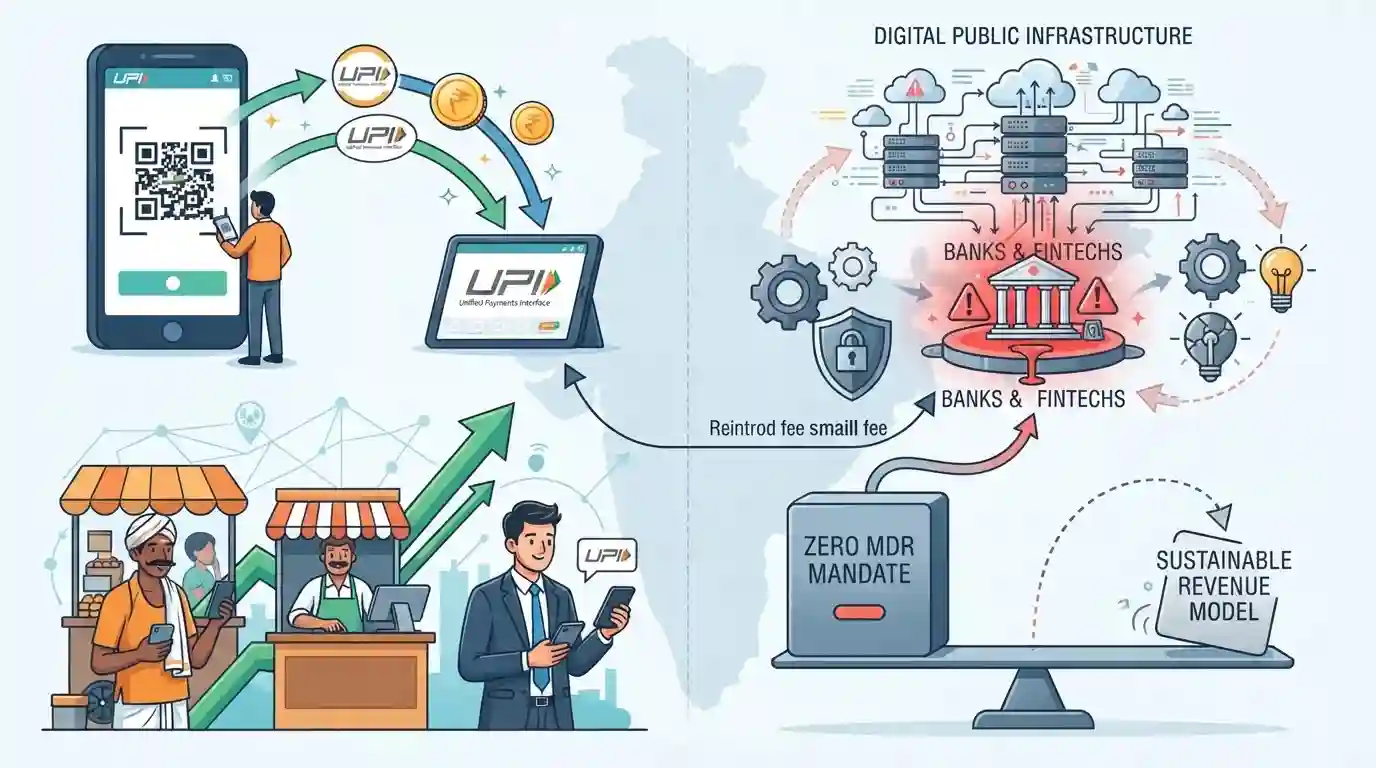
The article examines the economic implications of India's zero Merchant Discount Rate (MDR) mandate for Unified Payments Interface (UPI) transactions. While eliminating transaction fees has catalyzed unprecedented digital payment adoption and bolstered financial inclusion, it has placed significant financial strain on the banks and fintech companies operating the backend infrastructure. The piece discusses the hidden costs of this policy, warning that without a viable revenue model, continuous innovation, network upgrades, and cybersecurity in the payment ecosystem may be compromised. It evaluates the arguments for a 'policy reversal' that would reintroduce sustainable fees to maintain the health of India's critical Digital Public Infrastructure.
Key Points
- The zero Merchant Discount Rate (MDR) policy for UPI transactions has successfully driven massive consumer adoption and financial inclusion by making digital payments free.
- This policy forces banks, payment gateways, and fintech platforms to absorb the operational and infrastructure costs without a direct revenue stream, stressing their business models.
- The lack of transaction revenue creates a disincentive for stakeholders to invest in system upgrades, cybersecurity, and technological innovation.
- A potential policy reversal—reintroducing MDR or a tiered fee structure—is debated to balance the sustainability of the digital payment ecosystem with continuous public access to Digital Public Infrastructure (DPI).
Prelims Trap
MDR on UPI transfers is borne directly by the consumer for transactions exceeding ₹2,000.
MDR is a fee charged to the merchant, not the consumer. Furthermore, the proposed changes target P2M (merchant) transactions above ₹2,000; all P2P (person-to-person) transfers remain completely free.
Static Concepts Connected
What is Merchant Discount Rate (MDR) and how is the fee distributed?
- Definition: A fee charged to a merchant by their bank or payment service provider for facilitating, processing, and securing digital payment transactions.
- Revenue Split: The fee is fundamentally shared among three entities: the customer's issuing bank, the merchant's acquiring bank, and the payment network operator (e.g., NPCI, Visa).
- Economic Purpose: It serves as the primary revenue stream to fund hardware infrastructure, system upgrades, cybersecurity measures, and continuous technological innovation in payments.
How is India's Digital Public Infrastructure (DPI) framework structured?
- Three Pillars: The 'India Stack' is broadly categorized into three core layers: identity (Aadhaar), interoperable payments (UPI), and consent-based data sharing (DEPA).
- Public-Private Model: The state creates foundational open-source backend protocols functioning as a public good, while private entities (banks, fintechs) innovate on the frontend to deliver consumer services.
Cross-Topic Patterns
UPI Export vs Domestic Sustainability
As India actively exports its UPI framework to countries like Singapore and France, finalizing a sustainable domestic revenue model is critical to proving the long-term viability of India's DPI diplomacy.
Fintech Viability vs Financial Inclusion
The zero-MDR policy debate mirrors a classic economic tension: mandated free services achieve rapid state welfare goals but can suffocate private-sector capital needed for cybersecurity and infrastructure scaling.

Expect a 2026 Prelims statement differentiating MDR applicability on P2M vs P2P UPI transactions under the amended PSS Act.
Linked PYQs · 5
Linked PYQs · 5
- 2017PrelimsGS1
Which of the following is a most likely consequence of implementing the 'Unified Payments Interface (UPI)'?
- 2018PrelimsGS1
With reference to digital payments, consider the following statements: 1. BHIM app allows the user to transfer money to anyone with a UPI-enabled bank account. 2. While a chip-pin debit card has four factors of authentication, BHIM app has only two factors of authentication. Which of the statements given above is/are correct?
- 2026PrelimsGS1
Which one of the following statements about Unified Payments Interface (UPI) and Central Bank Digital Currency (Digital Rupee) is not correct ?
- 2025PrelimsGS1
Consider the following countries : I. United Arab Emirates II. France III. Germany IV. Singapore V. Bangladesh How many countries amongst the above are there other than India where international merchant payments are accepted under UPI?
- 2023MainsGS3
What is the status of digitalization in the Indian economy? Examine the problems faced in this regard and suggest improvements.
