Unified payments interface completes decade of digital inclusion
Source:The Hindu ↗
কেন এটি গুরুত্বপূর্ণ
India's Digital Public Infrastructure (DPI), led by UPI, is a prime example of technology-driven financial inclusion and a cornerstone of the 'Digital India' initiative. Questions on UPI, digital currencies, and NPCI are highly recurrent in both Prelims and Mains GS3, making understanding of UPI's evolving tech architectures (like CBDC interoperability, credit lines) and operational challenges strictly necessary.
সারসংক্ষেপ
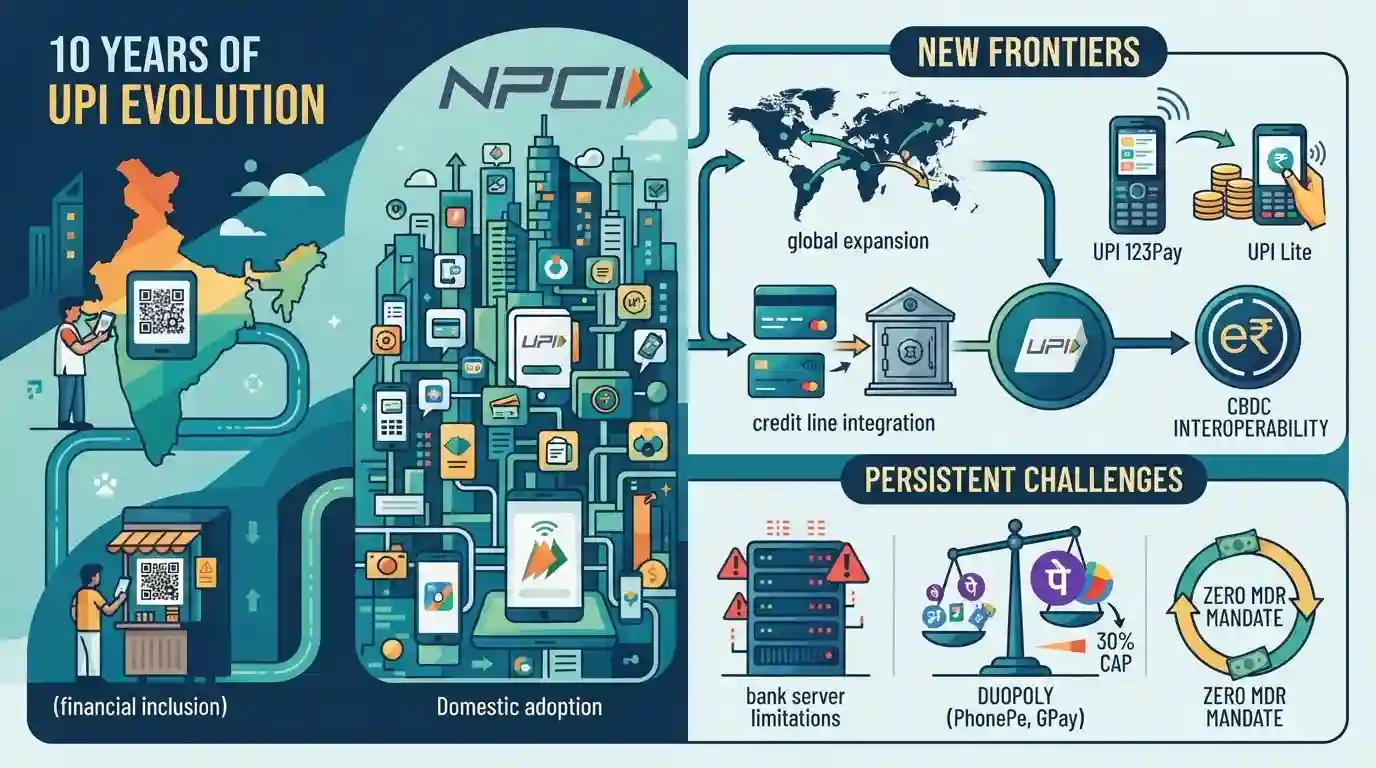
The article evaluates the evolution and future trajectory of the Unified Payments Interface (UPI) as it completes its 10-year milestone. Developed by the National Payments Corporation of India (NPCI), UPI has been central to India's digital payments revolution and financial inclusion efforts. While celebrating its massive domestic adoption, the piece details new frontiers for the platform, including global expansion, credit line integration, offline payments via UPI Lite, feature phone capabilities (UPI 123Pay), and interoperability with the RBI's Digital Rupee. It also underscores persistent challenges, particularly the lack of profitability due to the zero-MDR mandate, bank server limitations, and the market duopoly of PhonePe and Google Pay, which complicates NPCI's 30% market share cap mandate.
মূল বিষয়
- UPI has completed 10 years, drastically shifting India towards a less-cash economy and successfully driving financial inclusion by simplifying bank-to-bank transfers.
- Next frontiers include internationalization via NPCI International Payments Limited (NIPL), with UPI merchant payments now accepted in nations like the UAE, France, and Singapore.
- Technological expansions like UPI Lite (for low-value offline payments), UPI Circle (for delegated payments), and Credit Line on UPI are aimed at broadening the user base and credit access.
- Integration between UPI and the Reserve Bank of India's Central Bank Digital Currency (Retail Digital Rupee) aims to use existing UPI QR codes to boost CBDC adoption.
- The ecosystem faces structural challenges, including heavy bank server loads, a zero Merchant Discount Rate (MDR) policy hindering payment players' profitability, and a high market concentration (duopoly) held by PhonePe and Google Pay.
গুরুত্বপূর্ণ শব্দ
Unified Payments Interface (UPI)

A real-time interoperable digital payment system developed by NPCI and regulated by the RBI. It enables instantaneous peer-to-peer and person-to-merchant fund transfers by linking multiple bank accounts into a single mobile app.
UPSC context
GS Paper 3 (Economy). Tests knowledge of digital payments, financial inclusion, and India's digital public infrastructure.
National Payments Corporation of India (NPCI)
A Section 8 not-for-profit umbrella organization established in 2008 by the RBI and the Indian Banks' Association. It operates India's retail payment and settlement systems, including UPI, IMPS, and RuPay.
UPSC context
GS Paper 3 (Economy). Tests the regulatory and structural framework governing India's payment and settlement infrastructure.
Digital Rupee (e₹)
India's Central Bank Digital Currency (CBDC) issued by the RBI. It is sovereign fiat money in programmable digital form, differing from UPI by being an actual central bank liability rather than a settlement rail.
UPSC context
GS Paper 3 (Economy). Tests understanding of digital sovereign currency versus commercial bank money transacted via UPI.
UPI Lite
An on-device wallet feature for rapid, low-value offline or near-offline payments without requiring a UPI PIN. It reduces the transaction burden on bank servers, addressing persistent infrastructure limitations.
UPSC context
GS Paper 3 (Economy). Highlights technological innovations overcoming structural bottlenecks like bank server loads and internet connectivity.
UPI Circle
A delegated digital payment feature allowing primary account holders to securely authorize secondary users, like family members, to make payments directly from the primary bank account within predefined limits.
UPSC context
GS Paper 3 (Economy/Digital India). Tests awareness of delegated financial innovations driving inclusive digital payments.
NPCI International Payments Limited (NIPL)
A wholly-owned subsidiary of NPCI dedicated to exporting India's digital payment solutions globally. It actively drives the internationalization of UPI and RuPay, enabling cross-border remittances and interoperable payments.
UPSC context
GS Paper 2 & 3. Connects India's technological soft power with international relations and cross-border payment integration frameworks.
প্রিলিমস ফাঁদ
"The RBI levies a nominal Merchant Discount Rate (MDR) to maintain UPI's backend infrastructure."
The government mandated a Zero-MDR policy for UPI and RuPay debit cards from January 2020. No MDR is levied on standard peer-to-peer or merchant UPI payments.
সংযুক্ত স্থির ধারণা
What is the National Payments Corporation of India (NPCI)?
- Origin: It is an initiative of the RBI and Indian Banks' Association (IBA) under the Payment and Settlement Systems Act, 2007.
- Legal Status: It is incorporated as a 'Not for Profit' Company under Section 8 of the Companies Act 2013 to operate retail payment systems.
- Umbrella Products: Key products include UPI, RuPay, IMPS, NETC (FASTag), Bharat BillPay, NACH, and Aadhaar Enabled Payment System (AePS).
How does CBDC (Digital Rupee) fundamentally differ from UPI?
- Asset Nature: CBDC is sovereign digital fiat (a direct liability of the RBI). UPI is merely an interface transferring existing commercial bank deposits.
- Settlement Mechanism: CBDC settles instantly peer-to-peer (like physical cash) without bank intermediation, whereas UPI requires backend bank-server interbank settlement.
আন্তঃবিষয় প্যাটার্ন
DPI and India's Soft Power Diplomacy
Exporting UPI via NIPL to countries like Singapore and UAE aligns with India's foreign policy of leveraging Digital Public Infrastructure (DPI) as diplomatic soft power.
Financial Inclusion vs. Fintech Viability
The Zero-MDR mandate highlights the classic public policy tension between accelerating financial inclusion (public good) and ensuring the commercial viability of fintech infrastructure (private profit).

A multi-statement Q contrasting UPI's bank settlement with the Retail Digital Rupee (e₹) and evaluating the Zero-MDR is highly likely.
সংযুক্ত PYQ · 5
সংযুক্ত PYQ · 5
- 2026PrelimsGS1
Which one of the following statements about Unified Payments Interface (UPI) and Central Bank Digital Currency (Digital Rupee) is not correct ?
- 2025PrelimsGS1
Consider the following countries : I. United Arab Emirates II. France III. Germany IV. Singapore V. Bangladesh How many countries amongst the above are there other than India where international merchant payments are accepted under UPI?
- 2017PrelimsGS1
Which of the following is a most likely consequence of implementing the 'Unified Payments Interface (UPI)'?
- 2017PrelimsGS1
Consider the following statements: 1. National Payments Corporation of India (NPCI) helps in promoting the financial inclusion in the country. 2. NPCI has launched RuPay, a card payment scheme. Which of the statements given above is/are correct?
- 2018PrelimsGS1
With reference to digital payments, consider the following statements: 1. BHIM app allows the user to transfer money to anyone with a UPI-enabled bank account. 2. While a chip-pin debit card has four factors of authentication, BHIM app has only two factors of authentication. Which of the statements given above is/are correct?
