UPERC Grid Code Regulations 2026 for Renewable Energy Integration
Source:energetica-india ↗
Why It Matters
As India transitions towards a higher share of renewable energy, updating state-level electricity grid codes is critical to handle the intermittency of green power. This development is significant for UPPSC aspirants as it bridges state policy with national climate and infrastructure goals, impacting energy security and technological governance.
Summary
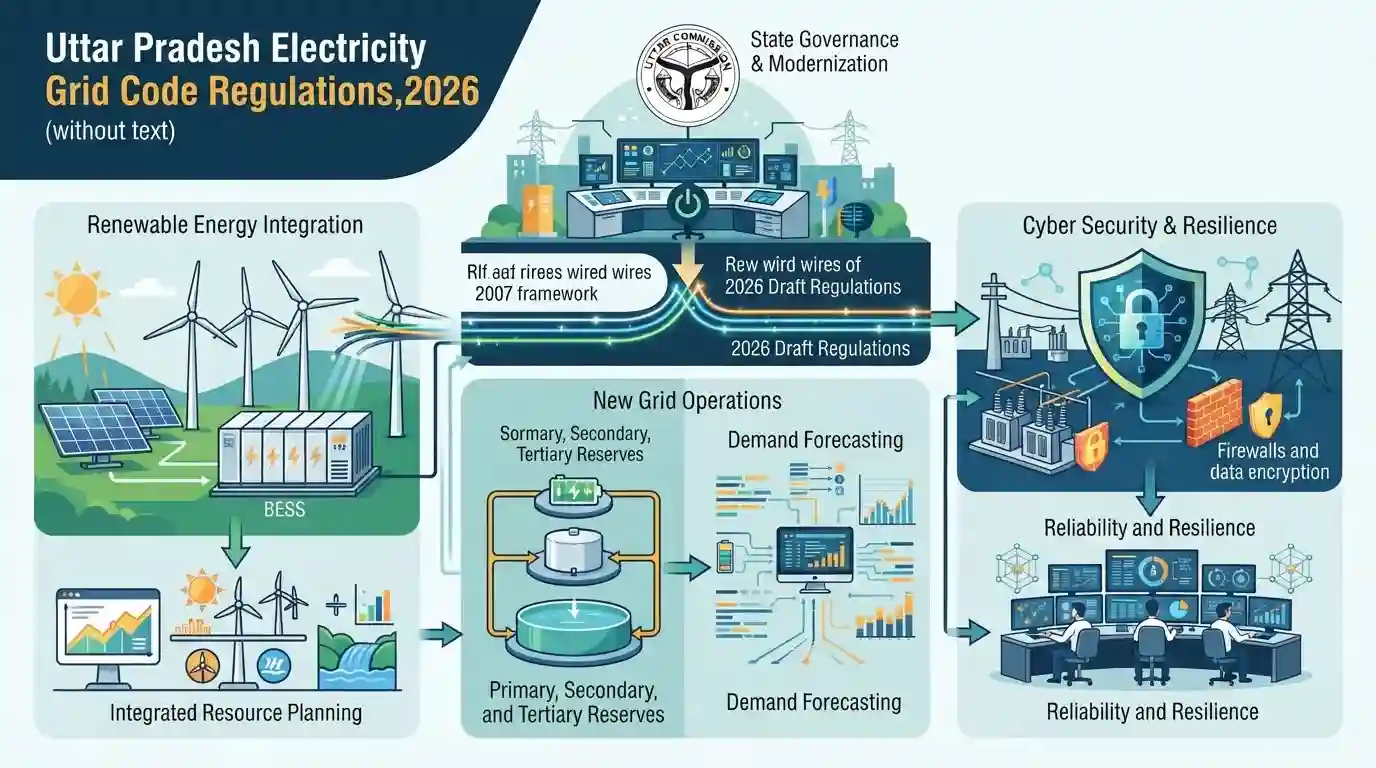
The Uttar Pradesh Electricity Regulatory Commission (UPERC) has proposed the draft Uttar Pradesh Electricity Grid Code Regulations, 2026, aimed at modernizing the state's power network to better integrate renewable energy and energy storage systems. Aligning with the national Indian Electricity Grid Code 2023, the draft aims to replace the outdated 2007 framework. It introduces primary, secondary, and tertiary grid reserves, and emphasizes critical operational components like integrated resource planning, demand forecasting, and cybersecurity to ensure grid reliability and resilience.
Key Points
- UPERC has released the draft Uttar Pradesh Electricity Grid Code Regulations, 2026, to replace the existing 2007 grid code.
- The new framework aligns with the Indian Electricity Grid Code, 2023, emphasizing the integration of renewable energy and energy storage systems (BESS) into the state network.
- Introduces a structured framework for different categories of grid reserves (primary, secondary, and tertiary) to be adopted by the State Load Despatch Centre for power reliability.
- The regulations also dedicate provisions to cybersecurity, dynamic demand forecasting, and integrated resource planning to manage the variability of green energy.
Important Terms
Uttar Pradesh Electricity Grid Code Regulations, 2026

Draft regulations by UPERC to modernize the intra-state power network. They mandate integrated resource planning, facilitate renewable energy and storage integration, and introduce primary, secondary, and tertiary grid reserves.
UPSC context
Essential for UPPSC GS Paper 3 (Energy) and Paper 6 (UP State Economy & Infrastructure) regarding grid modernization.
Indian Electricity Grid Code, 2023
The national regulatory framework governing the operation of the inter-state power system. It emphasizes grid security, resource adequacy, security-constrained economic dispatch, and the integration of renewable energy and storage.
UPSC context
Important for GS Paper 3 (Energy) as the national benchmark that state-level grid codes must align with.
Uttar Pradesh Electricity Regulatory Commission (UPERC)
An autonomous statutory body created under the U.P. Electricity Reform Act, 1999. It regulates the state's power sector, sets tariffs, drafts grid codes, and promotes renewable energy development.
UPSC context
Relevant for UPPSC GS Paper 2 (Statutory Bodies) and Paper 5 (UP State Polity & Governance).
State Load Despatch Centre (SLDC)
The apex body responsible for the integrated, secure, and economical operation of a state's power system. In UP, UPSLDC manages real-time grid operations, energy dispatch, and grid reserve implementation.
UPSC context
Key for UPPSC GS Paper 3 (Infrastructure) and Paper 6, detailing the real-time technical management of UP's power grid.
Uttar Pradesh Electricity Grid Code, 2007
The previous regulatory framework for UP's power grid operations. It is now considered outdated for modern power requirements and is being replaced by the 2026 regulations to handle renewables.
UPSC context
Provides historical context for UPPSC GS Paper 6 (UP Infrastructure) when discussing the evolution of state energy policies.
Prelims Trap
"The UP Grid Code 2026 is enforced by the National Load Despatch Centre to manage grid reserves."
The State Load Despatch Centre (SLDC) is responsible for state-level grid reserves implementation, not the NLDC. Additionally, the 2026 code is currently a proposed draft, not an enforced act.
Static Concepts Connected
What is the statutory basis and function of the UPERC?
- Statutory Body: Constituted under the Electricity Regulatory Commissions Act, 1998, and now governed by the Electricity Act, 2003.
- Key Mandate: Regulates electricity tariffs, grants transmission/distribution licenses, and frames grid codes within Uttar Pradesh.
- Composition: Consists of a Chairperson and two Members, appointed by the State Government on the recommendation of a Selection Committee.
What are Primary, Secondary, and Tertiary Grid Reserves?
- Primary Reserve: Automated, instantaneous response to frequency deviations through generator governor action within seconds to stabilize the grid.
- Secondary Reserve: Centralized automatic generation control (AGC) deployed within minutes to restore grid frequency to its nominal value.
- Tertiary Reserve: Manually deployed generation reserves used to restore secondary reserves and manage prolonged grid imbalances (15+ minutes).
Cross-Topic Patterns
Grid Modernization meets Cybersecurity
As UP rapidly scales its solar capacity (e.g., Bundelkhand solar parks), the integration of digital smart grids increases vulnerability, making the cybersecurity mandate in this Grid Code critical for GS-3.
Energy Federalism & National Alignment
UP aligning its 2026 state code with the Indian Electricity Grid Code 2023 highlights cooperative federalism in managing concurrent list subjects like electricity and renewable energy integration.

Expect a GS-5 mains question linking the 2026 Grid Code's BESS & cyber provisions with UP's Solar Energy Policy 2022 targets.
Linked PYQs · 4
Linked PYQs · 4
- 2021UPPSC_PRELIMSGS1
The functions of the State Public Service Commission of Uttar Pradesh can be extended by
- 2022UPPSC_PRELIMSGS1
Solar energy is converted into electric energy through
- 2021UPPSC_PRELIMSGS1
A non-renewable source of energy is
- 2022UPPSC_PRELIMSGS1
Most of the sources of energy we use, represent stored solar energy. Which of the following is NOT ultimately derived from the sun's energy ?
