UPERC Issues Final Notice in UPSLDC Grid Dispute
Source:solarquarter ↗
Why It Matters
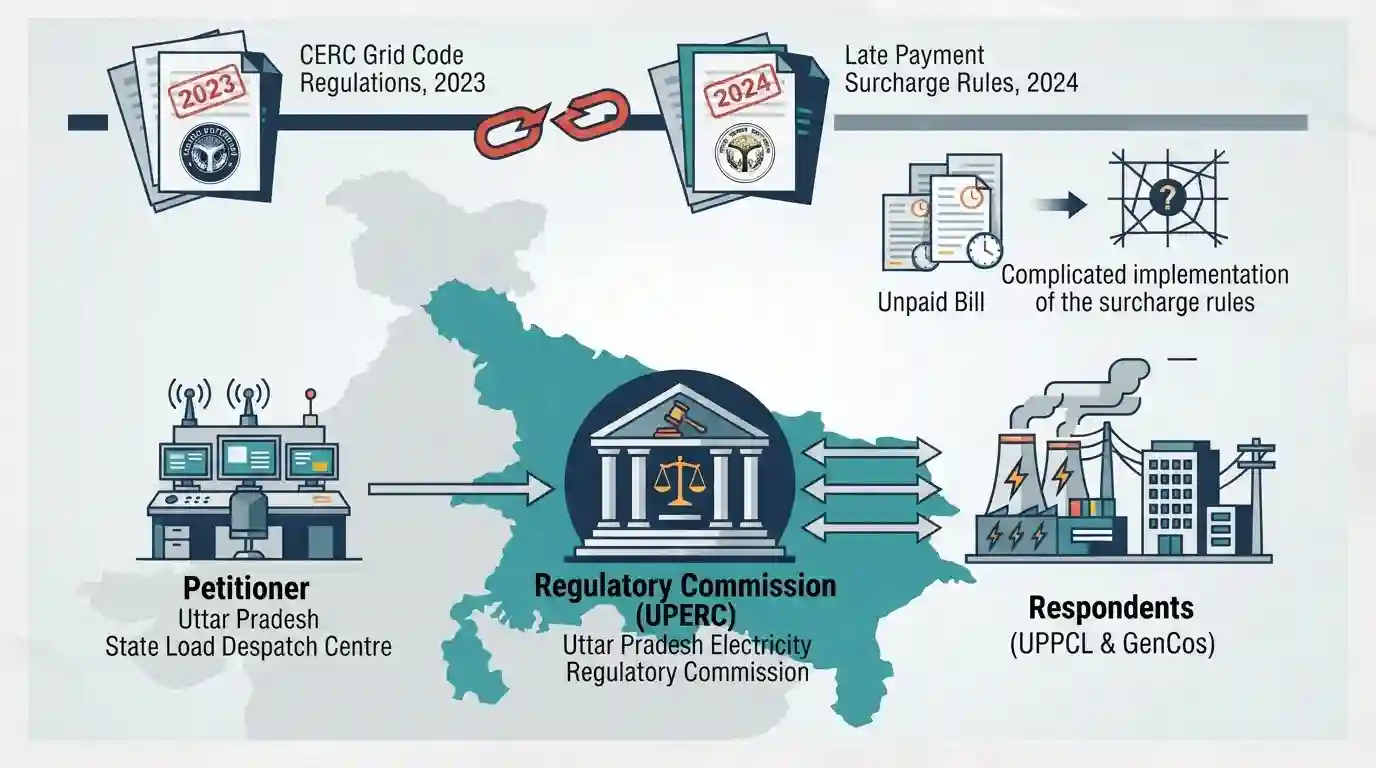
This dispute highlights the practical and administrative challenges of implementing unified central electricity rules (like the Late Payment Surcharge) alongside independent state regulatory frameworks, reflecting on the financial health and operational efficiency of the power sector.
Summary
The Uttar Pradesh Electricity Regulatory Commission (UPERC) has given a final opportunity to respondents, including UPPCL and various power generation companies, to reply to a petition filed by the Uttar Pradesh State Load Despatch Centre (UPSLDC). The dispute centers on operational and regulatory inconsistencies between the Central Electricity Regulatory Commission (CERC) Grid Code Regulations, 2023, and state-level guidelines, which are complicating the implementation of the Late Payment Surcharge Rules, 2024.
Key Points
- The Uttar Pradesh State Load Despatch Centre (UPSLDC) filed a petition seeking regulatory relief over inconsistencies between central and state grid codes.
- Conflicts between the CERC's Indian Electricity Grid Code 2023 and the existing state framework have complicated the enforcement of the Late Payment Surcharge Amendment Rules 2024.
- The UPERC (Uttar Pradesh Electricity Regulatory Commission) has granted state power utilities and private power generation companies a final opportunity to submit their responses.
- The dispute underscores systemic challenges in aligning central electricity directives with state-level grid operation frameworks.
Important Terms
Indian Electricity Grid Code (IEGC) Regulations, 2023

CERC-issued regulations governing the technical and commercial operation of India's national power grid. They mandate standards for power scheduling, integration of renewables, cybersecurity, and overall grid stability.
UPSC context
GS Paper 3 (Infrastructure - Energy). Tests knowledge of grid integration and technical governance in India's power sector.
Electricity (Late Payment Surcharge and Related Matters) (Amendment) Rules, 2024
Ministry of Power rules promoting financial discipline. They penalize DISCOMs for payment defaults and mandate generators to sell un-requisitioned surplus power in open markets, preventing capacity wastage.
UPSC context
GS Paper 3 (Economy/Infrastructure). Critical for understanding DISCOM financial health, capacity optimization, and power sector reforms.
State Load Despatch Centre (SLDC)
The statutory apex body established under the Electricity Act, 2003, responsible for real-time monitoring, load-generation balancing, and secure operation of the power grid within a specific state.
UPSC context
GS Paper 3 (Infrastructure). Essential for understanding state-level grid management and power distribution mechanisms.
Central Electricity Regulatory Commission (CERC)
A key statutory body under the Electricity Act, 2003. It regulates inter-state power transmission, determines national power tariffs, and frames policies like the Indian Electricity Grid Code.
UPSC context
GS Paper 2 (Statutory Bodies) & GS Paper 3 (Energy). Central to inter-state power regulation and market structure.
Uttar Pradesh Electricity Regulatory Commission (UPERC)
A state-level statutory body under the Electricity Act, 2003. It determines intra-state power tariffs, regulates state grid codes, and adjudicates power-related disputes between local utilities and dispatch centers.
UPSC context
GS Paper 2 (Statutory Bodies / Centre-State relations). Illustrates regulatory decentralization and potential state-centre policy friction.
Prelims Trap
State Load Despatch Centres (SLDCs) are subordinate administrative branches of the Central Electricity Authority (CEA) and report directly to CERC.
SLDCs are statutory bodies established by State Governments under Section 31 of the Electricity Act, 2003. They operate under their respective State Commissions (SERCs), not as branches of the central CERC or CEA.
Static Concepts Connected
What is the dual regulatory framework of India's power sector under the Electricity Act, 2003?
- Concurrent Jurisdictions: Electricity is placed under Entry 38 of the Concurrent List (List III), granting both Parliament and State Legislatures jurisdiction to draft laws.
- Regulatory Split: CERC regulates interstate transmission, central generation tariffs, and national market licensing, while SERCs govern retail tariffs and license intra-state distribution/transmission.
- Grid Operations: NLDC/RLDCs oversee interstate grid operations, while State Load Despatch Centres (SLDCs) function as the statutory apex bodies for secure intra-state grid management.
Cross-Topic Patterns
Green transition vs federal grid friction
Central mandates like CERC's 55% thermal limit to absorb intermittent renewable energy conflict with state grid operations, illustrating how national climate goals challenge state-level power economics.
Concurrent List friction in infrastructure
The dispute highlights broader cooperative federalism challenges, where central guidelines run into friction with state-level administrative utilities, delaying national programs like Late Payment Surcharge rules.

CERC-SERC jurisdictional friction under the Electricity Act is a prime candidate for a GS-2 federalism or GS-3 energy-infrastructure question.
Linked PYQs · 2
Linked PYQs · 2
- 2021UPPSC_PRELIMSGS1
The functions of the State Public Service Commission of Uttar Pradesh can be extended by
- 2022UPPSC_PRELIMSGS1
Solar energy is converted into electric energy through
