Rashtriya Lok Morcha Leadership Re-election and Policy Demands
Source:thehindu ↗
Why It Matters
This article provides an excellent intersection of constitutional law (ministerial eligibility rules under Article 164), administrative legislation (Bodh Gaya Temple Act), state history/culture (Pataliputra and Mahabodhi Temple), and federal dynamics (special category status and delimitation), which are highly tested themes in BPSC Prelims and Mains.
Summary
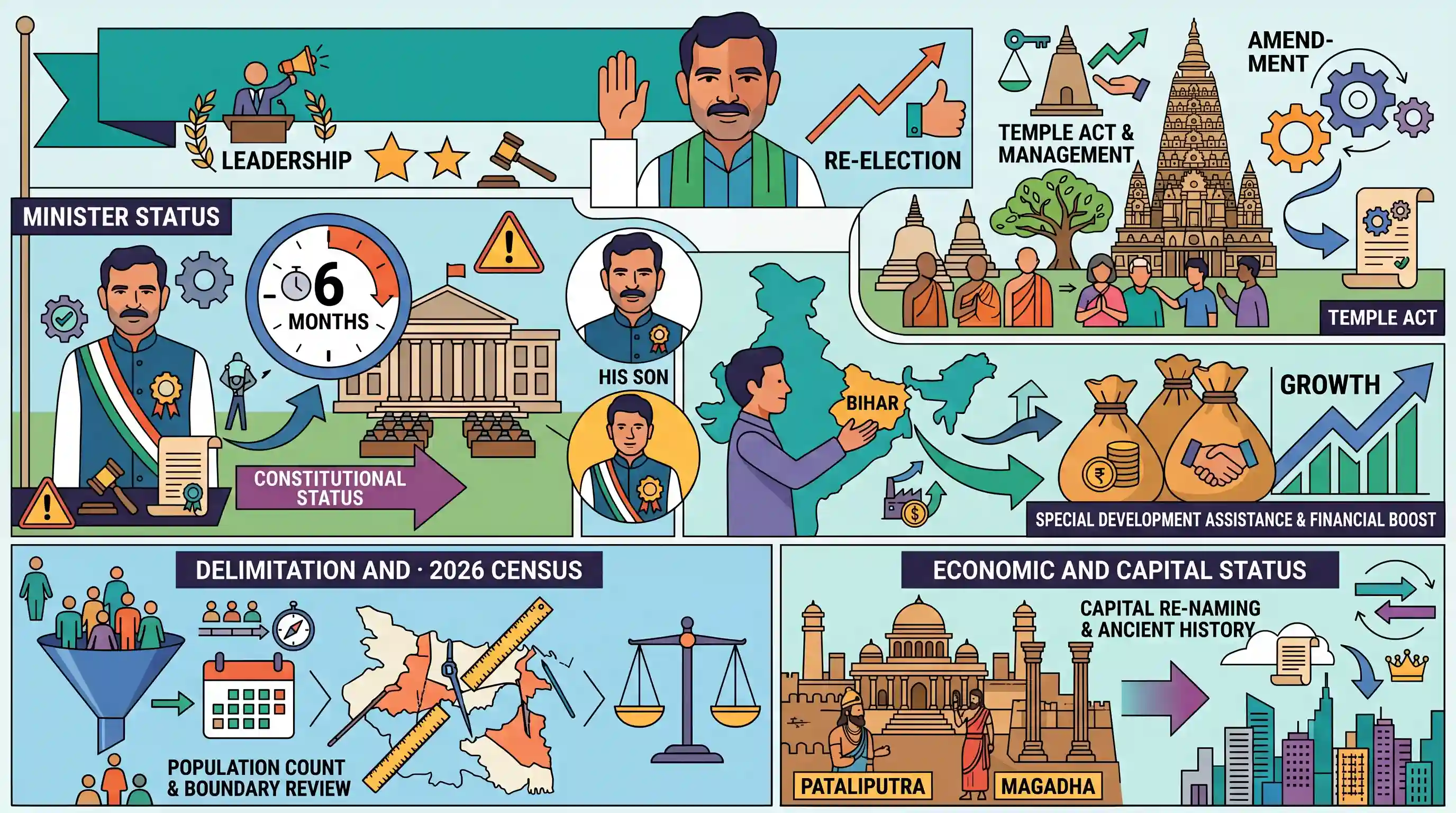
Rashtriya Lok Morcha (RLM) chief Upendra Kushwaha was re-elected as party president. Amid political friction, he defended his son Deepak Prakash's position as a Bihar Cabinet Minister despite not being an MLA or MLC, which brings Article 164(4)'s six-month legislative membership rule into focus. The party also adopted resolutions demanding the renaming of Patna to Patliputra, Special Category Status for Bihar, delimitation based on the 2026 Census, and an amendment to the Bodh Gaya Temple Act, 1949.
Key Points
- Upendra Kushwaha was unanimously re-elected as the national president of the Rashtriya Lok Morcha (RLM) during its national convention in New Delhi.
- The political development highlights Article 164(4) of the Indian Constitution: Deepak Prakash (Kushwaha's son) is Bihar's Panchayati Raj Minister but is not a member of either the Legislative Assembly or Legislative Council. Under this constitutional mandate, he must secure membership in either house within six consecutive months from taking oath (May 7, 2026) to retain his ministership.
- The RLM reiterated its long-standing demand to amend the Bodh Gaya Temple Act, 1949, to transition the management of the Mahabodhi Mahavihara Temple (Bodh Gaya) completely to the Buddhist community.
- The party adopted resolutions demanding the official renaming of Bihar's capital, Patna, back to its historical name 'Patliputra'.
- Other key demands in the political resolution included granting Special Category Status (SCS) to Bihar and basing future Lok Sabha delimitation exercises strictly on population ratios using the 2026 Census data.
Important Terms
Constitution of India (Article 164)

Constitutional provisions detailing the appointment, tenure, collective responsibility, size, and oath of the Chief Minister and the state Council of Ministers.
UPSC context
GS Paper II: Polity & Constitution; vital for understanding executive-legislature relationships and ministerial qualification rules.
Bodh Gaya Temple Act, 1949
Bihar state legislation that established a joint Hindu-Buddhist committee to govern and manage the historically significant Mahabodhi Temple in Bodh Gaya.
UPSC context
GS Paper I: Indian Heritage & Culture; tests secular governance of religious structures and preservation of ancient monuments.
Bihar Legislative Council (MLC)
The 75-member upper house of Bihar's bicameral state legislature, comprising indirectly elected and governor-nominated members serving staggered six-year terms.
UPSC context
GS Paper II: State Legislature; covers bicameralism, composition of Vidhan Parishad, and legislative powers.
Bihar Legislative Assembly
The 243-member directly elected lower house (Vidhan Sabha) of Bihar's bicameral legislature, which holds primary legislative and financial authority.
UPSC context
GS Paper II: Parliament and State Legislatures; tests election processes, assembly structures, and legislative functions.
Rashtriya Lok Morcha (RLM)
A regional political party in Bihar founded by Upendra Kushwaha in 2023, representing part of the National Democratic Alliance (NDA).
UPSC context
GS Paper II: Political Parties & Pressure Groups; relevant for studying regional party dynamics and coalition politics.
Prelims Trap
A non-legislator minister who fails to get elected within six months can be re-appointed consecutively for another six months.
The SC in S.R. Chaudhuri (2001) held that consecutive re-appointment of a non-legislator without an intervening election is unconstitutional and a subversion of democracy.
Static Concepts Connected
What are the criteria and financial benefits of Special Category Status (SCS) for states?
- Five-point Criteria: Introduced in 1969 based on Fifth Finance Commission criteria, including hilly terrain, strategic borders, economic backwardness, and non-viable state finances.
- Funding Ratio: SCS states receive 90% of Centrally Sponsored Schemes as grants (vs. 60% for general states), with the remaining 10% as interest-free loans.
- Non-lapsable Funds: Unlike general-category states, unspent central funds allocated to SCS states do not lapse and are carried forward to the next fiscal year.
How is the administration of the Mahabodhi Temple structured under the Bodh Gaya Temple Act, 1949?
- Balanced Representation: Mandates an eight-member Bodh Gaya Temple Management Committee comprising four Hindu and four Buddhist representatives to oversee administration.
- Ex-officio Chairperson: The District Magistrate of Gaya serves as the ex-officio Chairman; a 2013 amendment allowed non-Hindu DMs to hold this position.
Cross-Topic Patterns
Federal funding versus fiscal devolution
The 14th and 15th Finance Commissions phased out 'Special Category Status' classifications by raising tax devolution to 41%, leaving SCS demands as a major friction point in cooperative federalism.
Ancient urbanism and dynastic strategic shifts
The transition of Magadha's capital from Girivraja (Rajgir) to Pataliputra by Udayin reflects a strategic geopolitical shift from defensive hill barriers to river-based commerce and communication.

Constitutional limits of Article 164(4) and the Supreme Court's bar on consecutive non-legislator ministerial terms will likely feature in 2026.
Linked PYQs · 4
Linked PYQs · 4
- 2023BPSC_PRELIMSGS1
The Council of Ministers in a State is collectively responsible to
- 2023BPSC_PRELIMSGS1
Which of the following has been added to the UNESCO World Heritage List in 2022?
- 2023BPSC_PRELIMSGS1
Which city served as the capital of the ancient kingdom of Magadha during the early Vedic period?
- 2020BPSC_PRELIMSGS1
Which was the first capital of ancient Mahajanapada Magadh?
