Tamil nadu minister frames upcoming polls as federal conflict
Source:The Hindu ↗
Why It Matters
The statements reflect the increasing salience of regional identity, linguistic pride, and welfare politics in Indian federal dynamics. Understanding these regional assertions helps contextualize broader UPSC debates on State autonomy versus centralization, regional parties vs. national parties, and the political friction surrounding state-funded welfare schemes.
Summary
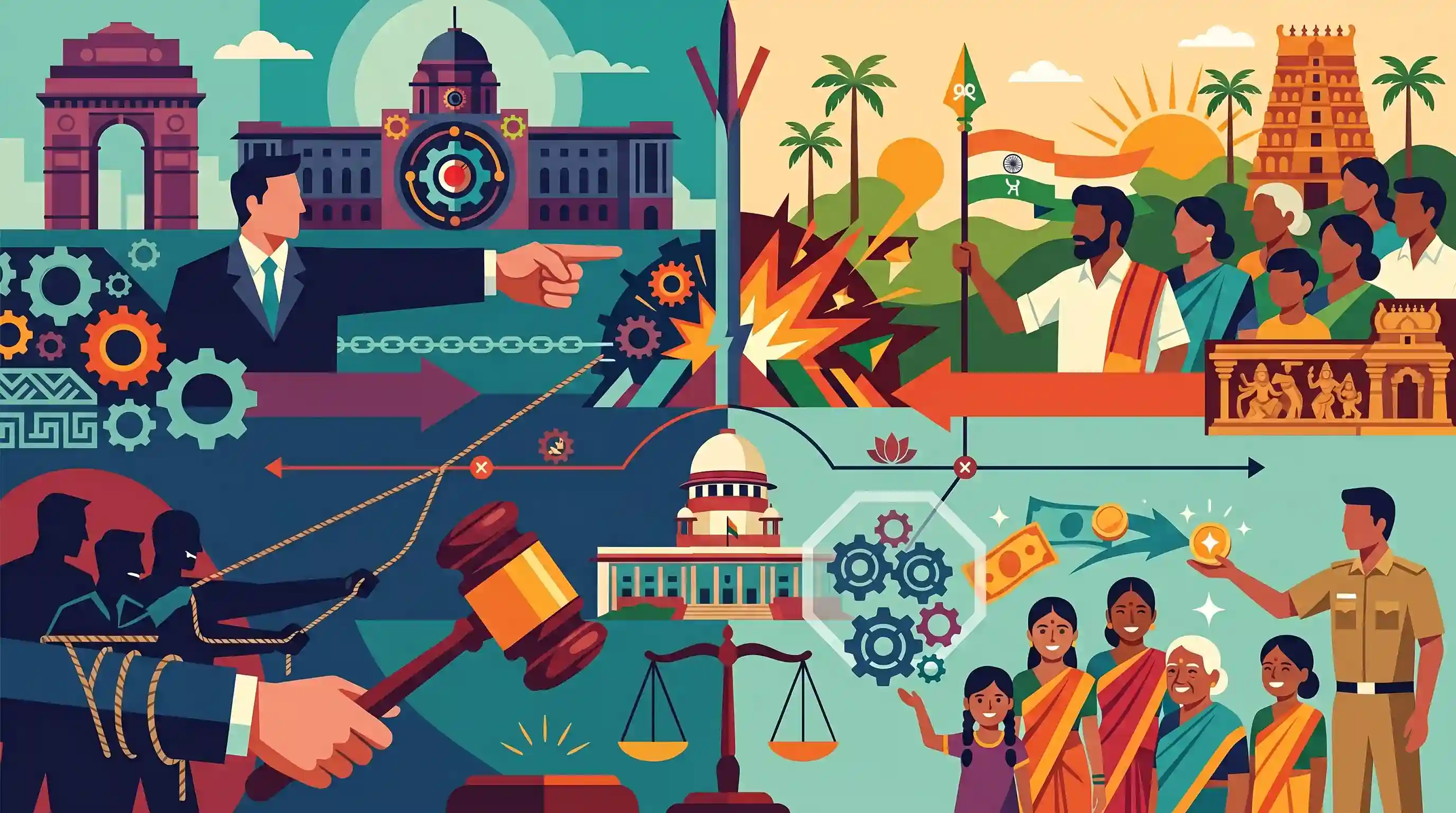
Tamil Nadu Deputy Chief Minister Udhayanidhi Stalin has framed the upcoming state Assembly elections as a political and ideological 'war between Delhi and Tamil Nadu.' Highlighting recurring themes in federal politics, he presented the electoral contest as a battle between regional autonomy ('Tamil') and centralization ('Hindi imposition'), as well as a fight for social justice. He further accused political adversaries of attempting to use the Supreme Court to stall the state’s flagship welfare initiative, the Kalaignar Magalir Urimai Thittam (women's cash assistance scheme).
Key Points
- Tamil Nadu Deputy Chief Minister Udhayanidhi Stalin framed the upcoming state Assembly elections as a direct contest between 'Delhi and Tamil Nadu', reflecting ongoing federal tensions.
- He highlighted regional identity, characterizing the political battle as one between Tamil culture and alleged Hindi imposition, as well as 'social justice and social injustice'.
- The Deputy CM accused political opponents of attempting to stall the state’s flagship Kalaignar Magalir Urimai Thittam (a cash assistance scheme for women) by approaching the Supreme Court.
- The remarks underscore the prominent role of linguistic identity, state autonomy, and welfare politics in shaping Centre-State relations in India.
Important Terms
Kalaignar Magalir Urimai Thittam

A flagship Tamil Nadu welfare scheme providing ₹1,000 monthly to eligible women heads of households to promote financial independence and social respect.
UPSC context
GS Paper II: Social Justice/Welfare Schemes. Tests understanding of direct benefit transfers and gender-sensitive governance.
Article 131
The Supreme Court's exclusive power to hear disputes between the Union and States or between States, recently invoked by Tamil Nadu regarding withheld education funds.
UPSC context
GS Paper II: Polity/Judiciary. Tests knowledge of the Supreme Court's original jurisdiction in federal disputes.
Federalism
The constitutional distribution of power between central and regional governments, currently under strain due to fiscal and linguistic disputes in India.
UPSC context
GS Paper II: Indian Constitution. Core topic regarding Centre-State relations and functional autonomy.
Dravidian Model
A governance framework emphasizing social equality, regional autonomy, and welfare-led development, often contrasted with centralized national governance models.
UPSC context
GS Paper II: Governance/Social Justice. Tests understanding of state-specific ideological approaches to development.
Regionalism
Political ideology prioritizing the interests and culture of a specific region over national concerns, often emerging from perceived central overreach or neglect.
UPSC context
GS Paper I: Society. Tests ability to analyze identity-based political movements within a federal structure.
Social Justice
Fair treatment and shared benefits for all societal members, particularly marginalized groups, through policies like the Magalir Urimai Thittam.
UPSC context
GS Paper II: Social Justice. Fundamental value testing the implementation of inclusive policies.
Prelims Trap
Promising direct cash assistance schemes constitutes a 'corrupt practice' under the Representation of the People Act, 1951.
In the Subramaniam Balaji case (2013), the Supreme Court ruled that manifesto promises for welfare schemes do not amount to a 'corrupt practice' under Section 123 of the RPA.
Static Concepts Connected
What are the Constitutional provisions regarding the Hindi language?
- Article 343: Declares Hindi in Devanagari script as the official language of the Union.
- Article 351: Imposes a duty on the Union government to promote the spread and development of the Hindi language.
- Official Languages Act: Provides for the continued use of English for official purposes alongside Hindi, easing non-Hindi states' concerns.
How is state funding for direct cash welfare legally justified?
- DPSP Mandate: Articles 38 and 39 direct the State to minimize inequalities in income and secure adequate means of livelihood.
- Article 282: Empowers both the Union and the States to make public grants for any public purpose, even if outside their direct legislative competence.
Cross-Topic Patterns
Sub-national debt vs. State Welfare
The RBI frequently flags states' direct cash transfer schemes for worsening state fiscal deficits, clashing with mandatory state-level FRBM limits on borrowing and sub-national debt stability.
Demographic shifts & Linguistic politics
Rising inward migration of northern laborers to industrialized southern states complicates regional linguistic politics, creating friction between economic integration needs and political cultural protectionism.

The 'welfare vs freebie' debate is highly likely to manifest in 2026 Mains GS2 (Federalism) or GS3 (State finances & FRBM compliance).
Linked PYQs · 4
Linked PYQs · 4
- 2025MainsGS2
Examine the evolving pattern of Centre-State financial relations in the context of planned development in India. How far have the recent reforms impacted the fiscal federalism in India?
- 2022MainsGS2
“While the national political parties in India favour centralisation, the regional parties are in favour of State autonomy.” Comment.
- 2024MainsGS2
What changes has the Union Government recently introduced in the domain of Centre-State relations ? Suggest measures to be adopted to build the trust between the Centre and the States and for strengthening federalism.
- 2019MainsGS2
Performance of welfare schemes that are implemented for vulnerable sections is not so effective due to absence of their awareness and active involvement at all stages of policy process. Discuss.
