UP announces Nomadic Development Board for Vimukt communities
Source:indianmasterminds ↗
Why It Matters
This development is crucial for the UPPSC Prelims as it deals with state-specific administrative initiatives for vulnerable and marginalized sections (Denotified and Nomadic Tribes). Questions often test knowledge of specific tribes native to UP (like Tharu, Buksa, Sahariya) and government boards/schemes launched for their welfare.
Summary
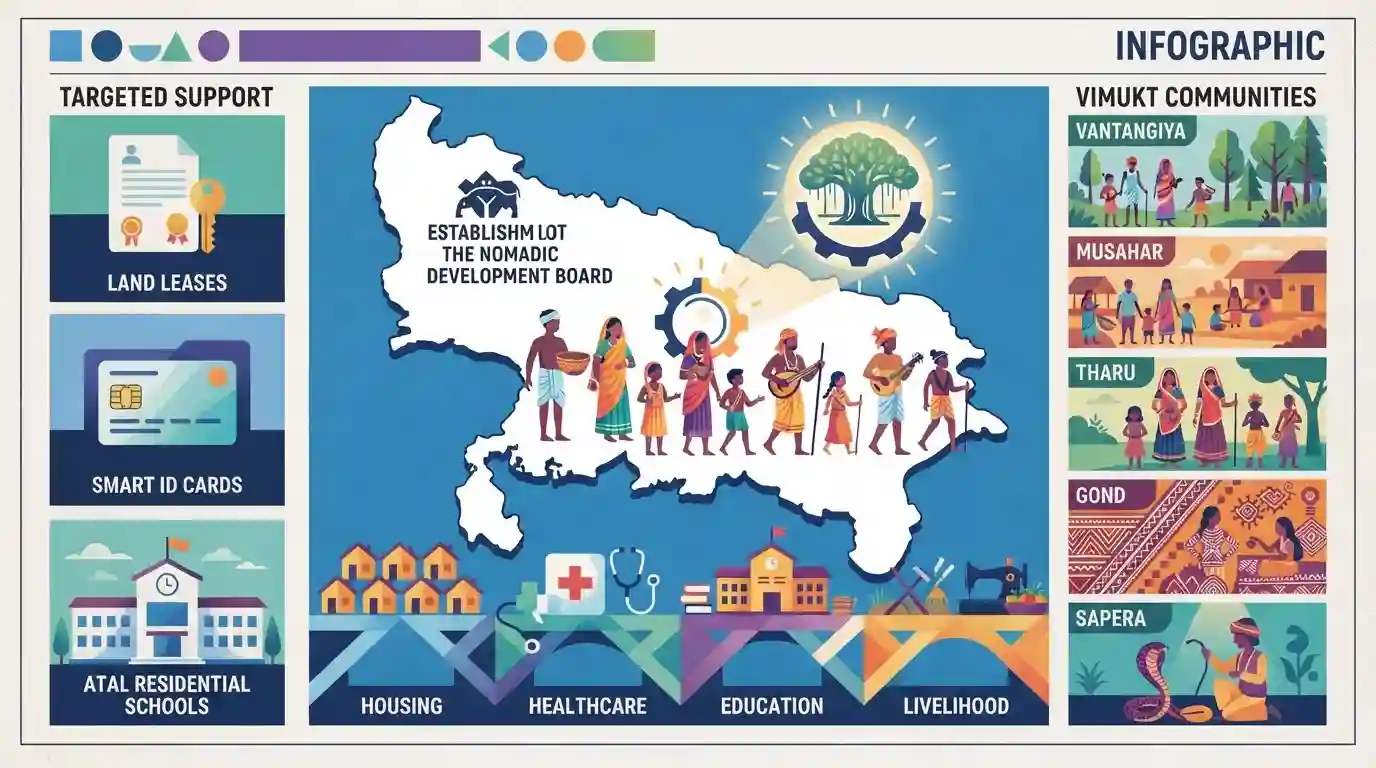
Uttar Pradesh Chief Minister Yogi Adityanath has directed the establishment of a Nomadic Development Board to rehabilitate and uplift the state's Nomadic and Denotified (Vimukt) communities. The board aims to integrate traditionally marginalized groups—such as the Vantangiya, Musahar, Tharu, Gond, and Sapera—into the mainstream by providing them with secure housing, healthcare, education, and livelihood opportunities under existing state and central welfare schemes. Highlighting their historical contributions to Indian society and culture, the government plans tailored interventions, including land leases, smart ID cards, and access to Atal Residential Schools, to ensure their socio-economic empowerment.
Key Points
- Chief Minister Yogi Adityanath announced the creation of the Nomadic Development Board to focus on the rehabilitation and welfare of Nomadic and Denotified (Vimukt) communities in Uttar Pradesh.
- The initiative targets marginalized communities including Vantangiya, Musahar, Tharu, Gond, Chero, Buksa, Kol, Sahariya, and Sapera, ensuring their access to mainstream welfare and dignity.
- Key directives include linking these communities with essential schemes like PM Awas Yojana, Ayushman Bharat, pensions, and educational facilities such as Atal Residential Schools and Ashram schools.
- The CM recognized the historical and cultural contributions of these communities, referencing the Sapera community's association with Guru Gorakhnath and the construction of the Maharaja Suheldev Vijay Memorial in Bahraich.
Important Terms
Nomadic Development Board

A newly constituted body in Uttar Pradesh aimed at the socio-economic rehabilitation and inclusion of denotified (Vimukt), nomadic, and semi-nomadic communities through targeted welfare schemes, housing, and livelihood support.
UPSC context
GS Paper 2 (Vulnerable Sections). Tests knowledge of state interventions addressing the historical marginalization of denotified tribes.
Atal Residential Schools
A network of residential schools in Uttar Pradesh providing free, high-quality education, holistic development, and secure accommodation to underprivileged children, including orphans and children of registered laborers.
UPSC context
GS Paper 2 (Education). Relevant for understanding state-level educational interventions and infrastructure for marginalized groups.
Pradhan Mantri Awas Yojana
A flagship central government scheme aimed at providing affordable housing for the urban and rural poor by offering financial assistance and subsidized credit to construct or purchase a pucca house.
UPSC context
GS Paper 2 (Welfare Schemes). Important for assessing housing policies, poverty alleviation, and basic service delivery.
Ayushman Bharat
A national health initiative comprising Health and Wellness Centres for primary care and PM-JAY, which provides cashless insurance coverage of up to ₹5 lakh per family annually for hospitalization.
UPSC context
GS Paper 2 (Health). Key for answering questions on universal health coverage, public health insurance, and healthcare accessibility.
Prelims Trap
"All Denotified and Nomadic Tribes (DNTs) are uniformly classified as Scheduled Tribes (ST) under the Constitution."
DNTs do not have a uniform constitutional category. Depending on the state, they are classified as SC, ST, OBC, or remain entirely outside reserved categories (e.g., Musahars are SC in UP).
Static Concepts Connected
What is the legal and historical background of Denotified Tribes (DNTs) in India?
- Criminal Tribes Act: Entire communities were unjustly classified as 'criminal by birth' under the British-era Criminal Tribes Act of 1871 to curb rebellions and control nomadic movements.
- Habitual Offenders Act: The 1871 Act was repealed in 1952, "denotifying" these tribes. However, it was replaced by the Habitual Offenders Act, which perpetuated social stigma.
- Key Commissions: The Idate Commission (2014) and Renke Commission (2008) highlighted their severe marginalization, recommending dedicated welfare boards, sub-categorization in quotas, and targeted economic empowerment schemes.
How are vulnerable communities constitutionally classified across different Indian states?
- State-specific Lists: Articles 341 and 342 empower the President to notify Scheduled Castes (SCs) and Scheduled Tribes (STs) strictly on a state-by-state or UT-by-UT basis.
- Asymmetrical Status: Due to varying socio-economic conditions, a community may be categorized differently across state borders. For example, a group could be ST in one state but SC or OBC in another.
Cross-Topic Patterns
Medieval History + Identity Politics
The commemoration of 11th-century Maharaja Suheldev highlights a recurring trend where medieval historical figures are revived to integrate marginalized tribal and nomadic communities into mainstream political and cultural narratives.
Central SEED Scheme + State Delivery
State development boards increasingly act as vital nodes to implement central welfare initiatives like SEED, addressing severe census data gaps and ensuring smart ID cards reach highly mobile populations.

Expect a Prelims question matching specific DNTs/Tribes (Tharu, Buksa, Musahar) with their states or assessing the Criminal Tribes Act.
Linked PYQs · 2
Linked PYQs · 2
- 2008UPPSC_PRELIMSGS1
Which of the following tribes has the highest number in Uttar Pradesh?
- 2019UPPSC_PRELIMSGS1
National Social Assistance include the following scheme for 'Below Poverty Line' households
