UP Governor Directs Universities to Establish Anti-Conversion Cells
Source:hindustantimes ↗
Why It Matters
This topic is highly relevant for UPPSC GS Paper-I (Prelims) and GS Paper-II (Mains) as it directly touches upon state legislation (UP Prohibition of Unlawful Conversion of Religion Act, 2021), constitutional powers of the Governor (as Chancellor of state universities), and basic Fundamental Rights regarding Freedom of Religion (Articles 25-28). It addresses the intersection of education, state authority, and individual rights.
Summary
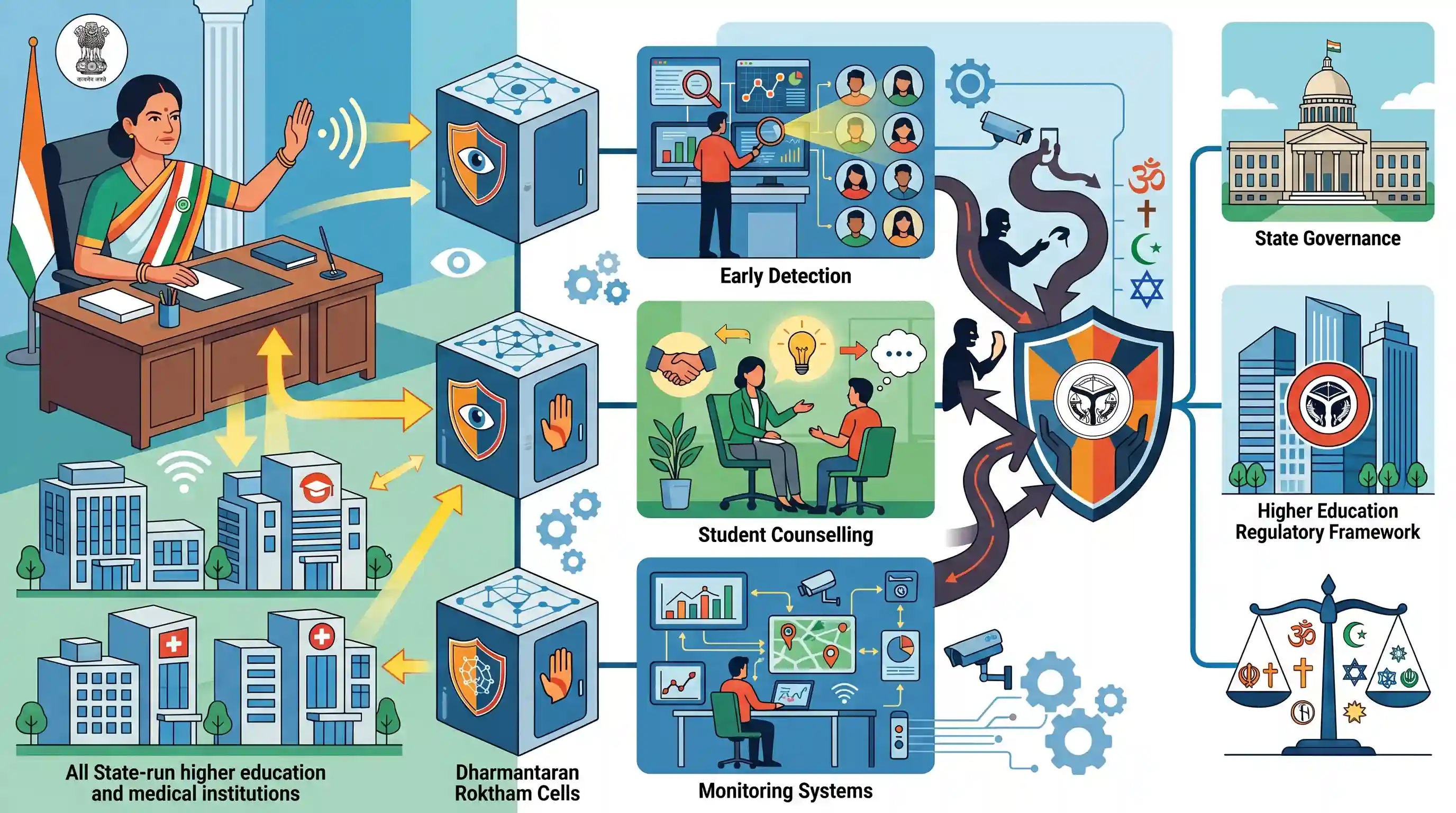
In June 2026, Uttar Pradesh Governor Anandiben Patel directed all state-run higher education and medical institutions to establish 'Dharmantaran Roktham Cells' (Anti-Conversion Cells) to enforce compliance with the state's 2021 anti-conversion law. The initiative aims to provide early detection, student counselling, and monitoring systems to protect students from coercive or fraudulent religious conversions.
Key Points
- Uttar Pradesh Governor Anandiben Patel, acting as the Chancellor of state universities, ordered all state-run higher educational institutions (including technical, medical, and dental colleges) to establish 'Dharmantaran Roktham Cells' (Anti-Conversion Cells).
- The directive seeks to prevent activities banned under the Uttar Pradesh Prohibition of Unlawful Conversion of Religion Act, 2021, by setting up early detection, monitoring, reporting, and student counselling mechanisms.
- The order was prompted by police investigations over the past two years into alleged organized religious conversion networks targeting students through inducement and psychological pressure, specifically at Lucknow's King George's Medical University (KGMU).
- Prominent UP institutions, including Lucknow University, AKTU, KGMU, and RMLIMS, have welcomed the decision and initiated the process to comply with the Governor's orders.
- The move has drawn political debate, with the ruling BJP supporting it as a protective measure and the opposition Samajwadi Party criticizing it for distracting from core issues of educational quality and funding.
Important Terms
Uttar Pradesh Prohibition of Unlawful Conversion of Religion Act, 2021

A state law prohibiting religious conversions through misrepresentation, force, coercion, allurement, or marriage, establishing strict penalties and requiring prior district magistrate approval.
UPSC context
GS Paper II: Fundamental Rights. Tests Article 25 and judicial oversight of state-level conversion laws.
Governor's Role as University Chancellor
An ex-officio statutory role enabling state Governors to head public universities, appoint Vice-Chancellors, and guide administration independently of the state council of ministers.
UPSC context
GS Paper II: Federalism. Tests understanding of center-state relations and university administrative autonomy.
King George's Medical University (KGMU)
A century-old, premier public medical school and state-run university located in Lucknow, Uttar Pradesh, renowned for regional healthcare and clinical research.
UPSC context
GS Paper II: Health. Tests public health infrastructure and administrative issues in state-funded medical institutions.
Dr. APJ Abdul Kalam Technical University (AKTU)
A major state-run technical university in Lucknow, Uttar Pradesh, regulating engineering, technology, and management education across hundreds of affiliated institutions.
UPSC context
GS Paper II: Education. Tests technical education regulation, reforms, and state-level higher education frameworks.
Dr. Ram Manohar Lohia Institute of Medical Sciences (RMLIMS)
A super-specialty medical institute and autonomous state university in Lucknow, Uttar Pradesh, offering advanced tertiary healthcare and postgraduate medical training.
UPSC context
GS Paper II: Health Infrastructure. Tests public healthcare delivery and autonomous institutional governance.
Samajwadi Party (SP)
A prominent state-level political party in Uttar Pradesh, advocating democratic socialist principles and currently serving as the main opposition in the state.
UPSC context
GS Paper II: Polity. Tests regional party dynamics and the role of legislative opposition.
Bharatiya Janata Party (BJP)
One of India's major national political parties, advocating national integration and serving as the current ruling party in Uttar Pradesh and at the Center.
UPSC context
GS Paper II: Polity. Tests understanding of party politics and ideological influences on governance.
Prelims Trap
The Governor, while discharging duties as the ex-officio Chancellor of state universities, is bound by the aid and advice of the Council of Ministers.
This role is statutory, not constitutional. Under state university laws, the Governor acts in an independent, discretionary capacity, not bound by Article 163.
Static Concepts Connected
Does Article 25 include the right to convert, and what is the landmark precedent?
- Propagate vs Convert: Propagate means to transmit or spread one's religion; it does not grant a fundamental right to convert another person.
- Rev. Stainislaus Case (1977): A 5-judge Supreme Court bench held that purposeful conversion impinges on the freedom of conscience of the individual being converted.
- State Regulations: Since public order is a State subject, states have the legislative competence to pass laws regulating coercive or fraudulent conversions.
What did major commissions recommend regarding the Governor's role as University Chancellor?
- Punchhi Commission: Recommended completely divesting the Governor of statutory roles like Chancellor to protect the dignity of the office.
- Sarkaria Commission: Suggested that the Governor should consult the Chief Minister or Council of Ministers before exercising university-related statutory powers.
Cross-Topic Patterns
Governor's Chancellor role & federal friction
Intersects state executive powers under Article 163 with state-run educational autonomy. Examines how statutory roles are leveraged to bypass the state Cabinet's aid and advice.
Article 25 vs State Police Powers
Examines the tension between individual religious freedom and the state's power to maintain public order and security under the State List of the Seventh Schedule.

2026 GS-2 may feature a comparative analysis of the Governor's constitutional powers versus statutory discretion as University Chancellor.
Linked PYQs · 3
Linked PYQs · 3
- 2015UPPSC_PRELIMSGS1
The appointment of a Governor in a State is made as per the provision in the Constitution under Article.
- 2024UPPSC_PRELIMSGS1
Given below are two statements, one is labelled as Assertion (A) and the other as Reason (R). Assertion (A) : According to the Constitution of India, the same person cannot function as the Governor of two or more States at the same time. Reason (R) : Article 153 of the Indian Constitution states that there shall be a Governor for each State. Select the correct answer from the codes given below :
- 2024UPPSC_PRELIMSGS1
Which one of the following is not correctly matched ?
