UP to establish research chairs to promote Indian knowledge tradition
Source:economictimes ↗
Why It Matters
This development is highly relevant for UPPSC Prelims as it combines state-specific governance initiatives with the implementation of the National Education Policy (NEP) 2020. It also touches upon India's rich cultural and historical heritage (Vedas, Upanishads, ancient sciences), bridging the gap between historical literature and modern education policy.
Summary
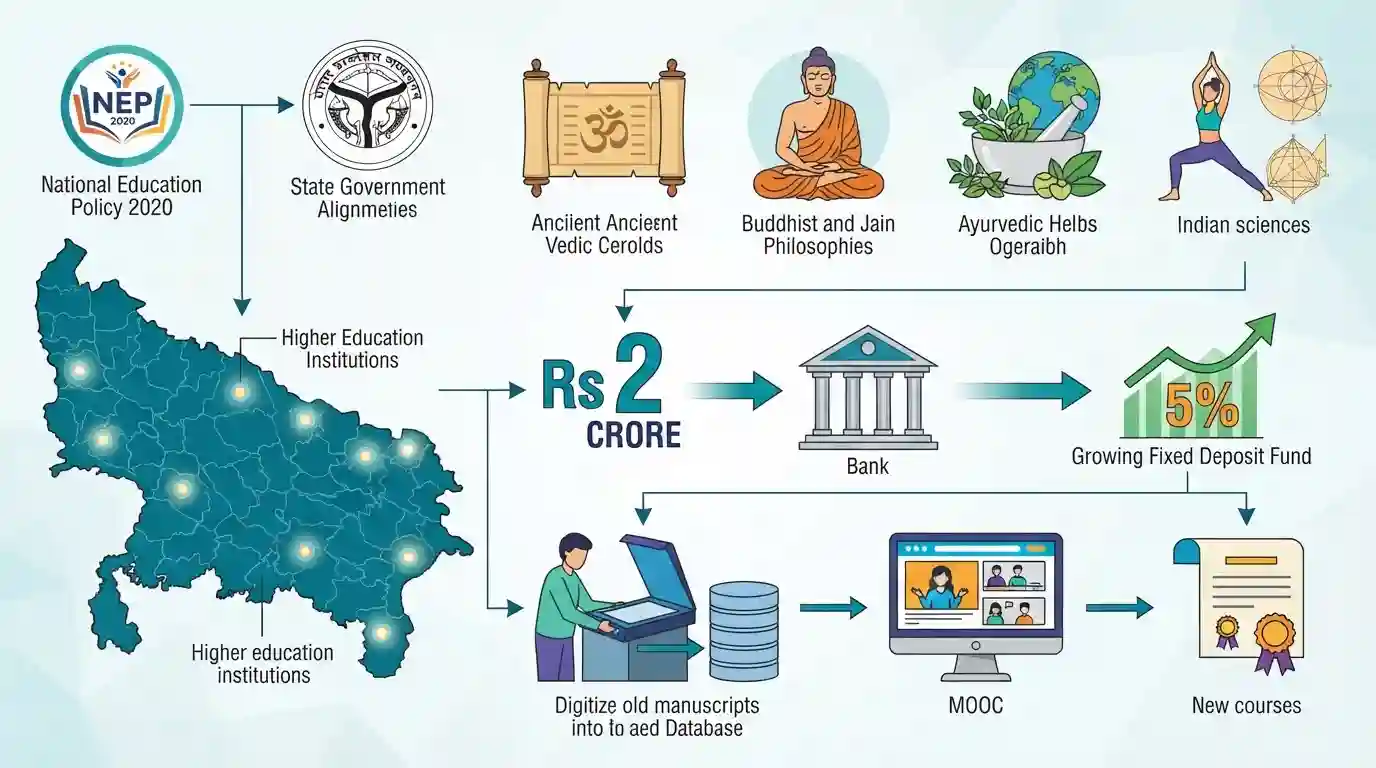
In alignment with the National Education Policy (NEP) 2020, the Uttar Pradesh government is introducing 'Indian Knowledge Tradition Promotion Research Chairs' in higher education institutions. The initiative aims to foster research into ancient Indian knowledge, including Vedic literature, Buddhist/Jain philosophies, Ayurveda, yoga, and traditional Indian sciences. Eligible state universities and historic colleges will receive a Rs 2 crore grant to fund the chairs using interest generated from fixed deposits. The program also mandates the digitization of ancient manuscripts and the launch of relevant MOOCs and diploma courses.
Key Points
- The Uttar Pradesh government will establish 'Indian Knowledge Tradition Promotion Research Chairs' in higher education institutions to research India's ancient knowledge systems.
- The initiative aligns with the National Education Policy (NEP) 2020 and covers areas like Vedas, Upanishads, Jain and Buddhist philosophies, Ayurveda, yoga, and ancient Indian mathematics and science.
- State universities and government/aided colleges established for at least 50 years with over 5,000 students (recognized under UGC Act Sections 2(f) and 12(B)) are eligible.
- Selected institutions will receive a one-time grant of Rs 2 crore for five years, kept in a fixed deposit, with the accrued interest funding the chair's research and operations.
- Additional activities include digitizing rare manuscripts, creating open-access digital libraries, and introducing MOOCs, diploma, and certificate courses on Indian knowledge traditions.
Important Terms
National Education Policy (NEP) 2020

India's overarching educational framework introduced in 2020. It seeks to overhaul the education system by promoting holistic, multidisciplinary learning and explicitly integrating the Indian Knowledge System (IKS) into modern curricula.
UPSC context
Highly relevant for GS Paper 2 (Education). Tests often focus on its implementation challenges, pedagogical shifts, and focus on indigenous knowledge.
Indian Knowledge Tradition Promotion Research Chairs
A Uttar Pradesh government initiative providing ₹2 crore grants to established universities and colleges. It funds research, digitizes manuscripts, and promotes courses on ancient Indian philosophies, sciences, and literature.
UPSC context
Pertinent for GS Paper 1 (Culture) and GS Paper 2 (Government Policies), illustrating state-level efforts to institutionalize traditional Indian heritage.
University Grants Commission (UGC)
A statutory organization responsible for determining and maintaining higher education standards in India. It recognizes universities and colleges, making them eligible for government grants under the UGC Act.
UPSC context
Important for GS Paper 2 (Statutory Bodies and Education). UPSC tests its regulatory functions, funding role, and higher education reforms.
Prelims Trap
A central scheme by the UGC to set up research chairs in all Indian universities.
Aspirants may confuse this state-level initiative with a central scheme. It is specifically a Uttar Pradesh government program, not a nationwide UGC mandate.
Static Concepts Connected
How does NEP 2020 integrate Indian Knowledge Systems (IKS)?
- Curriculum integration: It incorporates traditional Indian knowledge, including tribal and vocational skills, into school and higher education curricula.
- Language focus: It promotes the teaching of classical languages like Sanskrit, Pali, and Prakrit alongside regional languages.
- Holistic education: It mainstreams traditional sciences like Ayurveda, Yoga, and classical Indian mathematics into contemporary academic pedagogy.
What is the National Mission for Manuscripts (NMM)?
- Nodal Ministry: Launched in 2003 by the Ministry of Culture, Government of India.
- Core Objective: Aims to unearth, preserve, and digitize India's vast, undocumented wealth of ancient manuscripts.
- National Database: Maintains 'Kriti Sampada', a national database of manuscripts, to make heritage accessible to global researchers.
Cross-Topic Patterns
NEP 2020 bridging Culture & Governance
The integration of Vedic, Jain, and Buddhist philosophies into higher education explicitly blends the traditional Art & Culture syllabus with modern public policy frameworks.
Decentralized cultural digitization
State-level manuscript digitization efforts complement the central National Mission for Manuscripts, reflecting a growing multi-tier approach to heritage preservation and open-access digital libraries.

Expect a 2026 Prelims statement linking NEP 2020's Indian Knowledge Systems mandate with manuscript preservation initiatives like NMM.
Linked PYQs · 4
Linked PYQs · 4
- 2020UPPSC_PRELIMSGS1
Consider the following statements about New National Education Policy approved by Union Cabinet of India on 29th July, 2020 : 1. It was drafted by a Committee headed by Dr. K Kasturirangan. 2. It will replace the previous Education Policy which has been followed since last 38 years. Select the correct statement(s) from the codes given below.
- 2013UPPSC_PRELIMSGS1
The earliest occurrence of the mantra famous as Gayatri Mantra is found in the following text:
- 2023UPPSC_PRELIMSGS1
Which of the following Scheme/Programme is not the Central Government Programme and it is Uttar Pradesh Government's Programme?
- 2023UPPSC_PRELIMSGS1
Which of the following scheme/s is/are related to Uttar Pradesh? (1) Anuthee Uphar Scheme (2) Matra Shakti Udyamita Scheme (3) Kaushalya Matritva Scheme (4) Stree Nidhi Scheme Select the 'correct' answer using the code given below -
