IMD Predicts Intensified Monsoon Activity Across Uttar Pradesh
Source:theprint ↗
Why It Matters
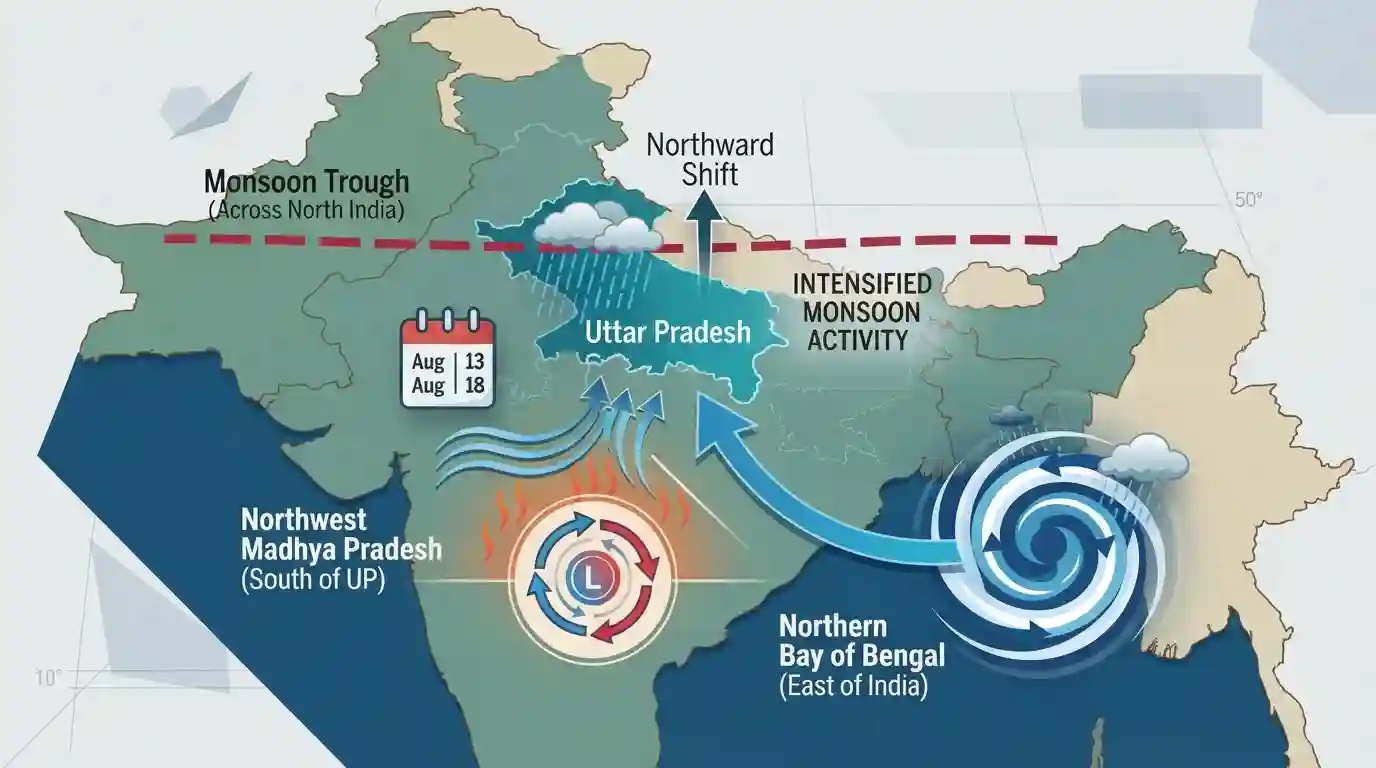
The article highlights practical examples of factors that dictate the spatial distribution of the Indian monsoon (such as depressions in the Bay of Bengal, low-pressure cells, and the movement of the monsoon trough). This is a core concept in Indian Geography relevant for UPPSC Prelims and Mains.
Summary
The India Meteorological Department (IMD) predicted intensified monsoon activity across Uttar Pradesh between August 13 and August 18. This weather pattern was primarily influenced by three simultaneous meteorological factors: a low-pressure area over northwest Madhya Pradesh, the strengthening of a low-pressure system into a depression over the northern Bay of Bengal, and the northward shift of the monsoon trough.
Key Points
- The IMD forecast intensified monsoon rainfall across Uttar Pradesh from August 13 to August 18.
- The increased rainfall was driven by a low-pressure area over northwestern Madhya Pradesh and adjoining East Rajasthan.
- Another contributing factor was a well-marked low-pressure area over the north Bay of Bengal that intensified into a depression.
- The monsoon trough's northward shift played a significant role in enhancing precipitation over northern India, including UP.
Important Terms
India Meteorological Department (IMD)

The principal Indian government agency under the Ministry of Earth Sciences responsible for meteorological observations, weather forecasting, seismology, and climate research.
UPSC context
Crucial for GS-1 and GS-3 (Disaster Management) regarding early warning systems, cyclone alerts, and monsoon predictions.
Monsoon Trough
A seasonal low-pressure belt running across the Indo-Gangetic plain, marking the summer position of the ITCZ. Its northward or southward shifts control India's active and break monsoon rainfall phases.
UPSC context
Vital for GS-1 (Indian Geography), testing the dynamics of monsoon mechanisms and rainfall distribution.
Low-Pressure Area
A region where atmospheric pressure is lower than its surroundings. It draws in moist, converging air from higher-pressure areas, leading to upward air movement, cloud formation, and precipitation.
UPSC context
Foundational GS-1 (Climatology) concept essential for understanding monsoon winds, tropical cyclones, and weather systems.
Monsoon Depression
An intense low-pressure system, usually originating in the Bay of Bengal during the monsoon, characterized by closed isobars. These systems travel inland and trigger widespread heavy rainfall.
UPSC context
Important for GS-1 and GS-3 to explain extreme weather events, spatial monsoon distribution, and inland flooding.
Prelims Trap
"A northward shift of the monsoon trough leads to widespread heavy rainfall across central and peninsular India."
A northward shift of the trough actually causes a "break" in the monsoon for central/peninsular India, while drastically intensifying rains only in the northern plains and Himalayan foothills.
Static Concepts Connected
What defines a 'Break' in the Indian Monsoon?
- Trough shift: The monsoon trough axis shifts northward, settling close to the Himalayan foothills instead of its normal position.
- Dry central India: Rainfall drastically declines over central and peninsular India, creating dry spells that can severely impact agriculture.
- Heavy foothill rains: Precipitation intensifies significantly along the Himalayan foothills, Northern plains, and Northeast India.
How do Bay of Bengal depressions influence monsoon distribution?
- Origin and trajectory: They predominantly form in the northern Bay of Bengal during July-August and move inland in a west-northwest direction.
- Trough dependence: They travel along the axis of the monsoon trough, acting as the principal rain-bearing systems for central and northern India.
- Rainfall delivery: The frequency, intensity, and path of these depressions determine the spatial and temporal distribution of active monsoon spells.
Cross-Topic Patterns
Monsoon spatial variation and Kharif sowing
Prolonged breaks or shifting troughs directly impact spatial rainfall distribution, determining the success or failure of Kharif sowing patterns and rainfed agriculture in central versus northern states.
Monsoon trough shifts and Himalayan floods
The northward shift of the monsoon trough concentrates intense rainfall in the Himalayan foothills, frequently triggering flash floods, landslides, and riverine flooding in upstream catchment areas.

Expect a multi-statement question linking spatial oscillation of the monsoon trough with central Indian droughts and Himalayan flash floods.
Linked PYQs · 1
Linked PYQs · 1
- 2023UPPSC_PRELIMSGS1
Assertion (A) – The Tamil Nadu coast remains dry during South-West monsoon season. Reason (R) – The Tamil Nadu coast is situated parallel to the Bay of Bengal branch of South-West monsoon and it lies in the rain shadow area of the Arabian Sea branch of the South-West monsoon during monsoon season. the correct answering the code given below –
