Uttar Pradesh Vehicle Registration Number Retention Policy
Source:etvbharat ↗
Why It Matters
This initiative highlights Uttar Pradesh's pioneering role in digital governance and public service delivery (faceless transport services), which aligns directly with syllabus topics on e-governance, administrative reforms, and citizen charters.
Summary
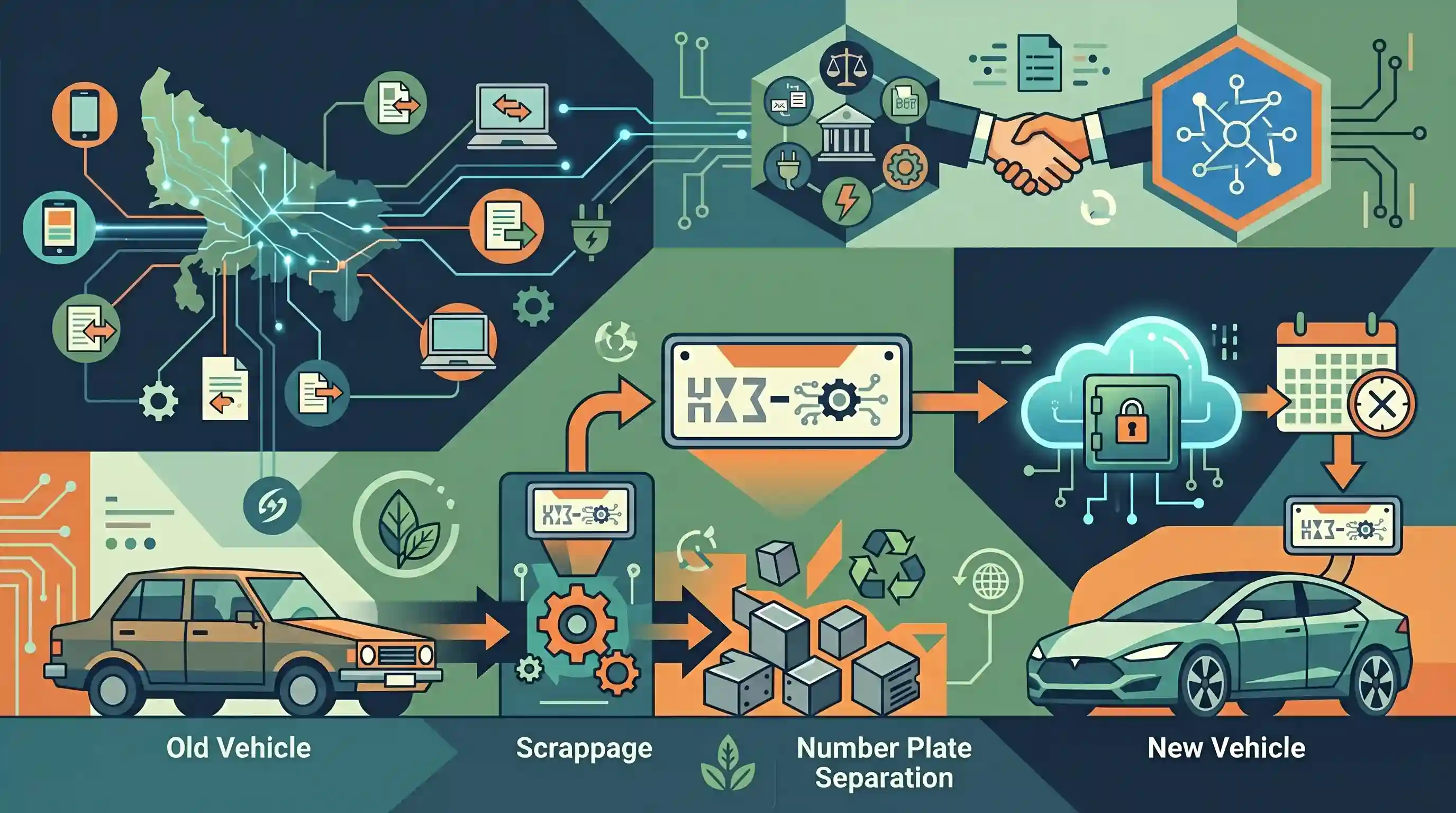
The Uttar Pradesh Transport Department, in collaboration with the National Informatics Centre (NIC), is introducing a new faceless service allowing vehicle owners to retain their favourite registration numbers for up to one year after scrapping or disposing of their old vehicles. This initiative is part of UP's broader push toward digital governance, where the state currently leads the country with 58 transport-related services available online.
Key Points
- The Uttar Pradesh Transport Department is rolling out a new facility allowing vehicle owners to retain and transfer their preferred vehicle registration numbers for up to one year after scrapping or disposing of old vehicles.
- Under the proposed retention system, a retention fee of Rs 5,000 along with an additional Rs 600 will be charged. The trial is being facilitated through the National Informatics Centre (NIC).
- Currently, vehicle registration numbers are blocked when a vehicle reaches the end of its legal life (10 years for diesel and 15 years for petrol vehicles) and is scrapped.
- Uttar Pradesh currently leads Indian states in the digitisation of public transport services, offering 58 online/faceless services (with 16 automated approvals), followed by Assam and West Bengal with 46 each.
Important Terms
Faceless Transport Services

A digital governance model allowing citizens to access transport services (such as licensing and registration) entirely online, eliminating the need for physical visits to Regional Transport Offices.
UPSC context
GS Paper II (e-Governance). Tests understanding of IT-enabled public service delivery and citizen-centric governance reforms.
National Informatics Centre
The premier ICT organisation under the Ministry of Electronics and Information Technology (MeitY) responsible for designing and implementing digital infrastructure and e-governance solutions for Indian governments.
UPSC context
GS Paper II & III. Tests knowledge of institutional frameworks driving e-governance initiatives and national IT infrastructure.
Vehicle Scrappage Policy
A national policy aimed at phasing out unfit and polluting old vehicles through automated scientific testing, thereby enhancing road safety, fuel efficiency, and a circular economy.
UPSC context
GS Paper III (Environment and Infrastructure). Tests policies on reducing vehicular pollution, green mobility, and waste recycling ecosystems.
VAHAN Portal
A centralized, national e-governance portal developed by MoRTH and NIC that digitizes and uniformizes vehicle registration, licensing, and road tax records across Indian states.
UPSC context
GS Paper II (e-Governance). Tests understanding of digital public infrastructure (DPI) and administrative reforms in India's transport sector.
Prelims Trap
The National Automobile Scrappage Policy, 2021, enforces a blanket, country-wide ban on all petrol vehicles older than 15 years.
The absolute 10/15-year ban is an NGT directive specifically for NCR. The 2021 National Scrappage Policy relies on fitness-based testing after 15/20 years, not absolute age bans.
Static Concepts Connected
What are the core pillars of the National Automobile Scrappage Policy, 2021?
- Fitness-centric testing: Shifts the trigger for decommissioning vehicles from absolute age to objective emission and safety fitness tests.
- Mandatory timelines: Commercial vehicles undergo automated fitness testing after 15 years, while private passenger vehicles undergo testing after 20 years.
- Financial incentives: Offers motor vehicle tax concessions, registration fee waivers, and scrap value certificates to encourage voluntary vehicle disposal.
How do VAHAN and SARATHI function under the e-Transport Mission Mode Project?
- VAHAN portal: Centralizes nation-wide vehicle registration, permit issuance, road tax collection, and fitness certification records.
- SARATHI portal: Standardizes driving license workflows, learner permit applications, and driving school licensing across Indian states.
- National Registry: Consolidates state data into a single queryable database to reduce tax evasion and vehicle registration fraud.
Cross-Topic Patterns
Judicial Environmentalism vs. Executive Policy
The absolute 10/15-year NCR vehicle bans (mandated by NGT under Article 21) highlight administrative friction with the executive's fitness-centric national scrappage policy.
2nd ARC & Faceless Governance
Uttar Pradesh’s automated transport services implement the 2nd ARC’s mandate on transition to "online interactivity," reducing manual interface, administrative discretion, and corruption.

Expect questions contrasting regional NGT age-based vehicle bans with the nationwide fitness-based Scrappage Policy 2021.
Linked PYQs · 2
Linked PYQs · 2
- 2024UPPSC_PRELIMSGS1
Which of the following statements are correct with regard to ICT-based e-Governance? 1. e-Governance reduces the transparency of Government. 2. e-Governance reduces the cost of Government. 3. e-Governance increases citizens input into Government. 4. e-Governance increases bureaucratic red tapism. Select the correct answer from the codes given below:
- 2016UPPSC_PRELIMSGS1
'e-Biz' sefer to
