Uttar Pradesh to Set Up Medical Colleges via PPP Model in Districts
Source:bestcolleges-indiatoday ↗
Why It Matters
Important for UPPSC aspirants tracking state-level policy shifts, healthcare infrastructure development, and economic models like PPP in public welfare sectors within Uttar Pradesh.
Summary
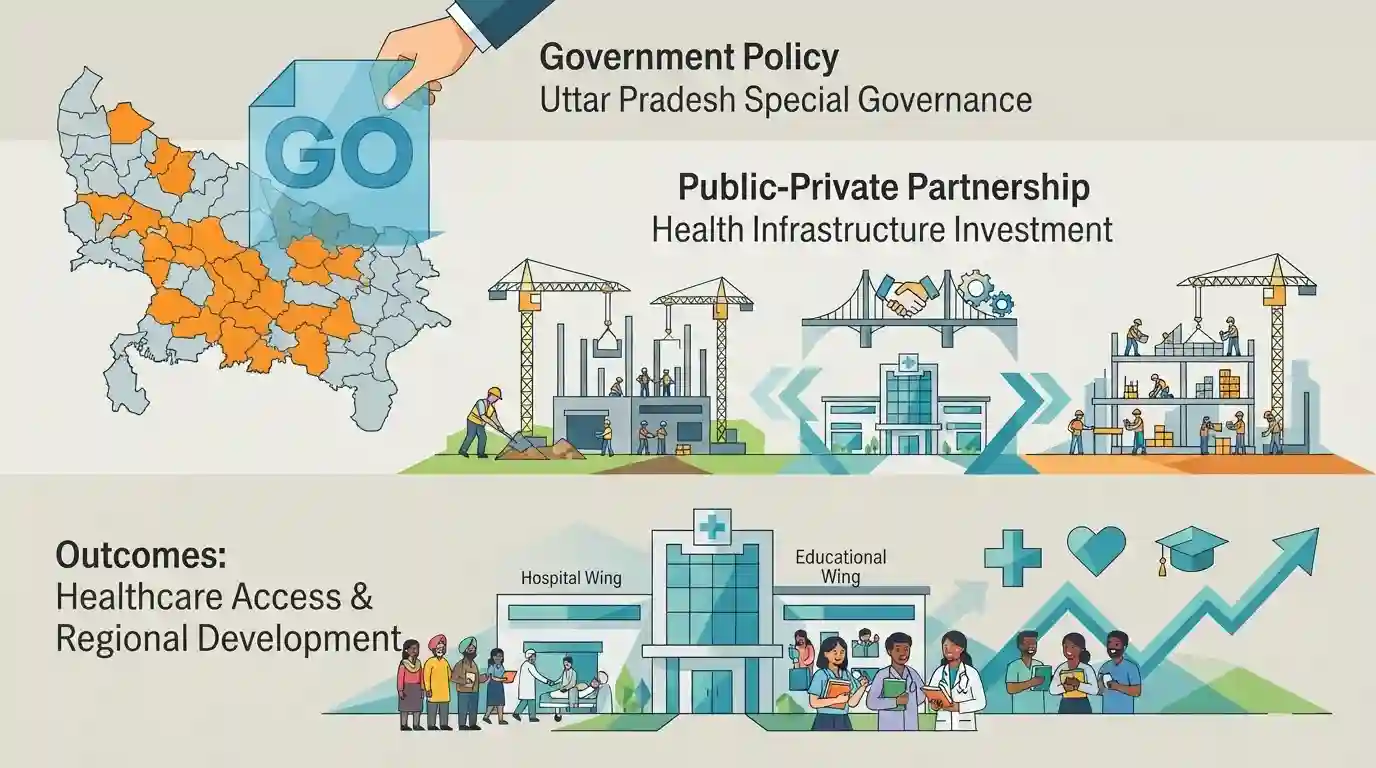
The Uttar Pradesh government is set to adopt a Public-Private Partnership (PPP) model to set up medical colleges in 16 districts that currently lack medical education infrastructure, boosting healthcare access and fulfilling regional development goals.
Key Points
- The Uttar Pradesh government has decided to adopt the Public-Private Partnership (PPP) model to establish medical colleges in 16 uncovered districts across the state.
- This initiative aims to address the shortage of medical infrastructure and healthcare professionals in backward or underserved regions of UP.
- The move aligns with the broader objective of ensuring 'One District, One Medical College' across Uttar Pradesh.
Important Terms
Public Private Partnership (PPP) Model

A cooperative arrangement between government agencies and private sector companies to finance, build, and operate infrastructure projects like medical colleges, leveraging private capital and efficiency for public welfare.
UPSC context
Important for GS Paper II (Governance, Welfare Schemes) and UPPSC Paper V/VI (State Governance and Infrastructure Financing).
Uttar Pradesh Government
The apex subnational executive authority of Uttar Pradesh responsible for policymaking, budgetary allocations, and executing governance reforms across state districts.
UPSC context
Essential for UPPSC General Studies Papers V and VI, focusing on Uttar Pradesh specific public policy, state budget allocations, and regional development initiatives.
Prelims Trap
private concessionaires are entrusted with financing, designing, constructing, and operating medical colleges while simultaneously upgrading associated district hospitals.
Aspirants often assume PPP medical colleges are 100% centrally funded or entirely privately managed without state oversight, missing the concessionaire-district hospital integration framework.
Static Concepts Connected
What are the standard models of Public-Private Partnership (PPP) in infrastructure projects in India?
- BOT Model: BOT model involves Build, Operate, and Transfer where private partner finances and operates before handing back to government.
- DBFOT Model: DBFOT model combines Design, Build, Finance, Operate, and Transfer for complex public infrastructure.
- HAM Model: HAM model blends Engineering, Procurement, and Construction with Annuity, where government pays installments over time.
- BOOT Model: BOOT model adds Ownership to the private entity for the operational concession period before transfer.
Cross-Topic Patterns
PPP healthcare models and central health schemes
The 'One District, One Medical College' initiative intersects with the PM-ABHIM scheme, linking state-level infrastructure expansion with central federal financing for critical healthcare blocks.
State fiscal capacity and PPP capital formation
PPP infrastructure delivery in UP connects directly to the state's fiscal deficit targets and capital expenditure prioritization under FRBM frameworks.

UP's 'One District, One Medical College' via PPP model in 16 uncovered districts will feature in Prelims matching or statement questions.
Linked PYQs · 2
Linked PYQs · 2
- 2021UPPSC_PRELIMSGS1
How many districts of Uttar Pradesh has been covered under the Aspirational District Programme run by NITI Aayog, up to June, 2021?
- 2022UPPSC_PRELIMSGS1
With reference to Budget of Uttar Pradesh for the Financial Year 2020 - 21, which of the following statement(s) is/are true ? 1. The size of the budget was Rs. 5,12,860.72 crores. 2. Certain new schemes were also included in this budget amounting to Rs. 10,967.87 crores. Select the correct answer from the code given below.
