Uttar Pradesh Startup Policy Financial Incentives and Body
Source:indiatoday ↗
Why It Matters
UPPSC PCS Prelims regularly tests state-specific industrial policies, economic targets (such as the 1 trillion dollar goal), administrative changes, and precise financial outlays. This policy marks a significant shift in UP's institutional startup architecture and financial limits.
Summary
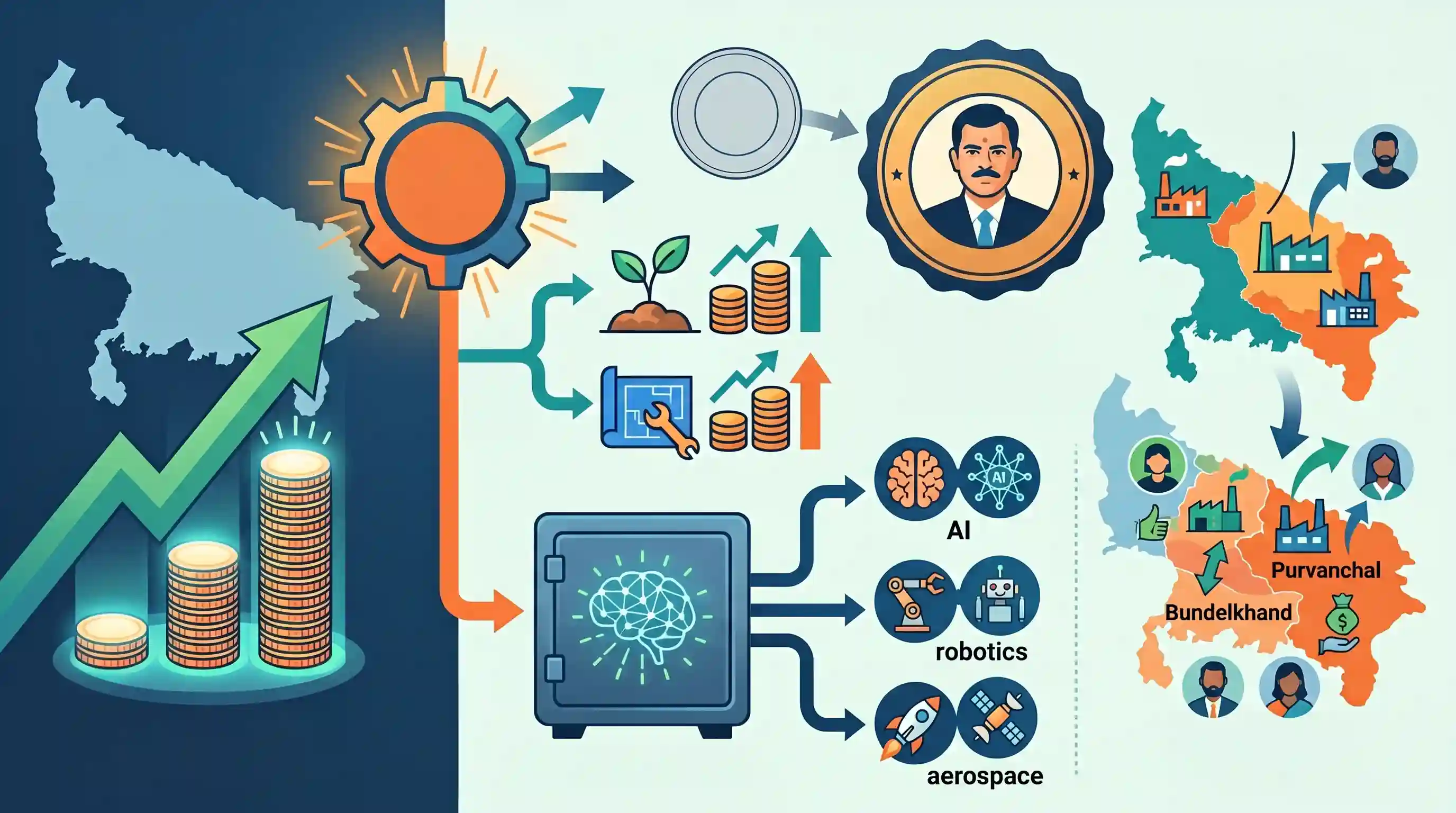
The Uttar Pradesh Cabinet has approved the 'UP Startup Policy 2026' to accelerate the state's startup ecosystem towards its USD 1 trillion economy objective by 2030. The policy significantly enhances financial support, increasing seed funding to Rs 15 lakh and prototype grants to Rs 10 lakh, while introducing a patient capital fund of up to Rs 100 crore for advanced technologies (AI, robotics, aerospace). Administratively, the newly formed UP Startup Mission, led by the Chief Secretary, will take over from the UP Electronics Corporation as the nodal agency. Special provisions for marginalized entrepreneurs and lagging regions like Purvanchal and Bundelkhand are maintained.
Key Points
- The Uttar Pradesh Cabinet, chaired by CM Yogi Adityanath on July 6, 2026, approved the 'UP Startup Policy 2026' to bolster the state's startup ecosystem in line with the USD 1 trillion economy target by 2030.
- Under the new policy, seed funding assistance has been doubled from up to Rs 7.5 lakh (under the 2020 policy) to up to Rs 15 lakh, and the prototype development grant is increased from up to Rs 5 lakh to up to Rs 10 lakh.
- Strategically important projects will receive financial assistance of up to Rs 50 lakh, and a 'patient capital' support of up to Rs 100 crore will be introduced for large-scale deep-tech projects in AI, ML, robotics, and aerospace.
- The administrative architecture is being overhauled: the newly formed 'UP Startup Mission', an autonomous body headed by the state's Chief Secretary, will replace 'UP Electronics Corporation' as the nodal agency.
- Additional perks include a monthly sustenance allowance of Rs 20,000 for up to 2 years and a cloud computing services reimbursement of up to Rs 2 lakh per year.
- To ensure inclusive growth, special incentives are sustained for women, PwD, transgender, and EWS entrepreneurs, alongside added promotional benefits for the Purvanchal and Bundelkhand regions.
- Uttar Pradesh currently hosts more than 17,000 DPIIT-recognized startups, 8 unicorns, and over 70 incubators. Its Rs 1,000 crore Startup Fund is managed by SIDBI through Alternative Investment Funds (AIFs).
Important Terms
UP Startup Policy 2026

An approved policy (July 2026) of the Uttar Pradesh government designed to expand the state's startup ecosystem, enhance financial assistance like seed funding, and establish a dedicated mission, driving the state's goal of a USD 1 trillion economy.
UPSC context
GS Paper III: Economy/Investment Models; tests understanding of state-level startup initiatives and policies designed for regional and technological growth.
UP Startup Mission
An autonomous nodal agency approved under the UP Startup Policy 2026, headed by the Chief Secretary, established to consolidate and streamline startup operations, mentorship, and funding across the state.
UPSC context
GS Paper II: Governance/Institutional Frameworks; tests administrative mechanisms created to coordinate sub-national technology and entrepreneurial development.
UP Startup Policy 2020
The previous five-year flagship startup policy of Uttar Pradesh, introduced to support 10,000 startups and establish incubators across 75 districts, which was succeeded by the enhanced UP Startup Policy 2026.
UPSC context
GS Paper III: Regional Development/Government Policies; tests comprehension of historical policies, sub-national ecosystem growth, and policy progression over time.
DPIIT
The Department for Promotion of Industry and Internal Trade is a central government department under the Ministry of Commerce and Industry responsible for formulating industrial policies, facilitating FDI, and executing the Startup India initiative.
UPSC context
GS Paper III: Indian Economy/Industrial Policy; tests knowledge of regulatory bodies governing internal trade, investments, and startup certification frameworks.
SIDBI
The Small Industries Development Bank of India is a statutory development financial institution established in 1990 to license, regulate, finance, and support the growth of micro, small, and medium enterprises (MSMEs).
UPSC context
GS Paper III: Economy/Financial Institutions; tests awareness of statutory financial bodies, refinancing mechanisms, and credit flow to small industries.
Alternative Investment Funds
Privately pooled investment vehicles in India (such as venture capital or private equity funds) regulated by SEBI, which collect funds from sophisticated investors to invest in non-traditional assets under a defined strategy.
UPSC context
GS Paper III: Capital Markets/Investment Models; tests knowledge of non-traditional risk capital, regulatory frameworks, and funding mechanisms for startups.
Prelims Trap
The UP Startup Fund is directly managed and disbursed as developmental grants to startups by the UP Startup Mission.
The UP Startup Fund is a Fund of Funds managed by SIDBI via SEBI-registered AIFs for equity-linked capital, rather than being directly disbursed as grants by the state cabinet or Startup Mission.
Static Concepts Connected
What is a Fund of Funds (FoF) under SEBI guidelines?
- Indirect investment: An investment strategy that invests in other portfolio funds (like AIFs) rather than buying direct equity in startups.
- Risk diversification: Spreads capital across multiple venture funds with different sector focuses, reducing the systemic risk of direct startup failures.
- Managerial leverage: Enables governments to utilize the commercial expertise of professional fund managers to select viable startup investments.
What is 'patient capital' and why is it vital for deep-tech?
- Extended timelines: Investment capital characterized by a long-term horizon, where investors do not expect quick exits or short-term returns.
- Deep-tech relevance: Essential for highly capital-intensive sectors like aerospace and biotech, which have long R&D gestation periods.
- Sovereign backing: Typically funded by state agencies or development banks when traditional private venture capital avoids high-risk, slow-gestating innovations.
Cross-Topic Patterns
Subnational competitive federalism
State-specific economic targets (like UP's USD 1 trillion goal) reflect a shifting landscape where states directly compete using custom fiscal incentives rather than relying solely on central schemes.
Spatial equity in industrial growth
By offering 50% extra incentives for Purvanchal and Bundelkhand, the policy attempts to decentralize tech ecosystems away from saturated Tier-1 hubs like Noida.

Subnational $1-trillion targets and state 'Fund of Funds' models through SIDBI will likely be framed under competitive federalism in 2026.
Linked PYQs · 2
Linked PYQs · 2
- 2017UPPSC_PRELIMSGS1
The specific requirements of the 'start-ups' can be fulfilled through:
- 2020UPPSC_PRELIMSGS1
When is India expected to achieve the target of becoming the 5th largest dollar economy?
