Saharnpur hosts launch of universal primary education drive in UP
Source:abplive ↗
Why It Matters
The 'School Chalo Abhiyan' is Uttar Pradesh's flagship drive to execute the Right to Education. For UPPSC aspirants, this article is highly relevant as it connects state welfare policies with constitutional developments (86th Amendment Act) and district-level political geography (border boundaries of Saharanpur), both of which are recurrent areas of questioning in the GS Prelims paper.
Summary
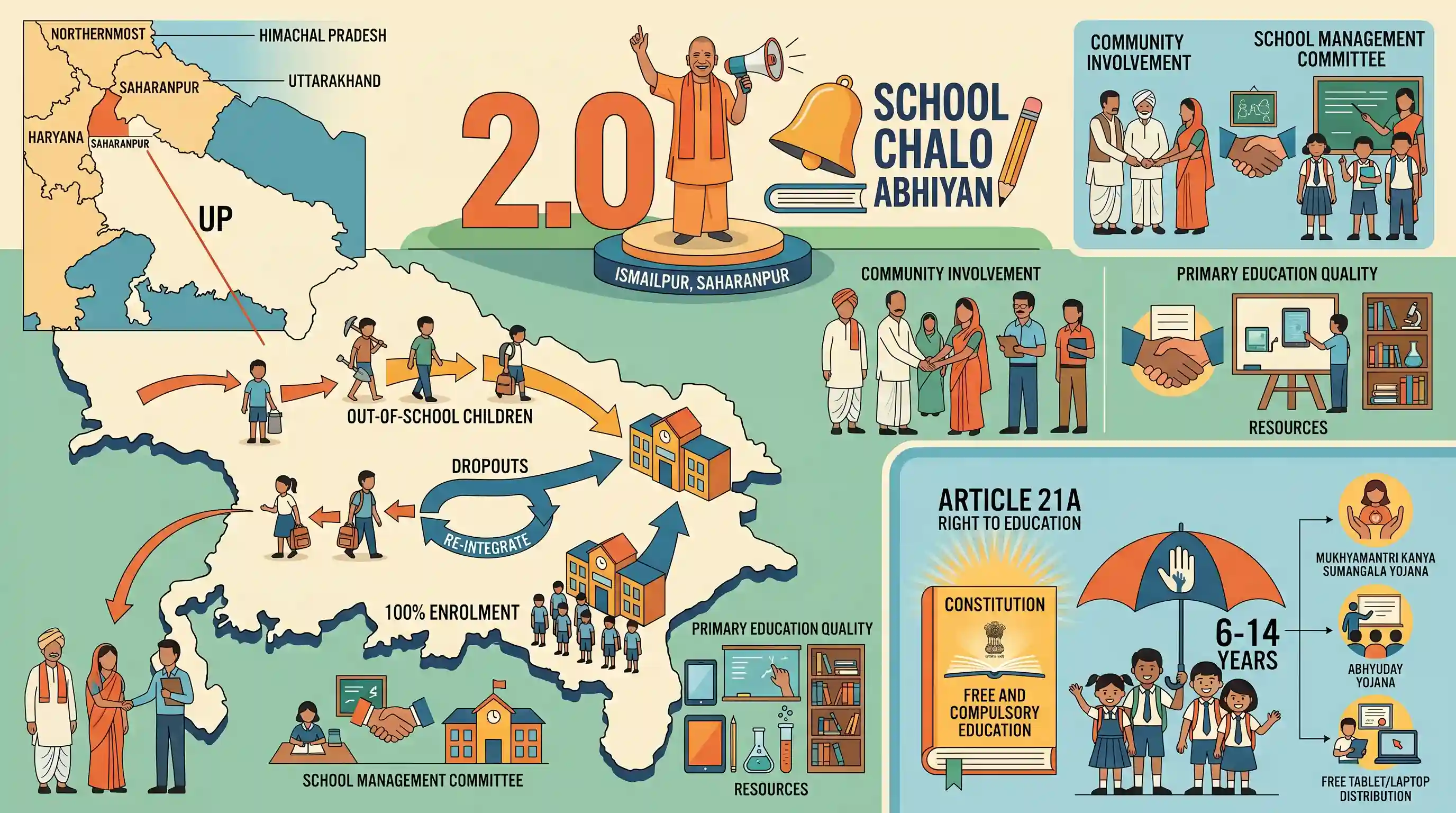
Uttar Pradesh Chief Minister Yogi Adityanath launched the second phase of 'School Chalo Abhiyan 2026' on July 1, 2026, from Ismailpur village in Saharanpur. This statewide campaign aims to achieve 100% school enrolment, integrate out-of-school children, and bring dropouts back to classrooms. It emphasizes local community involvement, including school management committees and elected representatives. The launch highlights the state's focus on primary education quality and resources, closely aligning with the Constitutional mandate of the Right to Education (Article 21A) and bringing special geographical attention to Saharanpur, UP's northernmost boundary-sharing district.
Key Points
- UP Chief Minister Yogi Adityanath launched the second phase of the state-wide 'School Chalo Abhiyan 2026' on July 1, 2026, from the CM Model Composite School in Ismailpur village, Saharanpur.
- The campaign's primary objective is to achieve 100 percent school enrolment in primary education, identifying out-of-school children, securing their admissions to nearby schools, and encouraging dropout students to resume their education.
- The first phase of the campaign was successfully executed between April 1 and April 15, 2026; the second phase aims to reinforce those gains and ensure no child is left behind in the new academic year.
- The initiative emphasizes community-driven governance, leveraging collaboration among local elected representatives, School Management Committees (SMCs), and parents to raise awareness about uninterrupted schooling.
- During the launch event, CM Yogi Adityanath distributed stationery kits, textbooks, and school bags, and also honored the district's best-performing headmasters for their contributions to improving basic educational standards.
- Geographical Relevance (UPPSC Connection): Saharanpur, where the campaign was launched, is the northernmost district of UP. It borders three states—Haryana, Himachal Pradesh, and Uttarakhand—and shares internal borders with only two UP districts: Shamli and Muzaffarnagar (ref: UPPSCPRELI2025GS01083).
- Constitutional Connection: The School Chalo Abhiyan aligns with Article 21A of the Indian Constitution, which makes free and compulsory education for children aged 6 to 14 a Fundamental Right, inserted by the 86th Constitutional Amendment Act, 2002 (ref: UPPSCPRELI2022GS01012).
Important Terms
School Chalo Abhiyan

A statewide school enrollment campaign in Uttar Pradesh aimed at achieving 100% registration in primary and upper primary schools, integrating out-of-school children, and reducing dropouts through community participation.
UPSC context
GS Paper II: Social Justice and Education; tests knowledge of state-level interventions to implement the Right to Education.
Right of Children to Free and Compulsory Education (RTE) Act, 2009
A landmark Central legislation in India that mandates free and compulsory elementary education (classes 1–8) for every child aged six to fourteen years, outlining minimum standards for schools.
UPSC context
GS Paper II: Governance and Constitution; tests provisions for social welfare, fundamental rights, and educational policy.
Constitution (86th Amendment) Act, 2002
A constitutional amendment that inserted Article 21A, making the Right to Education a Fundamental Right for children aged 6–14, and amended Articles 45 and 51A.
UPSC context
GS Paper II: Indian Constitution; tests major amendments, fundamental rights, directive principles, and fundamental duties.
School Management Committees
Decentralized governance bodies mandated under Section 21 of the RTE Act, 2009, composed primarily of parents, tasked with monitoring school operations and managing development plans.
UPSC context
GS Paper II: Governance and Social Sector; tests community participation, decentralization, and institutional accountability in primary education.
Saharanpur District
The northernmost border district of Uttar Pradesh, situated at the foothills of the Shivalik range, bordering the states of Uttarakhand, Himachal Pradesh, and Haryana.
UPSC context
GS Paper I: Geography of India; tests geographical borders, physical subdivisions (Bhabhar, Terai), and regional drainage patterns.
Prelims Trap
Article 21A guarantees free and compulsory education as a Fundamental Right to all children up to 14 years.
The right is restricted strictly to children aged six to fourteen. Children below six years are covered under Directive Principles of State Policy (Article 45).
Static Concepts Connected
What are the changes introduced by the 86th Constitutional Amendment Act, 2002?
- Fundamental Right: Inserted Article 21A, making free and compulsory education for children aged 6–14 years a Fundamental Right.
- DPSP Modification: Amended Article 45, shifting the state's directive to provide early childhood care for children up to six years.
- Fundamental Duty: Added Article 51A(k), making it a duty of parents/guardians to provide education opportunities to children aged 6–14.
What is the unique border geography of Uttar Pradesh's northern frontier?
- Three-State Border: Saharanpur shares borders with Haryana, Uttarakhand, and Himachal Pradesh, holding UP's only boundary contact with Himachal Pradesh.
- Internal Boundaries: Unlike Lalitpur which touches only Jhansi, Saharanpur connects internally with two districts: Shamli and Muzaffarnagar.
Cross-Topic Patterns
Primary education quality vs infrastructure deficits
Standard enrollment drives like 'School Chalo' require integration with programmatic structural upgrades like 'Operation Kayakalp' to convert temporary enrollment spikes into long-term retention.
State borders and federal-state coordination
Border districts like Saharanpur demand inter-state coordination to track and integrate seasonal migrant children, bridging gaps between different state education management portals.

Expect questions linking localized state primary education campaigns with statutory provisions of the RTE Act and Article 21A age limits.
Linked PYQs · 2
Linked PYQs · 2
- 2025UPPSC_PRELIMSGS1
Which of the following districts of Uttar Pradesh shares its boundary with only one other district of Uttar Pradesh ? 1. Lalitpur 2. Saharanpur 3. Sonbhadra Select the correct answer from the code given below :
- 2022UPPSC_PRELIMSGS1
Right to Education has been included into the Fundamental Rights by the
