Uttar Pradesh Scholarship Scheme 2026 27 for School Students
Source:economictimes ↗
Why It Matters
UPPSC PCS Preliminary Examination frequently tests candidates on significant state-specific welfare schemes, targeting vulnerable sections of society. Understanding the classification of these scholarships and their execution mechanism, particularly the use of Aadhaar-linked Direct Benefit Transfer (DBT) and e-governance frameworks (NIC), is critical for answering policy and governance-related questions.
Summary
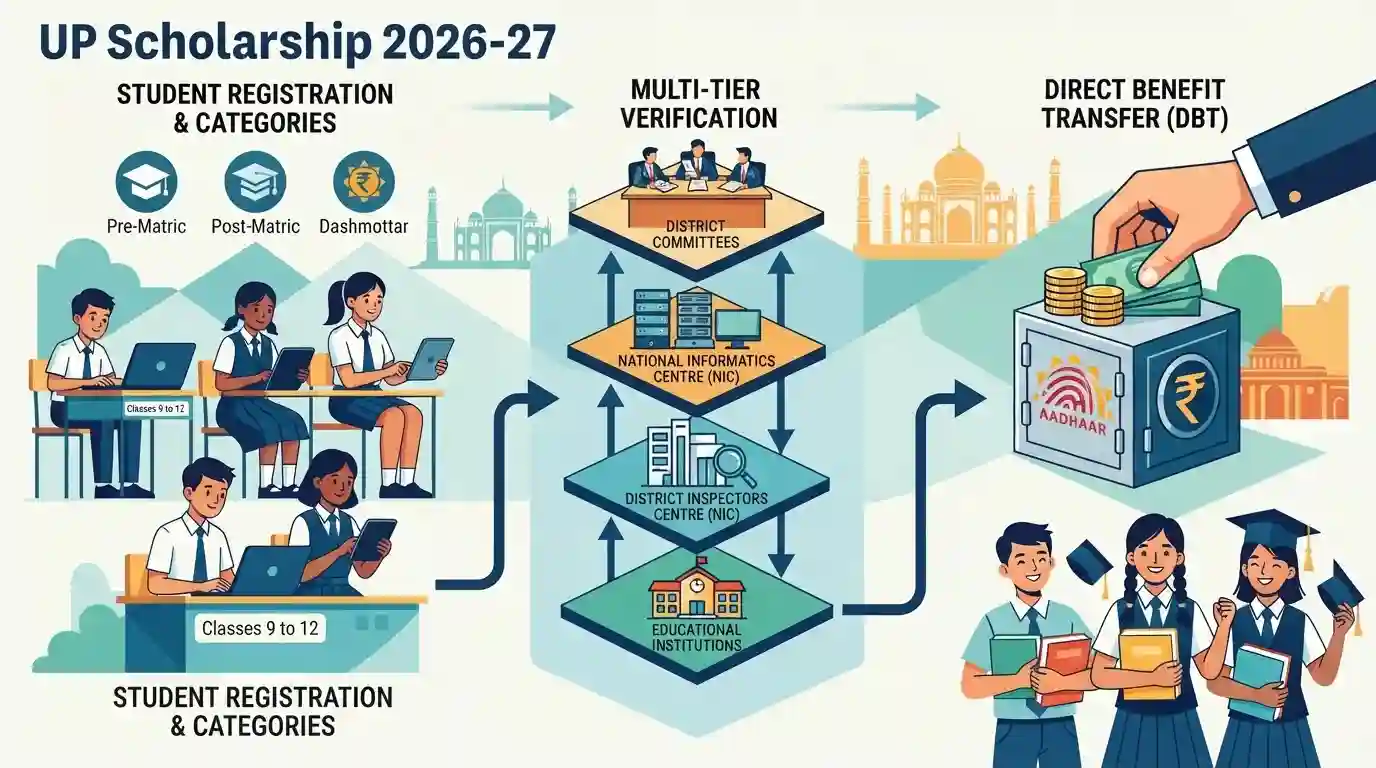
The Uttar Pradesh Social Welfare Department has initiated the registration process for the UP Scholarship 2026-27, aimed at students from classes 9 to 12 across various categories including General, SC, ST, OBC, and minorities. The scheme offers Pre-Matric, Post-Matric, and Dashmottar scholarships with financial aid disbursed directly into Aadhaar-seeded bank accounts via the Direct Benefit Transfer (DBT) system. A robust, multi-tier verification process involving educational institutions, district inspectors, the National Informatics Centre (NIC), and district committees ensures the integrity and targeted delivery of the scheme.
Key Points
- The Uttar Pradesh Social Welfare Department commenced the registration for the UP Scholarship 2026-27 for students in classes 9 to 12 starting August 11, 2026.
- The scheme covers students belonging to General, SC, ST, OBC, and minority communities, providing Pre-Matric, Post-Matric, and Dashmottar (higher education) scholarships.
- Scholarship funds are directly transferred to beneficiaries through the Direct Benefit Transfer (DBT) mechanism into their Aadhaar-seeded bank accounts.
- The application undergoes a multi-stage verification process, involving the respective schools, the District School Inspector, the National Informatics Centre (NIC), and finally the district-level committee.
Important Terms
Direct Benefit Transfer (DBT)

A governance mechanism that transfers subsidies, scholarships, and welfare funds directly into beneficiaries' Aadhaar-seeded bank accounts. It utilizes the JAM Trinity to eliminate intermediaries, prevent leakages, and ensure targeted, transparent delivery.
UPSC context
Highly relevant for GS-2 (e-Governance, Welfare Schemes). Tests knowledge of digital reforms, transparency, and subsidy targeting.
National Informatics Centre (NIC)
Established in 1976 under MeitY, the NIC is India's premier technology and e-governance agency. It provides critical ICT infrastructure, develops digital platforms, and conducts technical verification to support government administration.
UPSC context
Vital for GS-2 (e-Governance) and GS-3 (IT infrastructure). Evaluates institutional frameworks behind Digital India and technical administration.
UP Scholarship Scheme
A state-level financial assistance program for students from Class 9 to higher education. Administered by UP's Social Welfare Department, it supports marginalized students through multi-tier verification and direct bank transfers.
UPSC context
Important for GS-2 (State Interventions, Vulnerable Sections). Illustrates the implementation mechanics of state-level educational welfare and social justice.
District Social Welfare Committee
A decentralized administrative body at the district level that oversees the implementation of social security programs. It plays a crucial role in verifying beneficiary credentials and institutional data to prevent fraud.
UPSC context
Relevant for GS-2 (Local Governance, Scheme Implementation). Demonstrates the role of grassroots administration in ensuring accountability.
Prelims Trap
"The National Informatics Centre (NIC) acts as the final administrative approving authority for direct benefit transfers."
NIC provides technical checks, deduplication, and portal infrastructure. Final fund approval and disbursement authority remain with the designated administrative or district-level welfare committees.
Static Concepts Connected
How does the Aadhaar Payment Bridge (APB) facilitate Direct Benefit Transfers?
- Financial Address: Uses the beneficiary's Aadhaar number as their central financial address to route funds seamlessly.
- Seeding Requirement: Requires linking the Aadhaar number to a specific bank account mapped with the National Payments Corporation of India (NPCI).
- De-duplication: Automatically weeds out duplicate or 'ghost' beneficiaries across different schemes, fundamentally reducing welfare leakage.
What is the distinction between Central Sector and Centrally Sponsored Schemes?
- Central Sector: 100% funded and directly implemented by the Union Government machinery.
- Centrally Sponsored: Jointly funded (e.g., 60:40 Centre-State ratio) but administered and implemented by State Governments.
- Scholarship Application: Major programs like Post-Matric Scholarships for vulnerable sections generally operate as Centrally Sponsored Schemes to ensure shared fiscal responsibility.
Cross-Topic Patterns
E-Governance + Welfare Leakages
The multi-tier verification (institution to district to NIC) model in scholarships mirrors standard DBT frameworks like MGNREGA, emphasizing technical audits to plug leakages.
Education SDGs + Vulnerable Sections
Post-Matric and Dashmottar scholarships are key policy levers for achieving SDG 4, specifically aimed at improving the Gross Enrolment Ratio (GER) among SC, ST, and minority groups.

Expect a GS-2 question evaluating the effectiveness of the Aadhaar Payment Bridge (APB) in eliminating ghost beneficiaries in CSS schemes.
Linked PYQs · 3
Linked PYQs · 3
- 2023UPPSC_PRELIMSGS1
Which of the following scheme/s is/are related to Uttar Pradesh? (1) Anuthee Uphar Scheme (2) Matra Shakti Udyamita Scheme (3) Kaushalya Matritva Scheme (4) Stree Nidhi Scheme Select the 'correct' answer using the code given below -
- 2023UPPSC_PRELIMSGS1
Which of the following Scheme/Programme is not the Central Government Programme and it is Uttar Pradesh Government's Programme?
- 2019UPPSC_PRELIMSGS1
Which of the following Direct Benefit Scheme (DBS) has been recognized by the 'Guinness Book of World Record' as the world's largest Direct Benefit Scheme?
