International Day of Yoga 2026 Preparations in Uttar Pradesh
Source:careers360 ↗
Why It Matters
UPPSC PCS Prelims frequently exams state-specific initiatives (such as UPSRTC, IGRS portal, and regional implementation of central programs), the themes of important international days (like Yoga Day), and regulatory administrative decisions. Understanding these governance parameters is highly useful for GS Paper-II and UP-specific General Studies papers.
Summary
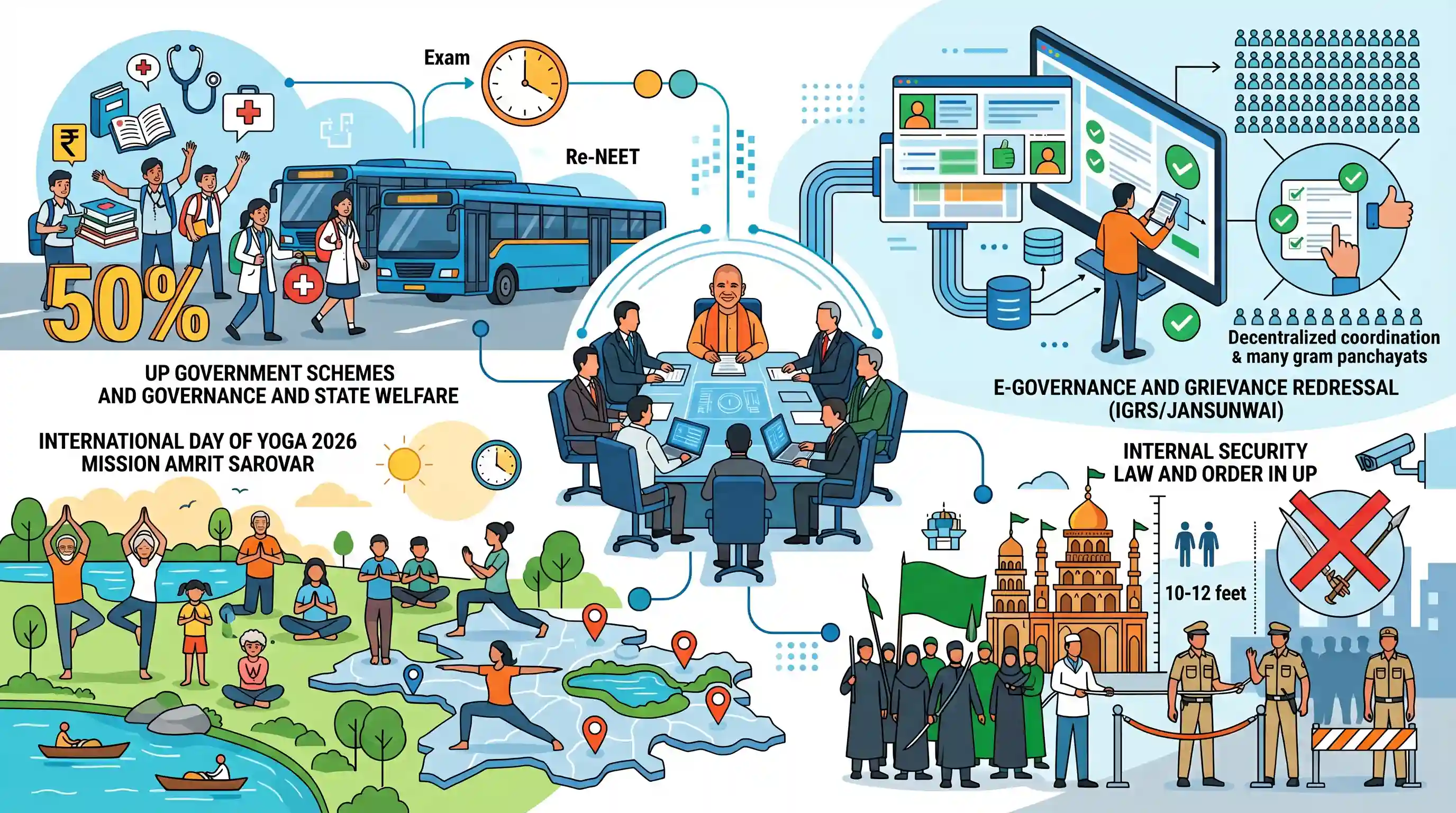
Uttar Pradesh Chief Minister Yogi Adityanath chaired a high-level review meeting addressing several critical administrative and socio-cultural agendas. Key directives include the announcement of a 50% fare discount on state-run UPSRTC buses for Re-NEET 2026 candidates, decentralized coordination across 58,000+ gram panchayats for the International Day of Yoga 2026 (themed 'Yoga for Healthy Ageing') with a focus on Amrit Sarovars, strict law-and-order parameters for Muharram processions (including a 10-12 feet height limit for Tazias and zero weapon displays), and a review of state public grievance redressal mechanisms under the IGRS (Jansunwai) portal.
Key Points
- UPSRTC Concession: UP CM Yogi Adityanath announced a 50% bus fare concession on state-run UPSRTC buses for the ~3.5 lakh Re-NEET 2026 candidates across 59 districts of the state, verifiable via their admit cards.
- International Day of Yoga 2026: Celebrated on June 21, the theme for 2026 is 'Yoga for Healthy Ageing'. In UP, celebrations will span over 58,000 gram panchayats and 762 urban local bodies (covering 14,000 wards), focusing on collective sessions at Amrit Sarovars, historical monuments, and cultural sites.
- State Cleanliness Drive: A special cleanliness drive will take place on June 20, 2026, coordinating the Urban Development, Rural Development, and Panchayati Raj departments with academic institutions.
- Muharram Security Guidelines: The CM mandated zero tolerance for weapon displays, prohibited new traditions, regulated high-volume DJs/sound systems, and capped the height of Tazias at 10 to 12 feet to prevent safety hazards.
- Grievance Redressal Review: The performance of the IGRS portal (Jansunwai), Chief Minister's Helpline, and Janata Darshan was reviewed, with strict warnings issued to low-performing districts regarding slow grievance disposal rates.
Important Terms
Integrated Grievance Redressal System (IGRS) / Jansunwai Portal

An online digital governance platform established by the Government of Uttar Pradesh to enable citizens to lodge, track, and receive timely, transparent resolutions to their complaints and grievances.
UPSC context
GS Paper 2 (Governance). Tests understanding of e-governance initiatives, citizen-centric administration, and grievance redressal mechanisms to enhance state accountability.
Mission Amrit Sarovar
A central water conservation initiative launched in April 2022 aiming to develop or rejuvenate at least 75 sustainable, community-driven water bodies (Amrit Sarovars) in each district across India.
UPSC context
GS Paper 2 (Government Schemes) and GS Paper 3 (Water Conservation). Tests understanding of local resources convergence, rainwater harvesting, and rural development.
National Testing Agency (NTA)
An autonomous, self-sustained testing organization under India's Ministry of Education, established in 2017 to conduct reliable, transparent, and international-standard entrance examinations for higher education admissions.
UPSC context
GS Paper 2 (Education/Governance). Tests knowledge of specialized testing bodies, administrative challenges, and structural reforms in high-stakes public examinations.
Provincial Armed Constabulary (PAC)
A specialized armed wing of the Uttar Pradesh Police, established in 1948 to handle severe breakdowns of law and order, riot control, VIP security, and counter-insurgency operations.
UPSC context
GS Paper 3 (Internal Security). Tests knowledge of the structure, role, and challenges of state armed police forces in maintaining public peace.
National Service Scheme (NSS)
A Central Sector public service program under the Ministry of Youth Affairs and Sports, launched in 1969 to develop student youth personality and civic responsibility through voluntary community service.
UPSC context
GS Paper 2 (Social Justice/Education) and GS Paper 1 (Social Empowerment). Tests awareness of national youth development schemes and youth mobilization in community welfare.
National Cadet Corps (NCC)
A tri-services youth organization in India comprising the Army, Navy, and Air Force, engaged in grooming students into disciplined and patriotic citizens with basic military and leadership training.
UPSC context
GS Paper 3 (Internal Security/Security Forces) & GS Paper 2 (Education). Tests knowledge of youth developmental bodies, leadership, and civilian volunteer auxiliaries.
Prelims Trap
Mission Amrit Sarovar is an exclusive initiative of the Ministry of Jal Shakti.
The Ministry of Rural Development is the main nodal ministry for Mission Amrit Sarovar, which operates through convergence with seven other ministries, rather than being exclusive to Jal Shakti.
Static Concepts Connected
What are the key targets and governance model of Mission Amrit Sarovar?
- Objective and target: Launched on April 24, 2022, to develop and rejuvenate 75 water bodies in every district of India as a sustainable water conservation measure.
- Technical specifications: Each Amrit Sarovar must have a minimum pond area of 1 acre with a water-holding capacity of about 10,000 cubic meters.
- Convergence model: Implemented through convergence of 8 ministries/departments, primarily driven by the Ministry of Rural Development.
What are the constitutional grounds for restricting Article 25 freedom of religion?
- Primary restrictions: Article 25(1) subjects the freedom of religion to public order, morality, and health, giving the state power to regulate practices accordingly.
- Secular regulation: Article 25(2) allows the State to regulate financial, economic, political, or other secular activities associated with religious practice.
- Judicial view: The judiciary holds that public safety, traffic management, and hazard prevention override preferences for specific public procession routes.
Cross-Topic Patterns
E-Governance & Civil Service Reforms
Linking grievance redressal portals (like UP's IGRS) to officers' Annual Confidential Reports (ACRs) turns passive digital portals into active tools for administrative accountability.
Public Order & Article 25 Restrictions
Standardizing safety protocols for religious processions (like Tazia height limits) shows how secular state authority regulates the physical dimensions of religious practices to ensure public safety.

Mains 2026 may analyze how integrating digital grievance portals with civil servant ACRs alters public service delivery dynamics.
Linked PYQs · 4
Linked PYQs · 4
- 2021UPPSC_PRELIMSGS1
‘The Clock is Ticking’ is the theme of which of the following days?
- 2023UPPSC_PRELIMSGS1
What is the theme of the International Day for the Eradication of Poverty for 2022-23?
- 2023UPPSC_PRELIMSGS1
Which of the following Scheme/Programme is not the Central Government Programme and it is Uttar Pradesh Government's Programme?
- 2022UPPSC_PRELIMSGS1
Which one of the following Watershed Development Projects sponsored by the Central Government of India which aims at enabling the rural population to conserve the water ?
