UP Rajeev Appointed Director of Vikram Sarabhai Space Centre
Source:The Hindu ↗
Why It Matters
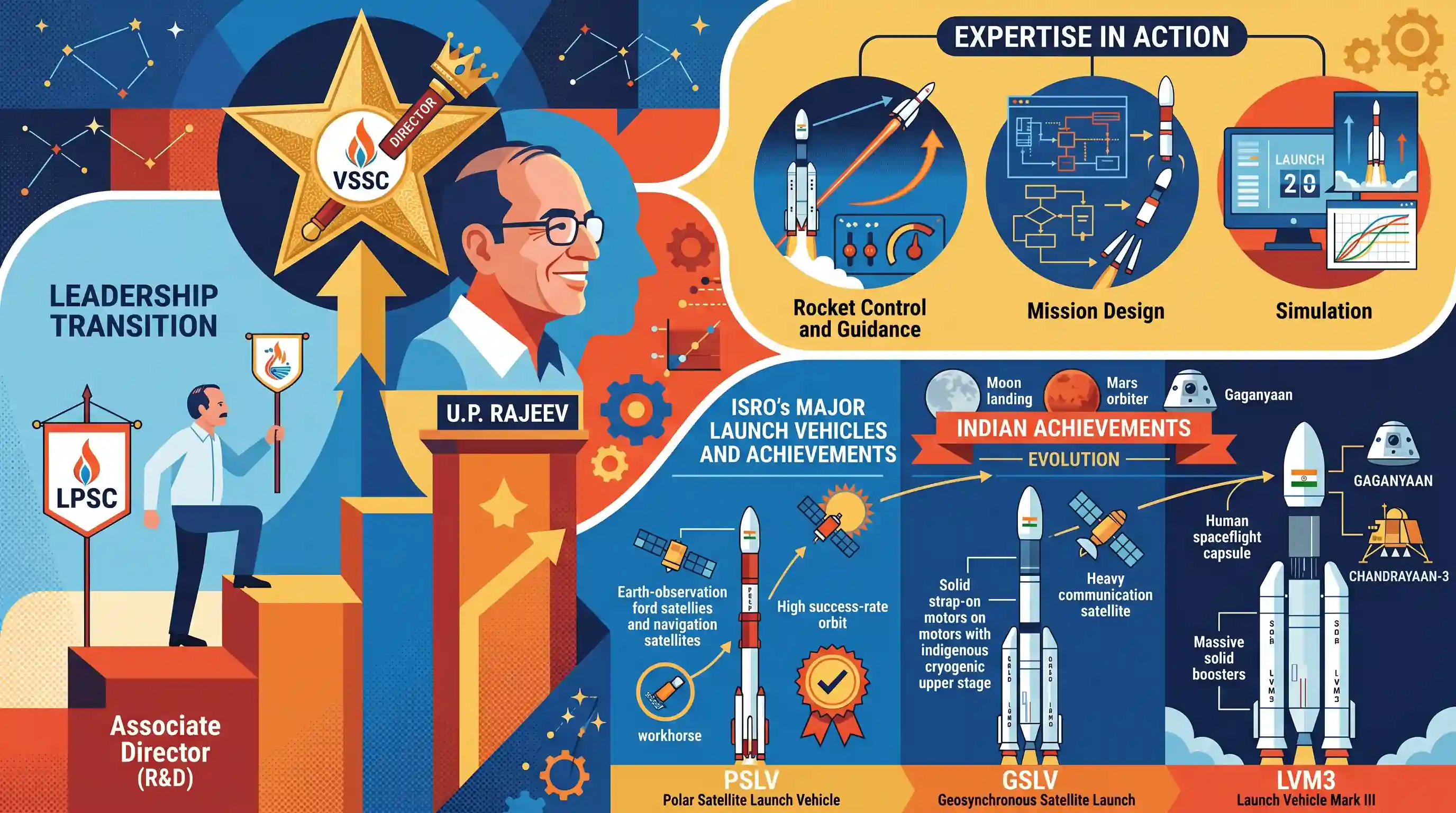
The Vikram Sarabhai Space Centre (VSSC) is ISRO's lead centre for the design and development of satellite launch vehicles. Changes in leadership and the background of its directors (such as expertise in rocket guidance and mission simulations) reflect India's strategic priorities in advancing its indigenous space capabilities, a recurring theme in the UPSC syllabus under Science & Technology.
Summary
U.P. Rajeev has been appointed as the new Director of the Indian Space Research Organisation's (ISRO) Vikram Sarabhai Space Centre (VSSC) in Thiruvananthapuram. An expert in rocket control and guidance with extensive experience in mission design and simulation for ISRO's major launch vehicles, Rajeev previously served as Associate Director (R&D) at VSSC. He succeeds Dr. S. Unnikrishnan Nair, who held the post concurrently with his directorship of the Liquid Propulsion Systems Centre.
Key Points
- U.P. Rajeev has been appointed as the new Director of the Vikram Sarabhai Space Centre (VSSC) in Thiruvananthapuram.
- He succeeds Dr. S. Unnikrishnan Nair, who had been holding the concurrent charge of VSSC in addition to his role as Director of the Liquid Propulsion Systems Centre.
- U.P. Rajeev has significant expertise in space launch vehicles, specifically in rocket control and guidance systems, mission design, and mission simulations.
- Prior to this appointment, he served as Associate Director (Research and Development) at VSSC and was the Project Director of the Advanced Technology Vehicle (ATV) sounding rocket project.
Important Terms
Vikram Sarabhai Space Centre (VSSC)

ISRO's lead facility for the design and development of launch vehicle technology, including the PSLV, GSLV, and experimental RLV-TD projects.
UPSC context
GS Paper 3: Science & Technology. Core institution for India's space launch capabilities and technical self-reliance.
Indian Space Research Organisation (ISRO)
The primary national space agency under India's Department of Space, mandated to harness space technology for national development and planetary exploration.
UPSC context
GS Paper 3: Science & Technology. Frequently tested in context of major missions and institutional structure.
Liquid Propulsion Systems Centre (LPSC)
An ISRO centre specializing in the development of liquid and cryogenic propulsion stages for launch vehicles and auxiliary systems for satellites.
UPSC context
GS Paper 3: Space Technology. Critical for understanding GSLV's cryogenic stages and Gaganyaan's propulsion requirements.
Advanced Technology Vehicle (ATV)
A modified Rohini-560 sounding rocket used as a testbed for India's air-breathing scramjet engine technology and hypersonic flight experiments.
UPSC context
GS Paper 3: Science & Technology. Tests knowledge of niche experimental technologies like scramjet engines and high-speed propulsion.
Scramjet Engine
An air-breathing engine that allows combustion to occur in a supersonic airflow, enabling highly efficient hypersonic flight for future reusable launch vehicles.
UPSC context
GS Paper 3: Space Technology. Key technical concept in ISRO's future-ready technology roadmap.
Prelims Trap
"VSSC is ISRO's primary facility for the design and fabrication of remote sensing and communication satellites."
A classic UPSC swap. VSSC develops *launch vehicles* (rockets like PSLV/LVM3). Satellites are actually designed and built by the U R Rao Satellite Centre (URSC) in Bengaluru.
Static Concepts Connected
What are the distinct primary functions of ISRO's major R&D facilities?
- VSSC (Thiruvananthapuram): Lead centre responsible for designing and developing satellite launch vehicle technology, including PSLV, GSLV, and LVM3.
- LPSC (Kerala/Bengaluru): Specialized facility for the design, development, and realization of liquid and cryogenic propulsion stages for rockets.
- URSC (Bengaluru): The primary centre for designing, manufacturing, assembling, and testing all Indian satellites.
- SDSC-SHAR (Sriharikota): The primary spaceport operating the launch pads from which ISRO's launch vehicles are launched into orbit.
What is the role of Sounding Rockets and Scramjet technology in ISRO's missions?
- Sounding Rockets: Sub-orbital solid propellant rockets used to probe the upper atmosphere and affordably test aerospace prototypes before orbital use.
- ATV Project: A heavy sounding rocket developed by ISRO that functioned as the booster for testing the Scramjet engine.
- Scramjet Engine: An air-breathing engine operating at supersonic combustion speeds (>Mach 5), using atmospheric oxygen to reduce onboard oxidizer weight.
Cross-Topic Patterns
Geography + Space: Thumba's Magnetic Equator
TERLS was established in Thiruvananthapuram because it sits directly under the Earth's magnetic equator, providing an ideal vantage point for studying the ionosphere and electrojets.
Space tech + Defence: Hypersonic crossover
Scramjet engine testing via ISRO's ATV sounding rocket shares foundational aerodynamic principles with DRDO's Hypersonic Technology Demonstrator Vehicle (HSTDV) project.

Expect a 'match-the-following' prelims question pairing ISRO R&D centres (VSSC, LPSC, URSC) with their core tech mandates.
Linked PYQs · 2
Linked PYQs · 2
- 2023MainsGS3
What is the main task of India's third moon mission which could not be achieved in its earlier mission? List the countries that have achieved this task. Introduce the subsystems in the spacecraft launched and explain the role of the Virtual Launch Control Centre' at the Vikram Sarabhai Space Centre which contributed to the successful launch from Sriharikota.
- 2016MainsGS3
Discuss India's achievements in the field of Space Science and Technology. How the application of this technology has helped India in its socio-economic development?
