Uttar Pradesh Heavy Rain Alerts and Administrative Action
Source:uniindia ↗
Why It Matters
Understanding monsoon dynamics (such as the Bay of Bengal branch's trajectory over Central India to UP) and regional classifications of Uttar Pradesh (Terai, Purvanchal, Western UP) is vital for UPPSC physical geography. Additionally, natural hazards like lightning strikes, flood alerts (Orange/Yellow), and the statutory institutional setup for disaster management (NDMA/SDMA under the Disaster Management Act, 2005) are highly tested conceptual areas.
Summary
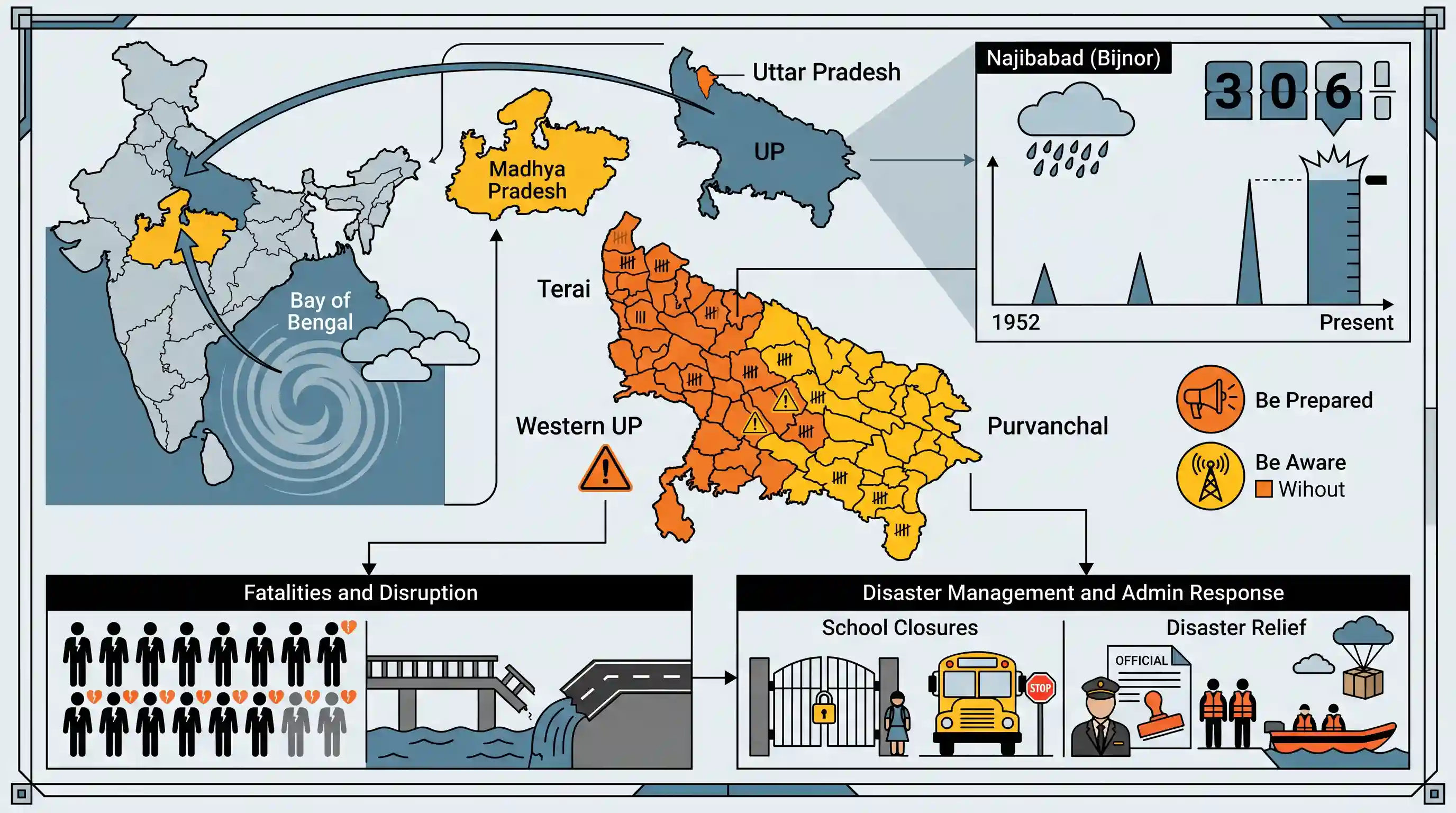
Monsoon rainfall has caused significant disruption and 16 fatalities in Uttar Pradesh. Najibabad (Bijnor) recorded its third-highest daily rainfall since 1952 at 306 mm. The Regional Meteorological Centre attributed the intense spell to a Bay of Bengal-origin weather system that moved over Madhya Pradesh. The IMD has issued 'Orange' and 'Yellow' alerts for 46 UP districts covering the Terai, Western UP, and Purvanchal regions, prompting school closures and administrative disaster relief orders.
Key Points
- Heavy monsoon rains in Uttar Pradesh have resulted in 16 deaths over 48 hours, primarily due to lightning strikes (notably in the Gorakhpur-Basti division) and electrocution.
- Najibabad in Bijnor district recorded 306 mm of rainfall in 24 hours, representing the third-highest precipitation event recorded in the area since 1952.
- The intense precipitation system originated from the Bay of Bengal, moved across areas around Madhya Pradesh, and extended its influence northward, thereby strengthening the monsoon over Uttar Pradesh.
- The India Meteorological Department (IMD) issued an 'Orange Alert' (extremely heavy rain warning) for 17 Terai districts (including Kushinagar, Maharajganj, Siddharthnagar, and Lakhimpur Kheri) and a 'Yellow Alert' (heavy rain warning) for 29 other districts across Western UP and Purvanchal.
- Chief Minister Yogi Adityanath directed state officials to inspect affected regions immediately and disburse financial compensation to victims of the rain-related disasters.
Important Terms
Disaster Management Act, 2005

A central legislation enacted to establish a legal and institutional framework for proactive disaster management, mitigation, capacity building, and coordinated emergency response at national, state, and district levels.
UPSC context
GS Paper III (Disaster Management); tests administrative frameworks, NDMA/SDMA structures, and transition from reactive relief to proactive mitigation.
India Meteorological Department (IMD)
The principal government agency under the Ministry of Earth Sciences responsible for meteorological observations, weather forecasting, warning dissemination, and seismological monitoring in India.
UPSC context
GS Paper I (Physical Geography) & GS III (Disaster Management); tests early warning systems, monsoon dynamics, and cyclone tracking.
Regional Meteorological Centre, Lucknow
A newly upgraded forecasting hub of the IMD (established in June 2026) that provides localized, impact-based weather forecasting, monitoring, and early-warning dissemination services for Uttar Pradesh and Uttarakhand.
UPSC context
GS Paper III (Disaster Management); tests localized weather monitoring infrastructure, early warnings, and regional climate resilience.
IMD Color-coded Weather Warnings
A standardized visual warning system utilizing four colors—Green (No Warning), Yellow (Be Aware), Orange (Be Prepared), and Red (Take Action)—to alert authorities and the public of impending hazardous weather events.
UPSC context
GS Paper III (Disaster Management); tests risk communication, public safety protocols, and standard operating procedures during extreme weather.
Terai Region
A lowland belt of fertile, swampy, and alluvial plains running parallel to the foothills of the outer Himalayas (Sivalik Hills) across northern India and southern Nepal, prone to monsoon flooding.
UPSC context
GS Paper I (Indian Physical Geography); tests geographical divisions, drainage systems, and natural hazard vulnerability in northern India.
Prelims Trap
Lightning is currently classified as a nationally notified disaster, allowing states to use unlimited SDRF funds for victim compensation.
Lightning is not a nationally notified disaster; states must currently fund compensation under the strict 10% cap for local state-specific disasters.
Static Concepts Connected
What are the key geomorphological distinctions between the Bhabar and Terai regions?
- Bhabar Zone: A narrow belt parallel to the Shivalik foothills dominated by coarse gravel and pebbles, where streams disappear due to high porosity.
- Terai Zone: A marshy, poorly drained belt south of Bhabar where underground streams re-emerge, characterized by clayey soils and rich biodiversity.
How is disaster funding structured under the Disaster Management Act, 2005?
- SDRF Contribution: Financed on a 75:25 sharing pattern between the Centre and general states (90:10 for Himalayan and NE states).
- The 10% Ceiling: States can spend a maximum of 10% of their annual SDRF allocation on local disasters not included in the central notified list.
Cross-Topic Patterns
Extreme Weather and Fiscal Federalism
Rising extreme weather frequency forces states to lobby the Finance Commission to lift the 10% SDRF cap on non-notified local disasters.
Monsoon Depressions and Kharif Risks
Northward-shifting Bay of Bengal depressions bring sudden, extreme precipitation to the Terai, triggering flash floods that devastate standing paddy nursery crops.

Expect questions combining the geomorphology of Terai/Bhabar zones with SDRF allocation rules for state-specific vs national disasters.
Linked PYQs · 3
Linked PYQs · 3
- 2021UPPSC_PRELIMSGS1
The National Disaster Management Division in India is the nodal division in the Ministry of Home Affairs for disaster management. Who is the Ex-officio Chairman of the National Disaster Management Authority?
- 2024UPPSC_PRELIMSGS1
Match List-I with List-II and choose the correct answer using the codes given below the lists. List-I (Famous Local Storm): (A) Mango shower (B) Blossom shower (C) Norwesters (D) Loo List-II (Place/Area): 1. Punjab to Bihar 2. Kerala 3. Karnataka Coastal Areas 4. West Bengal
- 2021UPPSC_PRELIMSGS1
Which one of the following causes is responsible for rainfall during winters in north-western part of India ?
