UP Police Constable Recruitment Exam Highlights Youth Unemployment
Source:The Hindu ↗
Why It Matters
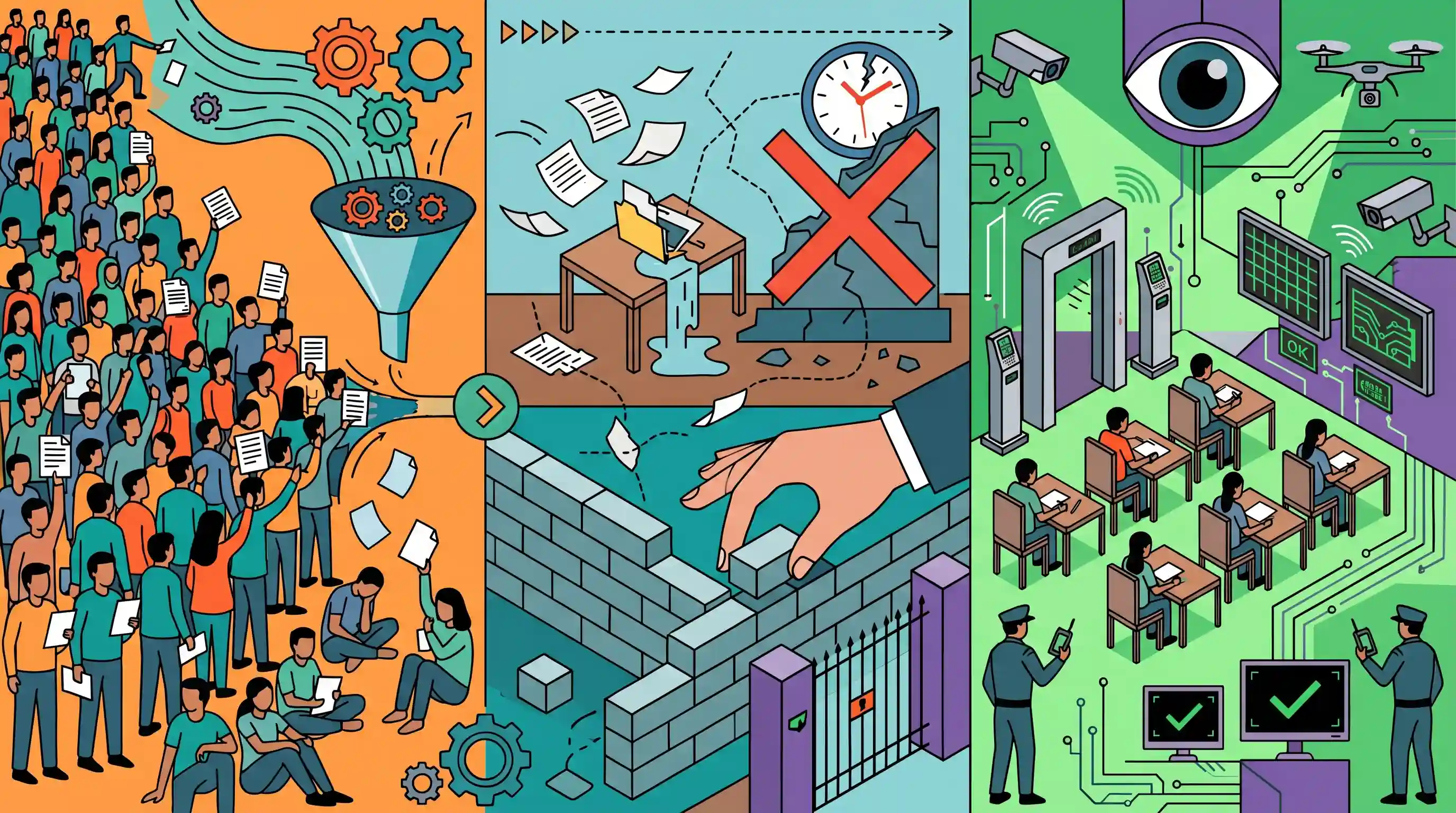
The massive candidate turnout highlights the socio-economic reality of youth underemployment in northern India and underscores the critical administrative challenge of safely executing mega-scale public examinations in the face of organized paper-leak syndicates.
Summary
The article details the immense logistical and human struggles surrounding the Uttar Pradesh Police Constable recruitment exam. Following the cancellation of the February 2024 exam due to paper leaks, the re-exam in August 2024 saw over 48 lakh candidates vying for 60,244 posts. It highlights the desperation of the state's youth who face severe underemployment and unemployment, prompting them to endure extreme physical hardships for a stable government job. To maintain the integrity of the process, the UP government deployed stringent digital surveillance measures and leveraged new anti-copying laws, highlighting the broader socio-economic challenges of tapping India's demographic dividend safely and productively.
Key Points
- The Uttar Pradesh Police Constable recruitment exam held in August 2024 was one of the largest public sector recruitment drives globally, with over 48 lakh applicants competing for 60,244 posts.
- The exam was a re-conducted exercise after the previous attempt in February 2024 was cancelled by the state government following massive public protests and evidence of paper leaks.
- Aspirants faced immense physical, financial, and logistical struggles, with hundreds of thousands traveling long distances, sleeping on railway platforms, and facing extreme congestion on public transport.
- The UP Government implemented unprecedented security measures, including biometric screening, iris scans, facial recognition, and surveillance by the UP Police Special Task Force (STF) to prevent paper leaks.
- The UP government utilized the newly introduced Uttar Pradesh Public Examinations (Prevention of Unfair Means) Ordinance, 2024, prescribing stringent penalties, including up to life imprisonment and ₹1 crore in fines, to deter cheating syndicates.
- The overwhelming candidate turnout underscores the severe gap between youth aspirations and available private-sector opportunities in Uttar Pradesh, illustrating the complex challenges of managing India's demographic dividend.
Important Terms
Uttar Pradesh Public Examinations (Prevention of Unfair Means) Ordinance, 2024

A state ordinance approved in June 2024 to curb paper leaks and cheating in UP, prescribing up to life imprisonment, ₹1 crore fines, property attachment, and recovery of exam expenses from perpetrators.
UPSC context
GS Paper II (Governance) & III (Employment); tests understanding of state-level legal measures tackling structural challenges in public recruitment.
Public Examinations (Prevention of Unfair Means) Act, 2024
A central law enacted in February 2024 and enforced in June 2024 to curb paper leaks, organized cheating, and malpractices in central public examinations, prescribing severe fines and imprisonment up to ten years.
UPSC context
GS Paper II (Polity & Governance); tests familiarity with national legislative measures addressing transparency, fairness, and systemic reforms in competitive exams.
Uttar Pradesh Police Recruitment and Promotion Board (UPPRPB)
The dedicated state-level board in Uttar Pradesh responsible for planning, organizing, and executing recruitment drives, examinations, and promotions of police personnel across civil and armed police cadres.
UPSC context
GS Paper II (Governance & Administration); tests knowledge of state-level recruitment agencies, organizational structures, and governance challenges in managing massive-scale exams.
Special Task Force (STF) of UP Police
An elite, specialized unit of the Uttar Pradesh Police formed in May 1998 to gather intelligence, combat organized crime syndicates, and investigate complex crimes like recruitment exam scams and paper leaks.
UPSC context
GS Paper III (Internal Security); tests understanding of state law enforcement agencies, security infrastructure, and tactical responses to organized criminal syndicates.
Uttar Pradesh State Road Transport Corporation (UPSRTC)
A state-owned public passenger transport corporation in Uttar Pradesh, established in 1972, providing extensive intra-state and inter-state bus services, including free transport for candidates during state recruitment exams.
UPSC context
GS Paper III (Infrastructure/Welfare Schemes); tests knowledge of state public utilities and welfare measures helping alleviate logistical burdens for job seekers.
Prelims Trap
The Public Examinations (Prevention of Unfair Means) Act, 2024 automatically applies to all state-level public service and police examinations.
The Central Act of 2024 applies only to central bodies (UPSC, SSC, NTA, etc.). States must pass their own laws to penalize leaks in state recruitment exams like State PSCs or state police.
Static Concepts Connected
How does the NSSO differentiate between Usual Status, CWS, and CDS in employment surveys?
- Usual Status (US): Measures chronic, long-term unemployment over a 365-day reference period; classifies individuals based on their principal activity for the majority of the year.
- Current Weekly Status: Measures weekly unemployment; classifies a person as employed if they worked for at least one hour on any day during the 7-day reference period.
- Current Daily Status: Tracks daily activity status over a 7-day recall period; the most comprehensive measure as it captures seasonal underemployment and daily fluctuations.
What defines India's demographic dividend and its differing age-group cohorts?
- Core Definition: Occurs when the working-age population share exceeds the dependent population share, offering a window of accelerated economic growth potential.
- Indian Planning Cohort: Classifies the productive working-age cohort strictly as ages 15 to 59 years in its demographic planning and policy frameworks.
- International Standard: Measures the working-age demographic bracket more broadly as ages 15 to 64 years.
Cross-Topic Patterns
Exam Integrity + Demographic Dividend
Repeated exam cancellations delay youth entry into formal employment, risking the conversion of India's demographic dividend into a socio-economic demographic liability.
Cooperative Federalism + Anti-Cheating Laws
While the Centre passed the Public Examinations Act 2024, states must enact parallel legislation to cover state-level recruitments like police and state PSCs.

PLFS employment metrics (CWS vs Usual Status) and the jurisdictional limits of central vs state anti-leak laws will be tested in 2026.
Linked PYQs · 3
Linked PYQs · 3
- 2022UPPSC_PRELIMSGS1
The demographic dividend is
- 2019UPPSC_PRELIMSGS1
The number of persons who remained unemployed for a major part of the year is called
- 2024UPPSC_PRELIMSGS1
Which of the following statements is true regarding the trend of unemployment rate in India between July-September, 2019 and July-September, 2022 ? 1. It remained the same. 2. It declined. Select the correct answer from the codes given below :
