UP plans PPP route to establish medical colleges in 16 districts
Source:hindustantimes ↗
Why It Matters
Important for UPPSC aspirants tracking state-level social sector policies, healthcare governance, and public-private partnership models in Uttar Pradesh.
Summary
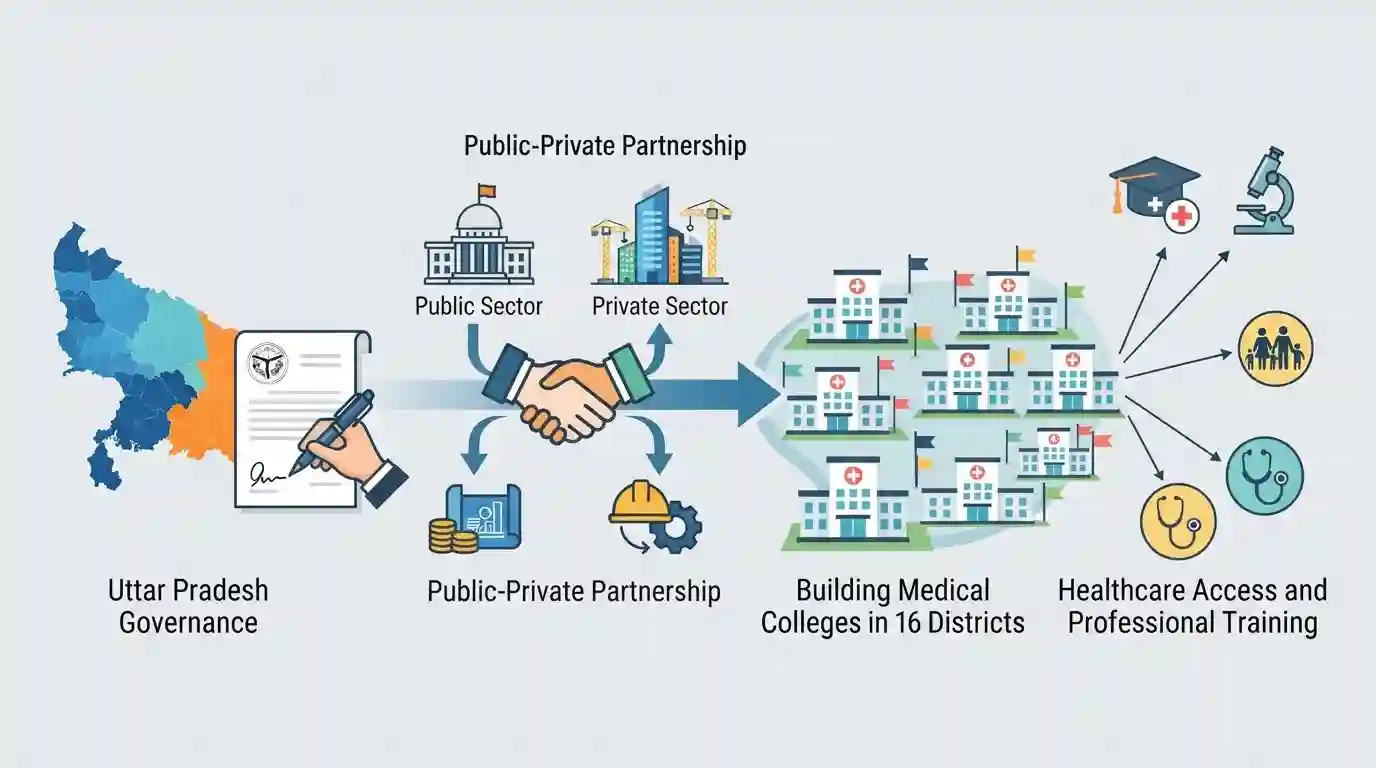
The Uttar Pradesh government has initiated plans to implement a Public-Private Partnership (PPP) model to build medical colleges in 16 districts that currently lack medical education infrastructure, boosting healthcare access and professional training across the state.
Key Points
- Uttar Pradesh government plans to use the Public-Private Partnership (PPP) route to establish medical colleges and fill medical education gaps across 16 uncovered districts.
- The initiative is aimed at expanding healthcare infrastructure, improving doctor-population ratios, and providing accessible medical education locally in backward or remote districts of the state.
- This policy push forms part of the state's broader strategy to enhance medical seats and healthcare delivery systems through private sector participation and investment.
Important Terms
Public-Private Partnership (PPP) Model

A collaborative model between government agencies and private sector entities to finance, build, and operate infrastructure projects, such as medical colleges in underserved districts, leveraging private efficiency and public resources.
UPSC context
Relevant for GS Paper II (Governance, Social Sector Policies) and GS Paper III (Infrastructure, PPP Models). Tests understanding of developmental financing and service delivery.
Uttar Pradesh Medical Education Policy
The state government's initiative to establish medical colleges in 16 unserved districts using private partners to expand medical education, specialist training, and healthcare access.
UPSC context
Important for UPPSC GS Paper V (State-specific governance, welfare schemes, and health infrastructure development in Uttar Pradesh).
Uttar Pradesh Government
The administrative machinery of Uttar Pradesh responsible for formulating state policies, budget allocation, and healthcare delivery across its districts.
UPSC context
Relevant for UPPSC GS Paper V and VI, examining executive decision-making, state governance, and implementation of public welfare programs.
Static Concepts Connected
What are the key models of Public-Private Partnership (PPP) in infrastructure development?
- Build-Operate-Transfer: BOT Model: Private partner builds, operates, and transfers the facility back to the government after a concession period.
- Design-Build-Operate: DBO Model: Government finances construction while private partner designs, builds, and operates the asset.
- Viability Gap Funding: VGF Scheme: Financial support provided by the government to make infrastructure projects economically viable.
Cross-Topic Patterns
PPP Health Infrastructure & Fiscal Federalism
UP's PPP medical college push intersects fiscal federalism and decentralized planning, balancing state capital outlays with private management efficiencies under Viability Gap Funding frameworks.
Doctor-Population Ratio & Regional Equity
Utilizing private sector investment in unserved districts directly supports the National Health Policy goal of achieving a 1:1000 doctor-population ratio.

UPPSC may combine UP's district-wise medical gap data with the central VGF scheme guidelines in a multi-statement question.
Linked PYQs · 1
Linked PYQs · 1
- 2022UPPSC_PRELIMSGS1
With reference to Budget of Uttar Pradesh for the Financial Year 2020 - 21, which of the following statement(s) is/are true ? 1. The size of the budget was Rs. 5,12,860.72 crores. 2. Certain new schemes were also included in this budget amounting to Rs. 10,967.87 crores. Select the correct answer from the code given below.
