Uttar Pradesh panchayat polls delayed for backward class reservation
Source:Indian Express ↗
Why It Matters
The article illustrates a direct conflict between two constitutional priorities: holding timely elections to Panchayati Raj Institutions (PRIs) as mandated by Article 243E, and ensuring adequate political representation for OBCs. It provides practical context on how state laws manage administrative vacuums in local bodies, which is highly relevant for GS2 questions on democratic decentralization and local governance challenges.
Summary
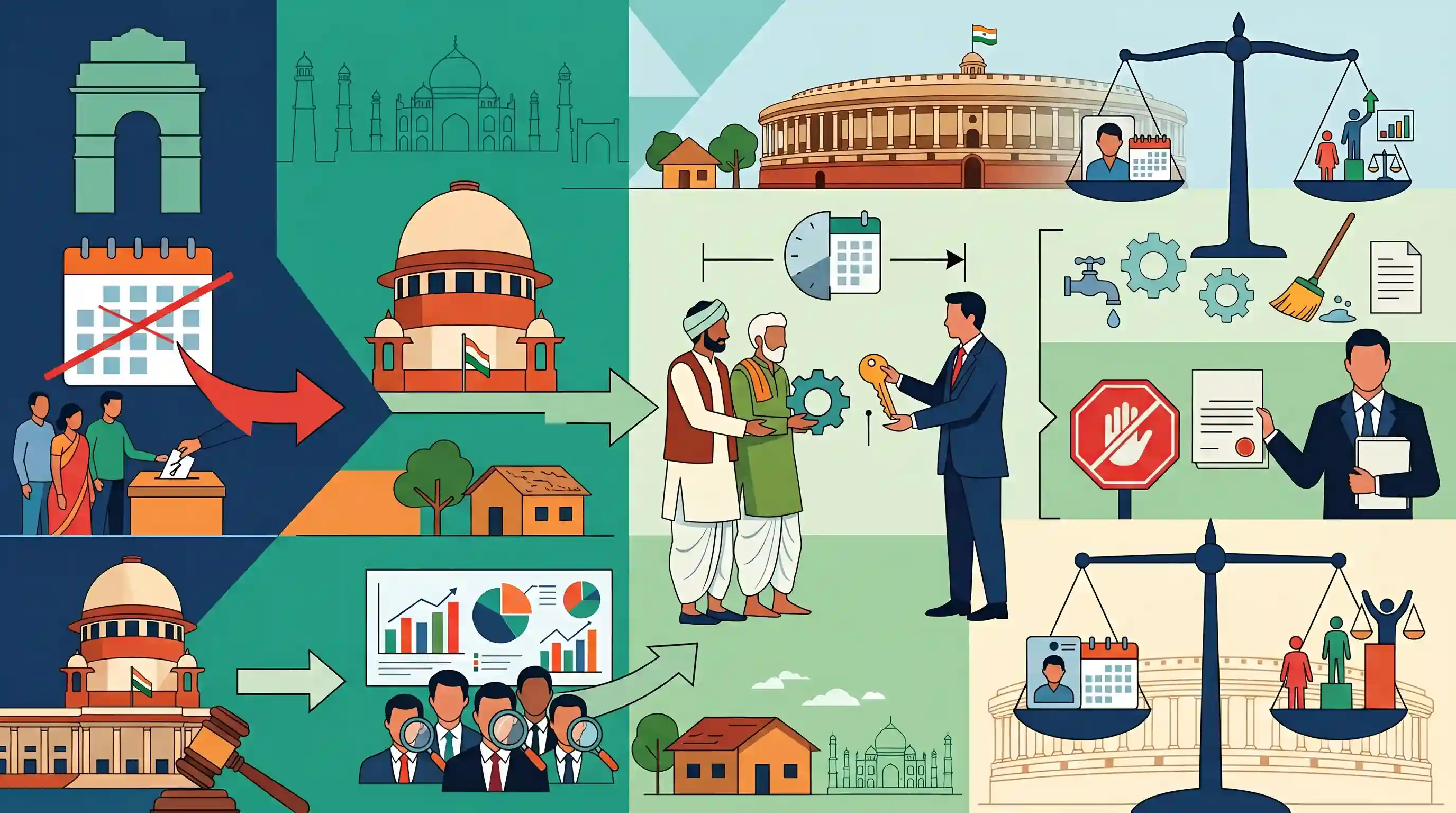
The Uttar Pradesh government has deferred gram panchayat elections, originally due before the expiration of the current panchayats' tenure on December 25, citing the ongoing process of determining OBC reservations. Following a Supreme Court mandate requiring a "triple test" for OBC quotas in local bodies, the state has constituted a five-member backward classes commission led by former High Court judge Ram Autar Singh to collect empirical data on political backwardness. To prevent a breakdown in local administration, the government has invoked the UP Panchayat Raj Act, 1947, appointing the outgoing gram pradhans as 'administrators' for up to six months. While these administrators can manage routine daily operations, they are restricted from making policy decisions without explicit approval from the District Magistrate. This development highlights critical governance challenges balancing the constitutional mandate for regular local elections (Article 243E) with the implementation of affirmative action policies.
Key Points
- Uttar Pradesh gram panchayat elections have been delayed to allow a dedicated commission to determine OBC reservations.
- A five-member backward classes commission, led by former High Court judge Ram Autar Singh, has a six-month deadline to submit its report.
- The delay stems from the need to comply with the Supreme Court's 'triple test' criteria for implementing OBC quotas in local bodies.
- Outgoing gram pradhans have been appointed as administrators (prashasaks) for up to six months to prevent an administrative vacuum.
- Administrators are authorized to manage routine operations but are barred from making policy decisions without prior approval from the District Magistrate.
- The administrative arrangement utilizes provisions of the UP Panchayat Raj Act, 1947, which allows alternative setups if elections cannot be held before the expiry of a panchayat's tenure.
Important Terms
73rd Constitutional Amendment Act, 1992

The 1992 legislation that granted constitutional status to rural local bodies, mandating a three-tier structure, direct elections, and reservations for SCs, STs, and women to ensure grassroots democracy.
UPSC context
GS2 (Local Governance/Polity). Fundamental for understanding the constitutional framework and devolution of powers to Panchayati Raj Institutions.
Triple Test
A Supreme Court-mandated three-step process for providing OBC quotas in local bodies: establishing a dedicated commission, collecting empirical data on political backwardness, and capping total reservations at 50%.
UPSC context
GS2 (Vulnerable Sections/Social Justice). Relevant for evaluating judicial guidelines on reservation and its implementation challenges in federal governance.
Article 243E
A constitutional provision mandating that every Panchayat continues for five years and that elections to constitute a new body must be completed before the expiry of this term.
UPSC context
GS2 (Polity). Essential for discussing the mandatory nature of local democracy and the legality of administrative extensions during poll delays.
State Election Commission (SEC)
An independent constitutional body established under Article 243K, responsible for the superintendence, direction, and control of electoral rolls and the conduct of all elections to Panchayats.
UPSC context
GS2 (Constitutional Bodies). Significant for questions regarding the independence and functions of local electoral management versus the Election Commission of India.
UP Panchayat Raj Act, 1947
State-specific legislation regulating the administration, powers, and duties of village-level local government in Uttar Pradesh, adapted to comply with constitutional mandates for rural self-governance.
UPSC context
GS2 (Governance/State Acts). Relevant for cases concerning how states operationalize local governance and the legal basis for appointing administrators.
Empirical Data
Quantifiable evidence gathered through rigorous study to substantiate political under-representation of a community, required by the judiciary to justify affirmative action in local body polls.
UPSC context
GS2 (Social Justice). Tests understanding of the "scientific" basis for reservation policies and the role of dedicated commissions in data-driven policy-making.
Prelims Trap
The Constitution allows extending a Panchayat's 5-year tenure by up to six months if local elections are delayed.
Article 243E strictly mandates a five-year term with no extension. To prevent a vacuum, states use statutory laws to appoint temporary 'administrators' for routine duties.
Static Concepts Connected
What is the Supreme Court's 'Triple Test' for OBC reservation in local bodies?
- Empirical Commission: States must set up a dedicated commission to collect empirical data on the nature and implications of political backwardness in local bodies.
- Proportional Allocation: The State must specify the proportion of reservations required local body-wise based on the commission's recommendations.
- 50% Ceiling: The total combined reservation for SCs, STs, and OBCs must not exceed 50% of the total seats.
How do reservation provisions in Panchayats differ under Article 243D?
- Mandatory Quotas: The Constitution mandates reservation of seats for SCs and STs (proportionate to population) and for women (at least one-third of total seats).
- Discretionary Quotas: Under Article 243D(6), providing reservations for Other Backward Classes (OBCs) is not mandated but left entirely to the discretion of the State Legislature.
Cross-Topic Patterns
Empirical data for affirmative action
The insistence on a dedicated commission mirrors recent SC judgments on SC/ST sub-categorization, enforcing the principle that affirmative action requires quantifiable data on backwardness.
Institutional dependence of SECs
While SECs are mandated to hold timely polls (Art 243K), state governments control delimitation and reservation quotas, frequently causing structural delays that undermine local self-governance.

Expect a 2026 Prelims multi-statement question contrasting mandatory SC/ST/Women quotas with discretionary OBC quotas and the Triple Test.
Linked PYQs · 3
Linked PYQs · 3
- 2024MainsGS2
Analyse the role of local bodies in providing good governance at local level and bring out the pros and cons merging the rural local bodies with the urban local bodies.
- 2011PrelimsGS1
The Constitution (Seventy-Third Amendment) Act, 1992, which aims at promoting the Panchayati Raj Institutions in the country, provides for which of the following? 1. Constitution of District Planning Committees. 2. State Election Commissions to conduct all panchayat elections. 3. Establishment of State Finance Commissions. Select the correct answer using the codes given below:
- 2015PrelimsGS1
The fundamental object of Panchayati Raj system is to ensure which among the following? 1. People's participation in development 2. Political accountability 3. Democratic decentralization 4. Financial mobilization Select the correct answer using the code given below.
