UP introduces ABC grading system for panchayat budget allocation
Source:indianmasterminds ↗
Why It Matters
This reform highlights a critical shift in state-level fiscal devolution, moving from uniform funding to equity-driven financial support for local bodies. It is highly relevant for UPPSC Prelims questions on state-specific governance, rural development schemes, and the functioning of Panchayati Raj institutions.
Summary
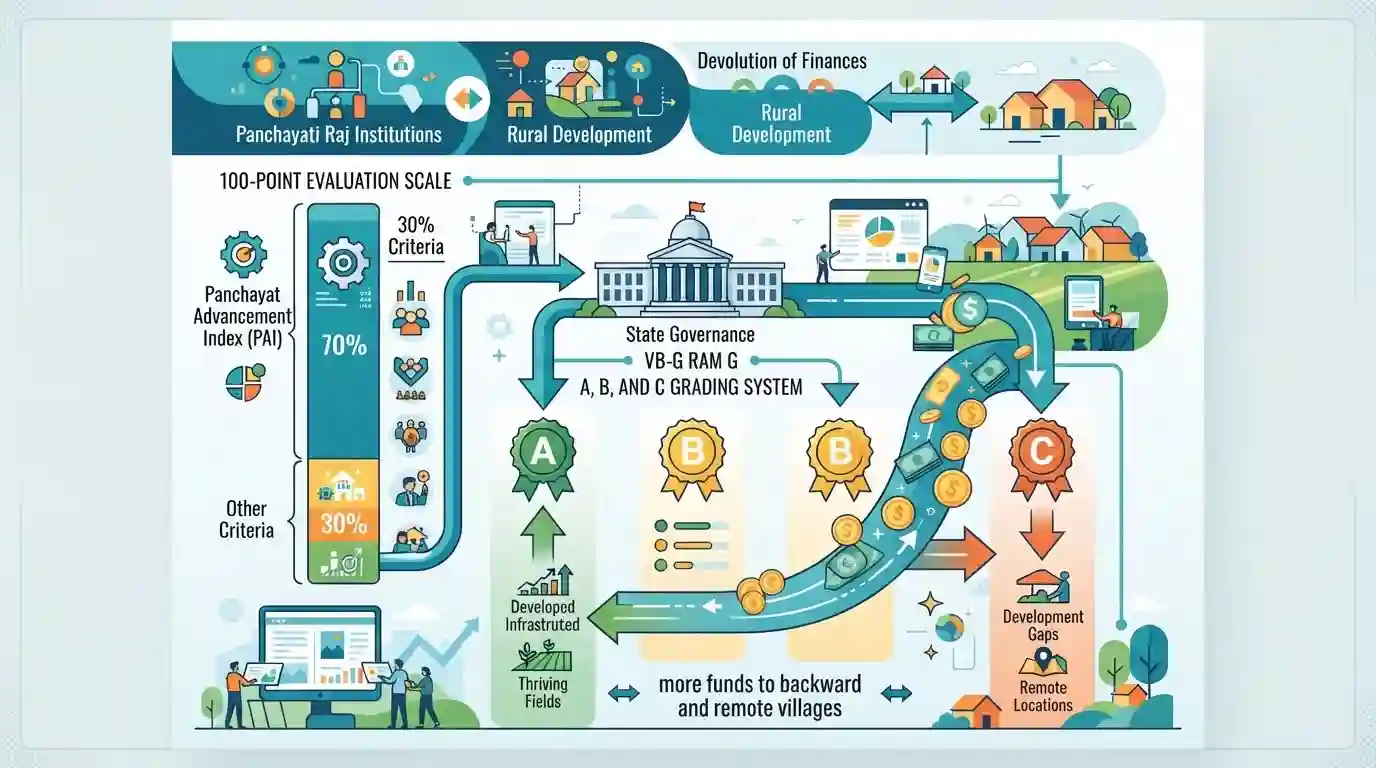
The Uttar Pradesh government has revamped its Gram Panchayat funding mechanism by introducing an A, B, and C grading system under the Viksit Bharat Guarantee for Rozgar and Aajeevika Mission (VB-G RAM G). Designed to bridge rural development gaps, the new system allocates more funds to backward and remote villages based on a 100-point evaluation scale, where the Panchayat Advancement Index (PAI) carries 70% weightage. This shift promotes equity-based fiscal devolution and data-driven grassroots governance in the state.
Key Points
- Uttar Pradesh has introduced an A, B, and C grading system for Gram Panchayats to determine their budget allocations.
- The funding mechanism operates under the newly formulated 'Viksit Bharat Guarantee for Rozgar and Aajeevika Mission' (VB-G RAM G).
- Budget allocations prioritize backward and remote villages, using a 100-point scale where lower development indicators result in higher financial support.
- The Panchayat Advancement Index (PAI) holds a 70% weightage in the funding formula, ensuring data-driven and targeted rural development.
Important Terms
Viksit Bharat Guarantee for Rozgar and Aajeevika Mission (VB-G RAM G)

A 2026 comprehensive rural development framework replacing MGNREGA. It enhances the statutory wage employment guarantee to 125 days per financial year while focusing on sustainable livelihood creation and durable rural assets.
UPSC context
UPPSC GS Paper 2 (Welfare Schemes) and GS Paper 5. Tests knowledge of major employment paradigm shifts in rural governance.
Panchayat Advancement Index (PAI)
A composite evaluation framework by the Panchayati Raj Ministry measuring Gram Panchayats\' progress on Localized Sustainable Development Goals. It carries 70% weightage in Uttar Pradesh\'s new funding allocation model.
UPSC context
UPPSC GS Paper 2 (Local Self Government) and Paper 5. Crucial for understanding data-driven decentralization and rural performance metrics.
A, B, C Grading System for Panchayats
Uttar Pradesh's new classification system evaluating Gram Panchayats based on PAI scores. It intentionally redirects higher financial allocations to backward and remote villages to bridge regional development gaps.
UPSC context
UPPSC GS Paper 5 (UP Governance). Tests awareness of specific structural reforms in UP's rural fiscal devolution and targeted development.
Equity-based Fiscal Devolution
The decentralized transfer of financial resources that explicitly prioritizes historically backward or geographically remote local bodies over developed ones, ensuring balanced regional growth and reducing inequality.
UPSC context
UPPSC GS Paper 2 (Devolution of Finances). Important for understanding progressive financial strategies used to empower lagging rural regions.
Data-driven Grassroots Governance
The administrative practice of utilizing objective metrics—such as evaluation indices and geographic distance—to formulate village-level policies, distribute state funds, and minimize political arbitrariness in local governance.
UPSC context
UPPSC GS Paper 2 (Governance & Accountability) and Paper 5. Reflects the modernization of local administrative machinery in Uttar Pradesh.
Prelims Trap
"Grade A or high-performing Panchayats receive the highest financial allocations under the new system."
The funding is inversely proportional to development status. The system prioritizes backward panchayats to bridge rural development gaps, rather than rewarding already prosperous ones.
Static Concepts Connected
What is the constitutional mechanism for financial devolution to Panchayats?
- State Finance Commission: Constituted by the Governor under Article 243-I every 5 years to review the financial position of Panchayats.
- Consolidated Fund Grants: The SFC recommends principles for grants-in-aid to Panchayats out of the State's Consolidated Fund.
- Central Finance Commission: Article 280(3)(bb) mandates the Central Finance Commission to recommend measures to augment the State Consolidated Fund for Panchayats.
How does the Constitution empower Panchayats to generate their own revenue?
- Article 243-H: Empowers the State Legislature by law to authorize Panchayats to levy, collect, and appropriate taxes, duties, tolls, and fees.
- State Discretion: Revenue generation powers are not absolute or self-executing; they depend entirely on specific legislation enacted by the State Legislature.
Cross-Topic Patterns
Aspirational Blocks Programme synergy
The PAI grading mirrors NITI Aayog's Aspirational Districts/Blocks methodology, shifting focus to data-driven upliftment of backward administrative units rather than uniform per-capita allocations.
Equity vs. Efficiency in Fiscal Federalism
While Central Finance Commissions increasingly use demographic performance and tax efforts (efficiency), this UP scheme heavily prioritizes equity (backwardness) for grassroots fiscal devolution.

Expect a multi-statement question pairing the VB-G RAM G scheme's inverse-funding logic with constitutional Articles 243-I and 243-H.
Linked PYQs · 3
Linked PYQs · 3
- 2023UPPSC_PRELIMSGS1
Which of the following statements is not true regarding 'Gram Sabha'?.
- 2019UPPSC_PRELIMSGS1
With reference to Panchayats which of the statements is/are correct? 1. Fifty percent seats shall be reserved for the women of SC/ST categories. 2. Gram Sabha is a body consisting of all persons living in the village. 3. There will be a Panchayat at intermediate level.
- 2024UPPSC_PRELIMSGS1
Which Amendment Acts deal with Local Governance Institutions in India ?
