Police State Debate and Rule of Law Concerns in Uttar Pradesh
Source:The Hindu ↗
Why It Matters
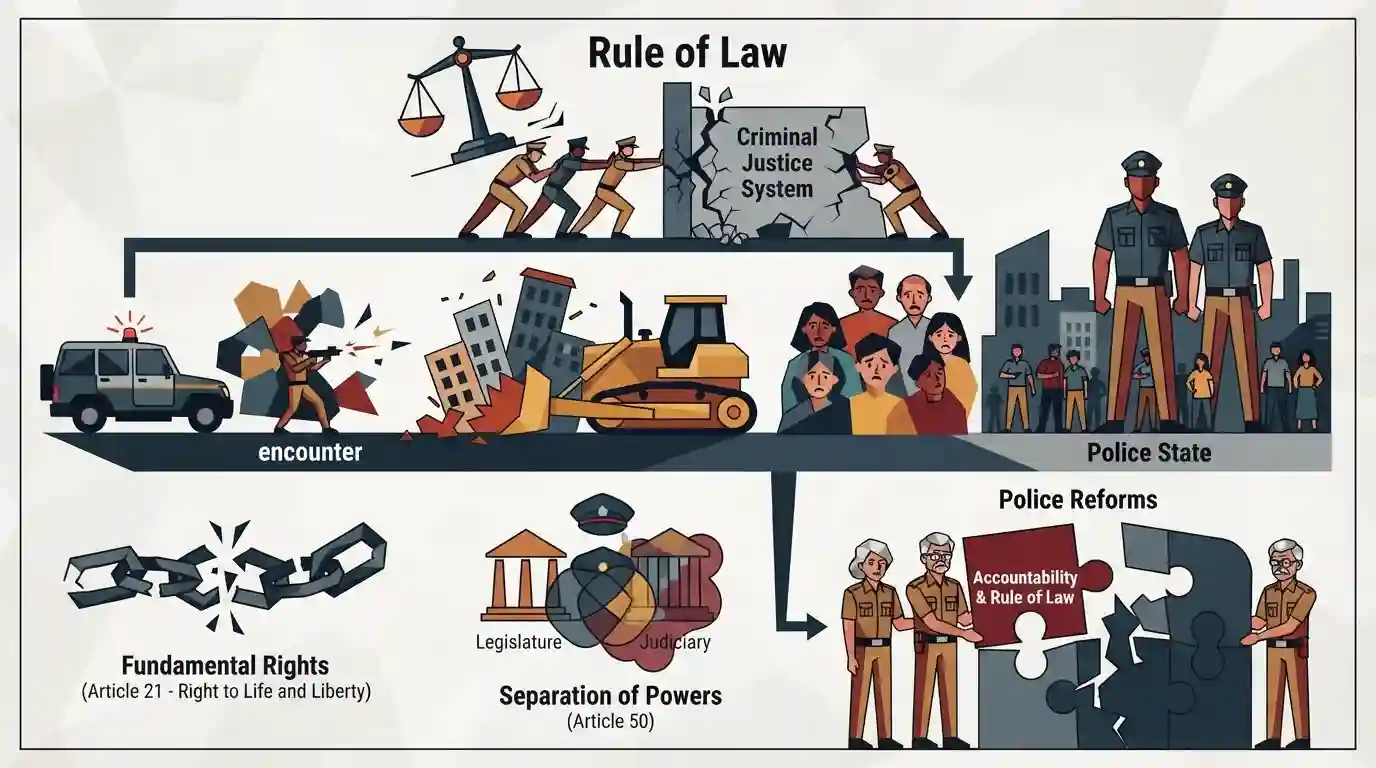
This debate touches upon core constitutional principles such as the Rule of Law, Article 21 (Right to Life and Personal Liberty), and the separation of judiciary from the executive (Article 50). These are critical concepts in UPPSC General Studies focusing on polity, governance, and human rights.
Summary
Retired Indian Police Service (IPS) officers, including former DGPs, have voiced serious concerns over the Uttar Pradesh government's reliance on extrajudicial methods like encounters and 'bulldozer justice.' They argue these practices are normalising violence, undermining the criminal justice system, and pushing the state toward a 'police state' by allowing the executive to assume judicial powers. Opposition leaders have also criticized these actions as indicators of an autocratic regime.
Key Points
- Former Uttar Pradesh Directors General of Police (DGPs) Vibhuti Narain Rai and Sulkhan Singh have criticized the state's security measures, warning that U.P. is turning into a 'police state.'
- The retired officers condemned the normalisation of violence through frequent police encounters and 'bulldozer justice', which bypass the formal criminal justice system.
- They highlighted that empowering the police to act as judges and executioners compromises the rule of law, constitutional due process (Article 21), and the separation of powers (Article 50).
- The political opposition, including Samajwadi Party leader Akhilesh Yadav, echoed these concerns, linking extrajudicial police actions to autocracy.
Important Terms
Article 21 of the Indian Constitution

A fundamental right under Part III of the Constitution guaranteeing that no person shall be deprived of their life or personal liberty except according to the procedure established by law.
UPSC context
Crucial for GS Paper 2 (Fundamental Rights). Tests the understanding of due process, civil liberties, and protection against arbitrary state action.
Article 50 of the Indian Constitution
A Directive Principle of State Policy (DPSP) that directs the State to take steps to separate the judiciary from the executive in the public services.
UPSC context
Core to GS Paper 2 (Separation of Powers). Tests knowledge of judicial independence and the constitutional boundaries preventing executive overreach.
Uttar Pradesh Police
The primary law enforcement agency of Uttar Pradesh, recently scrutinized by retired officers for its alleged reliance on extrajudicial methods and normalization of violence.
UPSC context
Relevant to GS Paper 2 (Governance) and GS 3 (Internal Security). Focuses on police reforms, rule of law, and state accountability.
Samajwadi Party
A major regional political party based in Uttar Pradesh with socialist ideological roots, frequently acting as the principal opposition to the ruling state government.
UPSC context
Relevant for GS Paper 2 (Political Parties). Tests the role of regional parties, democratic opposition, and state-level political dynamics.
Prelims Trap
The Indian Constitution explicitly guarantees "Due Process of Law" under Article 21 to prevent arbitrary extrajudicial state actions.
Article 21 explicitly uses the phrase "procedure established by law." While the Supreme Court later interpreted it to include "due process" (Maneka Gandhi case), the exact phrase is absent from the constitutional text.
Static Concepts Connected
What are the key directives of the Supreme Court in the Prakash Singh Case (2006)?
- State Security Commission: Constitute a commission to ensure the state government does not exercise unwarranted influence on the police.
- Fixed Tenure: Provide a minimum two-year tenure for the DGP and other key operational officers.
- Separation of duties: Separate the investigation function from the law-and-order function to ensure speedier and more expert probes.
- Complaints Authority: Establish authorities at the state and district levels to inquire into public complaints against police officers.
How do punitive demolitions ("bulldozer justice") intersect with Constitutional rights?
- Article 21: Violates the Right to Shelter, which the Supreme Court has implicitly protected under the Right to Life.
- Article 300A: Deprives individuals of the Right to Property without a valid, established authority of law.
- Natural Justice: Bypasses the principle of audi alteram partem (right to be heard) by lacking due notice and procedural fairness.
Cross-Topic Patterns
Urban Planning + Constitutional Law
Punitive demolitions are often justified using municipal anti-encroachment laws, bridging GS2 constitutional debates on arbitrary executive action with GS1/GS3 local urban governance and land-use regulations.
Internal Security + Human Rights
The normalisation of extrajudicial encounters directly connects GS3 internal security mandates (like combating organized crime) with GS2 human rights frameworks, NHRC guidelines, and judicial accountability.

Expect a 2026 Mains question linking the failure of police reforms (Prakash Singh case) to the rise of 'instant justice' and autocracy.
Linked PYQs · 2
Linked PYQs · 2
- 2017UPPSC_PRELIMSGS1
Which one of the following does not fall within the purview of Article 21 of the Constitution?
- 2021UPPSC_PRELIMSGS1
Which one of the following is NOT correctly matched? (Subject)
