Uttar Pradesh leads India in water conservation and Amrit Sarovars
Source:organiser ↗
Why It Matters
Water conservation, groundwater recharge, and rural development schemes are highly relevant for UPPSC Prelims. State-specific achievements like UP's leading position in the Amrit Sarovar initiative often feature in UP-specific factual and current affairs questions.
Summary
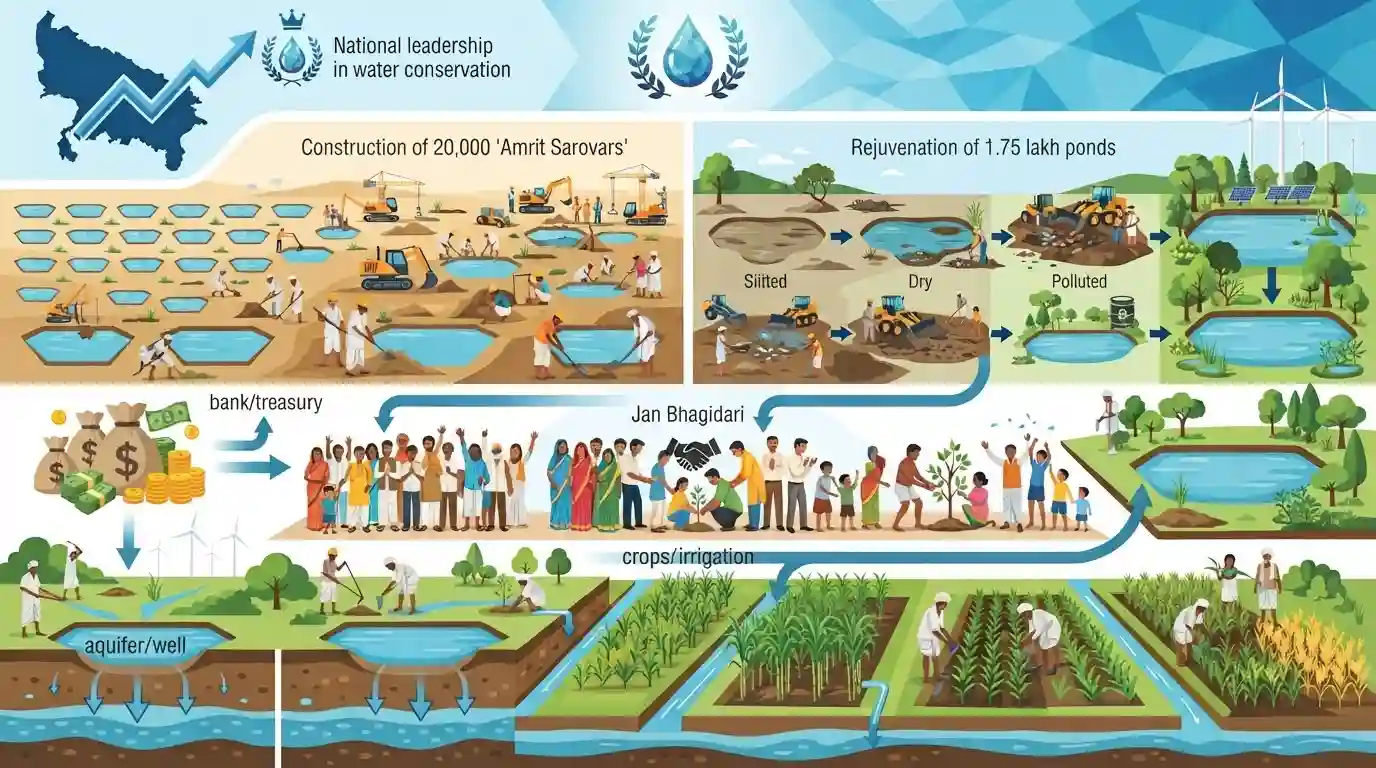
Uttar Pradesh has emerged as the national leader in water conservation by constructing 20,000 Amrit Sarovars and rejuvenating 1.75 lakh ponds over the past five years under the Yogi Adityanath government. Supported by investments exceeding Rs 16,000 crore and mass public participation, these initiatives have significantly improved groundwater recharge, irrigation, and rural employment. The integration of water security into rural development frameworks underscores the state's comprehensive approach to sustainable environmental management.
Key Points
- Uttar Pradesh has constructed a record 20,000 Amrit Sarovars, accounting for 27% of India's total, alongside reviving 1.75 lakh ponds in the last five years.
- The state ranks first in the country in water conservation, remaining three times ahead of the second-ranked state, Madhya Pradesh.
- Over Rs 16,000 crore has been invested in these water conservation and rejuvenation projects.
- These initiatives promote mass public participation and integrate rural development, directly benefiting groundwater recharge, irrigation, fisheries, and rural employment.
- Under the VB-GRAM-G framework, 107 out of 318 approved activities are directly aimed at water security, including check dams and rainwater harvesting.
Important Terms
Mission Amrit Sarovar

A national water conservation mission launched in 2022 to develop and rejuvenate at least 75 water bodies (ponds) in every district across India, aiming for surface and groundwater sustainability.
UPSC context
Relevant for GS Paper 3 (Environment/Water Resources). Tests understanding of government interventions for water conservation and rural ecological security.
VB-GRAM-G Framework
The Viksit Bharat–Guarantee for Rozgar and Ajeevika Mission (Gramin) is a rural development and employment framework that focuses on asset creation (like water security infrastructure) over simple wage-centric employment.
UPSC context
Crucial for GS Paper 2 (Governance/Welfare) and GS 3 (Economy). Tests the shift from demand-driven to supply-driven rural welfare.
Prelims Trap
Mission Amrit Sarovar is a central sector scheme with its own dedicated budgetary allocation.
It operates through the convergence of existing schemes (MGNREGS, 15th Finance Commission grants, and PMKSY) rather than having its own separate budgetary allocation.
Static Concepts Connected
What are the specific technical criteria for ponds under Mission Amrit Sarovar?
- District Target: Each district must develop or rejuvenate a minimum of 75 ponds.
- Minimum Area: Every constructed or rejuvenated pond must have a minimum area of 1 acre.
- Holding Capacity: The water body must possess a holding capacity of at least 10,000 cubic meters.
- Convergence Funding: Execution relies on existing schemes like MGNREGS, PMKSY, and Finance Commission grants instead of new funds.
What are the main methods of artificial groundwater recharge used in local watersheds?
- Surface Spreading: Involves check dams, percolation tanks, and recharge basins that allow water to slowly seep into the aquifer from the surface.
- Subsurface Techniques: Uses recharge pits, shafts, and injection wells to bypass impermeable upper layers and send water directly into deeper aquifers.
- Induced Recharge: Involves pumping groundwater near a surface water body to artificially lower the water table, drawing surface water into the aquifer.
Cross-Topic Patterns
Rural employment shift to eco-assets
The evolution of rural employment frameworks (like VB-GRAM-G/MGNREGS) increasingly prioritizes the creation of durable ecological assets, directly linking poverty alleviation to climate change adaptation.
Decentralized water governance and 73rd CAA
Amrit Sarovars rely heavily on 15th Finance Commission grants and local execution, showcasing how decentralized planning under the 73rd Amendment is critical for achieving national water security goals.

Expect a multi-statement prelims question combining Mission Amrit Sarovar's technical criteria (1 acre/10k cu.m) with convergence funding.
Linked PYQs · 5
Linked PYQs · 5
- 2022UPPSC_PRELIMSGS1
Which one of the following Watershed Development Projects sponsored by the Central Government of India which aims at enabling the rural population to conserve the water ?
- 2023UPPSC_PRELIMSGS1
A geographical unit that collects, stores and release water is called -
- 2025UPPSC_PRELIMSGS1
Which of the following prepared the Annual Groundwater Quality Report 2024 ? 1. Central Pollution Control Board 2. Central Water Commission 3. Central Groundwater Board Select the correct answer from the code given below :
- 2015UPPSC_PRELIMSGS1
National Rural Drinking Water Programme is one of the components of
- 2023UPPSC_PRELIMSGS1
Natural resources should be used by the present generation in such a way that if there is minimum degradation of natural resources, then what kind of development would it be called?
