Uttar Pradesh Enforces Homestay Policy with Mandatory Registration
Source:plotlandguide ↗
Why It Matters
This policy represents a key state-level intervention targeting rural micro-entrepreneurship, tourism infrastructure, and standardizing alternative accommodations ahead of mega spiritual tourism events in Uttar Pradesh. Such policy metrics (fees, capacities, administrative heads) are highly testable in UPPSC PCS Prelims.
Summary
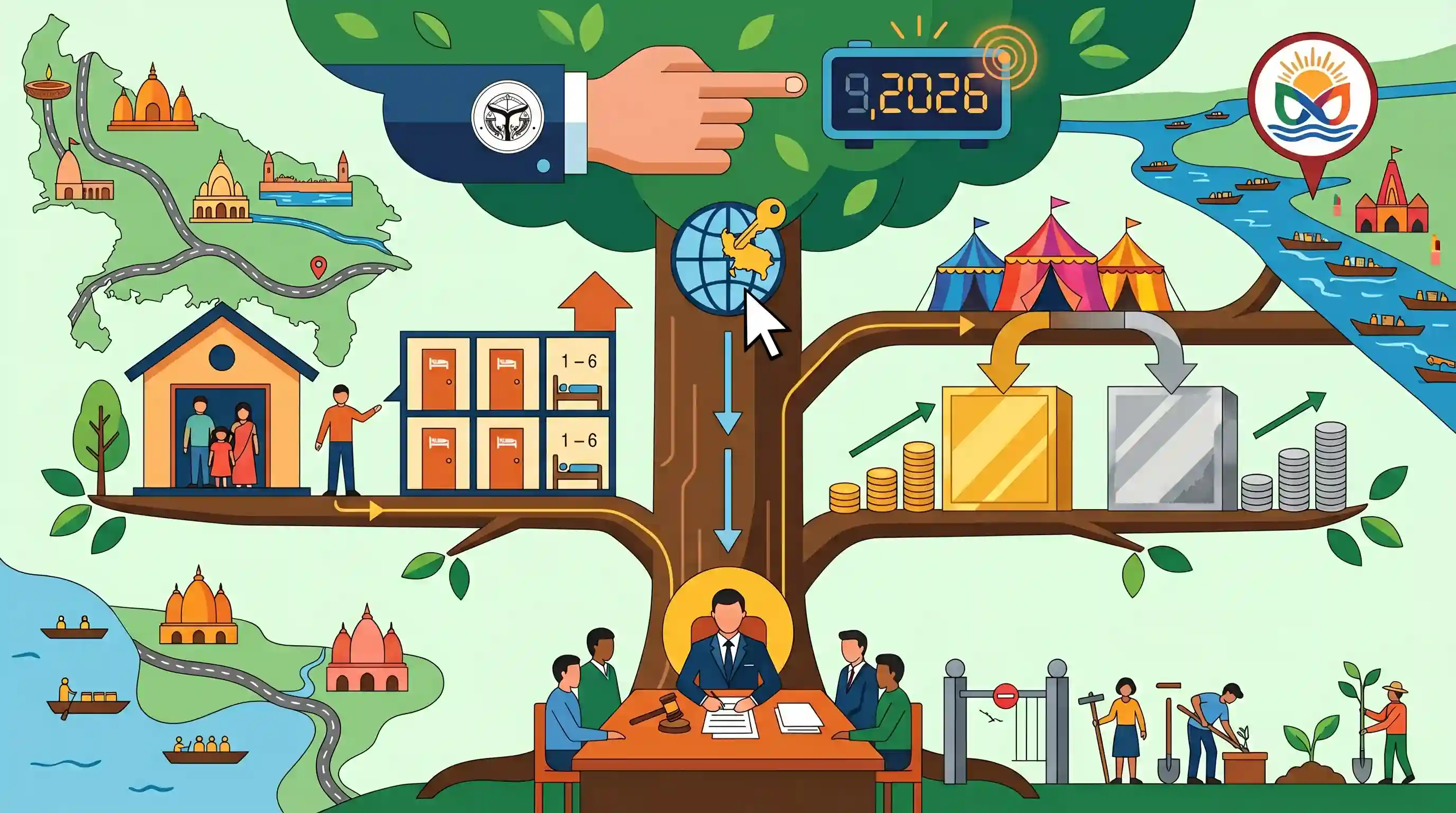
The Uttar Pradesh government has enforced the Bed and Breakfast (BnB) and Homestay Policy 2025, requiring all operators of home-based tourist accommodations to register on the state tourism portal by June 9, 2026. Designed to boost community-driven and rural tourism while offering standard accommodations ahead of major events like Mahakumbh, the policy strictly allows owner-occupied residences with 1 to 6 rooms (max 12 beds) to register. Units are categorized into Gold and Silver with varied fee structures, and overseen by a DM-led district committee. The policy aims to foster micro-entrepreneurship and regulate the emerging homestay sector near major religious and cultural centers.
Key Points
- The Government of Uttar Pradesh has implemented the Bed and Breakfast (BnB) and Homestay Policy 2025, which makes registration mandatory for all existing and new homestay operators by June 9, 2026.
- The policy differentiates between BnB Units (primarily urban and semi-urban settings) and Homestay Units (rural and semi-rural settings, especially near temples, ghats, and historical monuments).
- Eligibility criteria restrict registration to authentic homeowners (commercial hotels/guest houses are excluded); units must have between 1 to 6 rooms with a maximum capacity of 12 beds, the owner must live on the premises, and no more than two-thirds of the property can be utilized for guests.
- A maximum cap of 7 consecutive days is imposed on tourist stays, though this is renewable. Units are classified into Gold and Silver categories based on standard of facilities.
- District-level committees headed by the respective District Magistrate (DM), with the Superintendent of Police (SP) as a member, are tasked with oversight, verification, and compliance of the units.
- Registration fees are structured as follows: Rural Homestay (Silver) is Rs 500, Rural Homestay (Gold) is Rs 750, Urban BnB/Homestay (Silver) is Rs 2,000, and Urban BnB/Homestay (Gold) is Rs 3,000.
- Financial incentives include up to Rs 1 lakh for participating in domestic tourism fairs and up to Rs 3 lakh for attending international travel exhibitions.
- Ayodhya Dham leads in approved units with 19 homestays, followed by Siddharthnagar, Maharajganj, Kushinagar, and Gorakhpur with 17 each, while 229 rural locations have been prioritized for homestay development.
Important Terms
Uttar Pradesh Bed and Breakfast (BnB) and Homestay Policy 2025

A state policy mandating registration for local BnBs and homestays by June 9, 2026. It formalizes informal accommodations, offering residential tax rates and training to boost regional tourism infrastructure.
UPSC context
GS Paper II: Government Policies and Interventions. Tests understanding of regional tourism, regulatory compliance, and community-driven economic development.
District Tourism and Cultural Promotion Council (DTCPC)
A district-level administrative body in Uttar Pradesh, headed by the District Magistrate, tasked with identifying local tourist spots, resolving registrations, and implementing tourism development plans.
UPSC context
GS Paper II: Local Governance and Statutory Bodies. Tests administrative mechanisms for decentralized tourism planning and investment facilitation.
Uttar Pradesh Tourism Department
The state agency responsible for promoting regional tourism, drafting heritage and eco-tourism policies, and developing hospitality infrastructure near major cultural and religious centers in Uttar Pradesh.
UPSC context
GS Paper III: Indian Economy and Infrastructure. Tests awareness of state agencies managing tourism-led economic growth and regional planning.
NIDHI+ Portal
The National Integrated Database of Hospitality Industry, an upgraded digital portal of the Union Ministry of Tourism designed for registration and ease of doing business for hospitality units.
UPSC context
GS Paper II: E-governance and E-services. Tests understanding of digital databases designed to formalize and promote the service sector.
Homestay Tourism
An experiential, sustainable tourism model where visitors stay with local hosts in residential properties, fostering rural entrepreneurship, cultural exchange, and community-driven economic growth.
UPSC context
GS Paper III: Inclusive Growth and Sustainable Development. Tests conceptual knowledge of rural employment generation and decentralized economic models.
Prelims Trap
Homestays registered under the central NIDHI+ portal or those operated via leased/rented properties are automatically exempt/eligible under UP's policy.
The 2025 policy strictly mandates state-portal registration by June 2026, excluding rented properties and requiring physical residency of the actual homeowner on the premises.
Static Concepts Connected
What is Community-Based Tourism (CBT) and its core objectives?
- Local Ownership: Tourism managed and owned by local communities to ensure economic benefits remain within the region.
- Cultural Preservation: Protects local heritage and traditions by promoting them sustainably without loss of cultural authenticity.
- Economic Diversification: Creates supplementary income streams for rural households, reducing seasonal agricultural dependency and urban migration.
How does the Indian Constitution distribute powers regarding tourism regulation?
- State Competence: Tourism is not explicitly listed in the Seventh Schedule; states legislate using entries like sanitation, land, or theater.
- Union Role: The Union coordinates international promotion and national strategy formulation under its executive powers (Article 73).
Cross-Topic Patterns
Decentralized infrastructure vs carrying capacity
Homestays act as temporary capacity buffers during massive religious congregations like Mahakumbh, preventing permanent ecological and concrete over-construction in fragile riverine zones.
Rural tourism as MSME engine
By formalizing home-sharing, state policies convert domestic real estate into micro-enterprises, directly aligning rural service sectors with MSME-led credit schemes.

State-level homestay policies and DM-led regulatory committees will likely be framed under rural MSME and local economic resilience in GS3.
Linked PYQs · 3
Linked PYQs · 3
- 2021UPPSC_PRELIMSGS1
'Uttar Pradesh Swami Vivekanand Etihasik Paryatan Yatra Yojna 2021' was introduced by the U.P. Government for which of the following people for religious travel ?
- 2023UPPSC_PRELIMSGS1
Which of the following scheme/s is/are related to Uttar Pradesh? (1) Anuthee Uphar Scheme (2) Matra Shakti Udyamita Scheme (3) Kaushalya Matritva Scheme (4) Stree Nidhi Scheme Select the 'correct' answer using the code given below -
- 2021UPPSC_PRELIMSGS1
Which of the following Schemes in Uttar Pradesh were introduced in Budget of 2021-22? I. Atmanirbhar Krishak Samanvit Vikas Yojna II. Mukhya Mantri Saksham Suposhan Yojna III. Mukhya Mantri Pravasi Shramik Udyamita Vikas Yojna IV. Yuva Udyamita Vikas Abhiyan Select the correct answer from the codes given below.
