Uttar Pradesh Sets Up Shakti Sadan Shelters for Women in Distress
Source:Indian Express ↗
Why It Matters
This article provides a concrete example of state-level implementation of 'Mission Shakti' and its 'Samarthya' sub-scheme. It is useful for GS1 (Women's Issues) and GS2 (Welfare Schemes, Vulnerable Sections) mains answers to illustrate institutional rehabilitation mechanisms for women in distress.
Summary
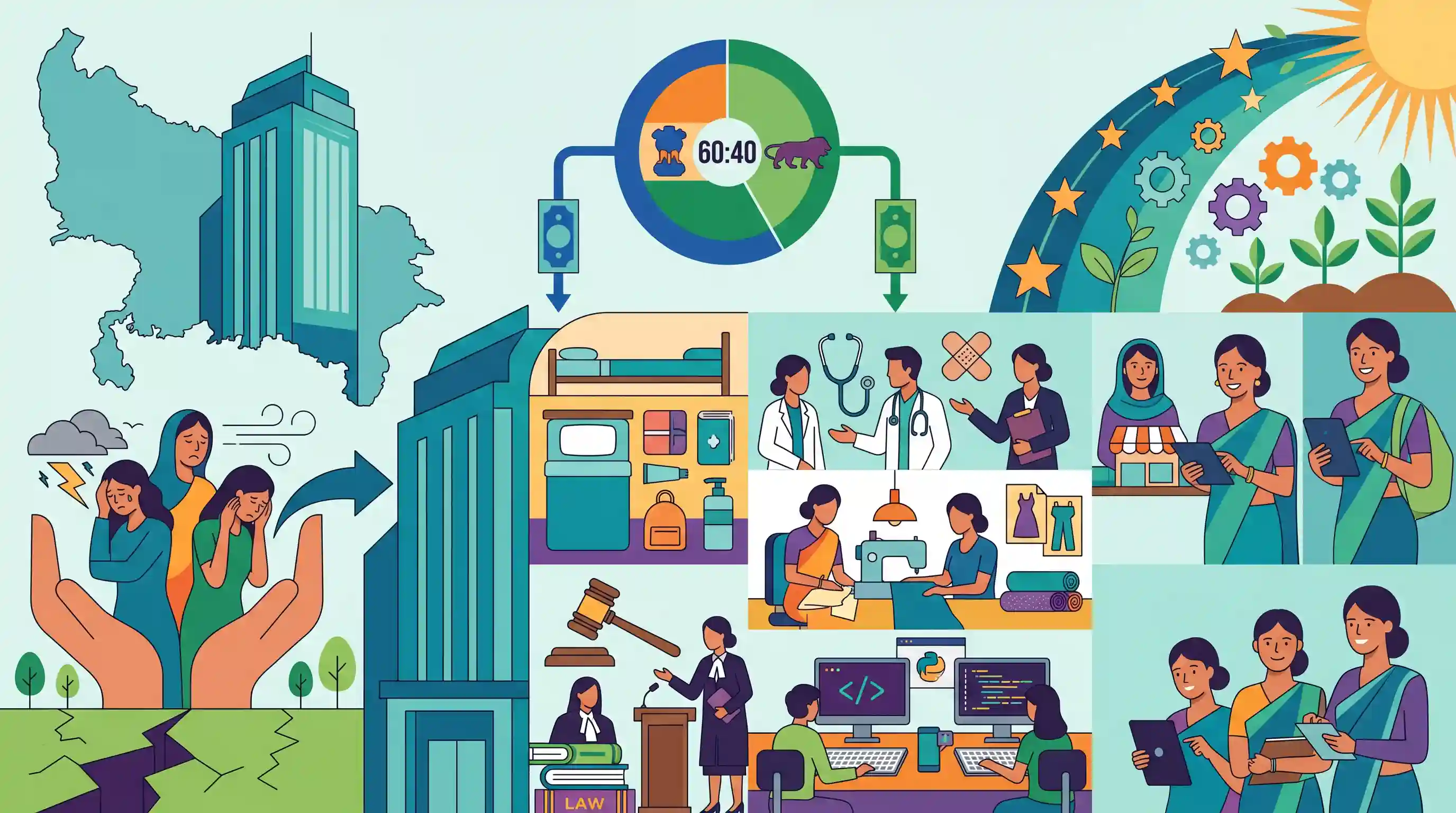
The Uttar Pradesh government is operationalizing 'Shakti Sadan' shelter homes in 10 districts to support women in distress, including victims of domestic violence and natural disasters. Established under the 'Samarthya' sub-scheme of the Centre's 'Mission Shakti', the project is funded in a 60:40 ratio by the Central and State governments. These facilities will offer safe accommodation, necessities, legal and medical aid, and vocational training (e.g., sewing, computer literacy) to help women become self-reliant.
Key Points
- The Uttar Pradesh government is establishing shelter homes called 'Shakti Sadan' in 10 districts for women in distress, including victims of domestic violence and trafficking.
- The initiative is implemented under the 'Samarthya' sub-scheme of the central government's 'Mission Shakti' programme.
- Funding is shared between the Centre and the State in a 60:40 ratio, with an approved budget of Rs 127.72 lakh.
- The shelters will provide free accommodation, food, legal and medical support, along with vocational training in skills like sewing, computer literacy, and beauty parlor work to foster self-reliance.
Important Terms
Mission Shakti

An umbrella scheme for the safety, security, and empowerment of women (2021-2026), focusing on a life-cycle continuum approach to achieve women-led development.
UPSC context
GS Paper II: Government Policies/Interventions; crucial for questions on social justice and women-centric welfare architecture.
Samarthya sub-scheme
The empowerment-focused sub-scheme of Mission Shakti, including components like Shakti Sadan, Sakhi Niwas (working women hostels), and Pradhan Mantri Matru Vandana Yojana (PMMVY).
UPSC context
GS Paper II: Welfare schemes for vulnerable sections; tests knowledge of specific sub-components and their distinct objectives.
Shakti Sadan
An integrated relief and rehabilitation facility formed by merging the Swadhar Greh and Ujjawala schemes to provide shelter, legal aid, and vocational training to women in distress.
UPSC context
GS Paper II: Social Justice; relevant for institutional mechanisms supporting victims of trafficking and domestic violence.
Sambal sub-scheme
The safety and security sub-scheme of Mission Shakti, encompassing One Stop Centres (OSC), Women Helplines (181), and the Beti Bachao Beti Padhao initiative.
UPSC context
GS Paper II: Mechanisms for protection of women; complements Samarthya in the dual-pillar structure of Mission Shakti.
Centrally Sponsored Scheme (CSS)
Schemes implemented by state governments but largely funded by the Centre with a defined cost-sharing ratio (e.g., 60:40 for general category states).
UPSC context
GS Paper II & III: Federalism and Budgeting; tests understanding of fiscal relations and administrative implementation between Centre and States.
Prelims Trap
Shakti Sadan falls under the Sambal pillar and is a 100% centrally funded scheme.
It falls under the 'Samarthya' (empowerment) pillar, not 'Sambal' (safety). Additionally, it is a Centrally Sponsored Scheme (60:40 ratio), not a Central Sector Scheme.
Static Concepts Connected
What are the two primary pillars of the Mission Shakti scheme?
- Sambal (Safety): Focuses on safety and security. It includes One Stop Centres (OSC), Women Helplines, Beti Bachao Beti Padhao, and Nari Adalats.
- Samarthya (Empowerment): Focuses on women's empowerment. It includes Shakti Sadan, Sakhi Niwas (Working Women Hostels), Palna (National Creche Scheme), and Pradhan Mantri Matru Vandana Yojana (PMMVY).
How do Central Sector Schemes differ from Centrally Sponsored Schemes (CSS)?
- Central Sector: Fully (100%) funded by the Union Government and implemented directly by central government machinery.
- Centrally Sponsored (CSS): Funding is shared between the Centre and States (e.g., 60:40 or 90:10). Implementation is carried out by State governments.
Cross-Topic Patterns
Trafficking laws & institutional rehab
Merging Ujjawala (trafficking survivors) into Shakti Sadan integrates the Immoral Traffic (Prevention) Act's enforcement with broad-based socio-economic rehabilitation.
CSS funding & fiscal federalism
The 60:40 funding mandate reflects the broader debate on Centrally Sponsored Schemes placing matching-grant burdens on state exchequers, a recurring GS2/GS3 theme.

Expect a multi-statement prelims question in 2026 contrasting the exact scheme components of Sambal versus Samarthya under Mission Shakti.
Linked PYQs · 3
Linked PYQs · 3
- 2019MainsGS2
Performance of welfare schemes that are implemented for vulnerable sections is not so effective due to absence of their awareness and active involvement at all stages of policy process. Discuss.
- 2025MainsGS2
Examine the evolving pattern of Centre-State financial relations in the context of planned development in India. How far have the recent reforms impacted the fiscal federalism in India?
- 2021MainsGS2
Can the vicious cycle of gender inequality, poverty and malnutrition be broken through microfinancing of women SHGs? Explain with examples.
