Spurious drug factory busted under BNS organized crime provisions
Source:thestatesman ↗
Why It Matters
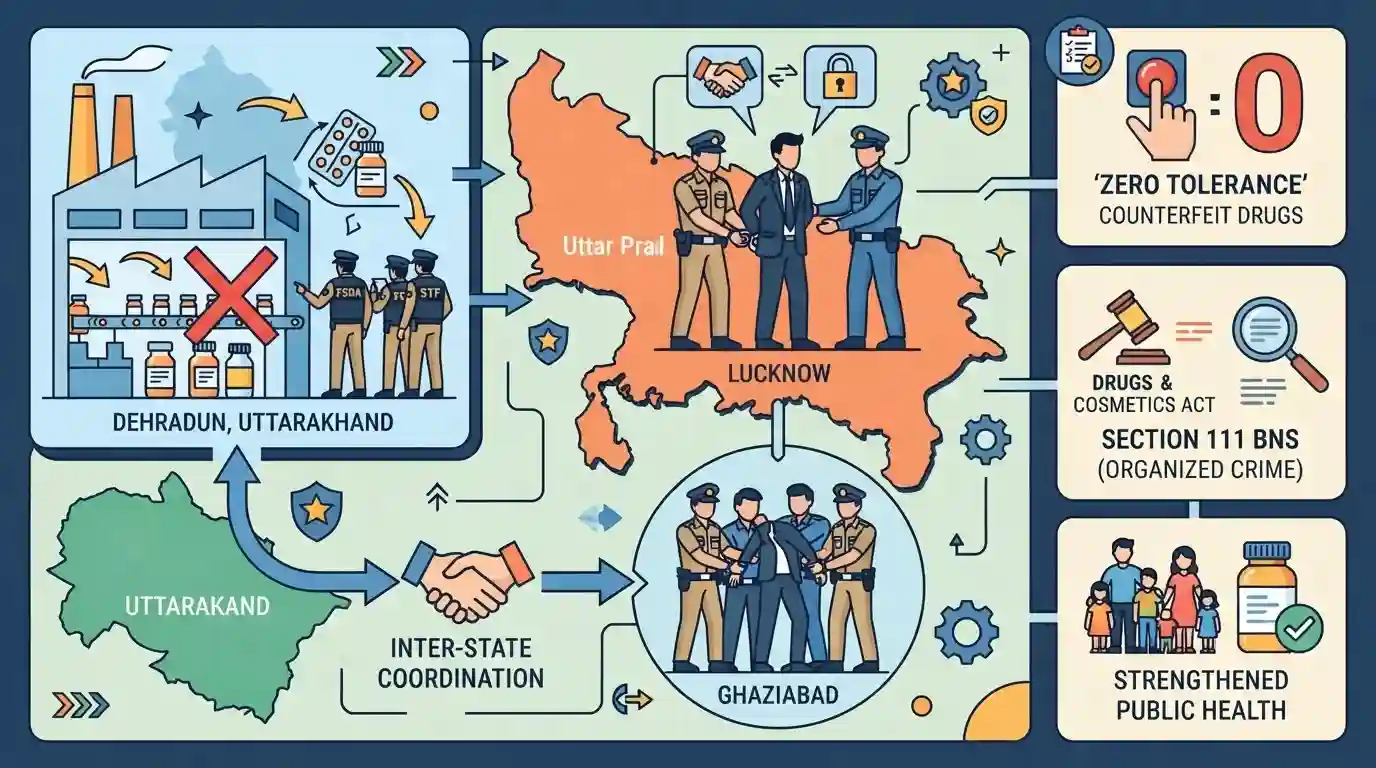
The raid highlights the critical issue of spurious drugs and pharmaceutical regulation in India. It also demonstrates the practical application of the new Bharatiya Nyaya Sanhita (BNS) 2023, specifically its provisions concerning organized crime (Section 111), and underscores inter-state law enforcement challenges and cooperation.
Summary
The Uttar Pradesh Food Safety and Drug Administration (FSDA), in coordination with the Special Task Force (STF), busted a major inter-state syndicate producing counterfeit medicines at a factory in Dehradun, Uttarakhand. Under the state's 'zero tolerance' policy, authorities arrested the prime accused in Lucknow and his brother in Ghaziabad. Highlighting a strict approach to public health and organized crime, an FIR was lodged invoking the Drugs and Cosmetics Act as well as Section 111 (Organised Crime) of the newly implemented Bharatiya Nyaya Sanhita (BNS), 2023.
Key Points
- The Uttar Pradesh Food Safety and Drug Administration (FSDA), acting on a tip-off, uncovered a factory manufacturing counterfeit medicines in Dehradun.
- The state's Special Task Force (STF) arrested the kingpin from Lucknow and his brother from Ghaziabad, tracing the inter-state network.
- The accused were charged under the Drugs and Cosmetics Act and notably under Section 111 of the Bharatiya Nyaya Sanhita (BNS) 2023 for organized crime.
- The enforcement action reflects inter-state police cooperation and emphasizes the UP government's 'zero tolerance' policy toward public health threats from spurious drugs.
Important Terms
Bharatiya Nyaya Sanhita (BNS), 2023

India's new criminal code replacing the colonial-era Indian Penal Code. Its Section 111 notably codifies "organised crime" as an ordinary penal offense, targeting syndicates engaged in kidnapping, extortion, cyber-crime, and economic offenses.
UPSC context
GS2 (Polity) & GS3 (Security). Tests awareness of major criminal law reforms and statutory frameworks countering organized crime.
Drugs and Cosmetics Act, 1940
A foundational Indian law regulating the import, manufacture, distribution, and sale of drugs and cosmetics. It establishes stringent guidelines to ensure the safety, efficacy, and quality of medicines, penalizing spurious and adulterated products.
UPSC context
GS2 (Health & Governance). Tests knowledge of India's statutory framework for public health, regulatory bodies, and pharmaceutical quality control.
Food Safety and Drug Administration (FSDA)
A state-level regulatory authority (like in Uttar Pradesh) that enforces the Drugs and Cosmetics Act and Food Safety standards. It conducts inspections, testing, and prosecutes manufacturers of counterfeit medicines and adulterated food.
UPSC context
GS2 (Governance & Health). Relevant as a case study for state-level execution of national health and safety regulations.
Special Task Force (STF)
A specialized intelligence and operational wing of state police departments created to combat organized crime, dismantle mafia syndicates, and execute targeted operations against inter-state criminals and disruptive elements.
UPSC context
GS3 (Internal Security). Tests understanding of specialized law enforcement agencies and operational strategies to counter organized crime syndicates.
Prelims Trap
"The CDSCO is the sole authority responsible for licensing drug manufacturing facilities in India."
The CDSCO handles new drug approvals and imports, but licensing of manufacturing facilities and post-market enforcement is executed by State Licensing Authorities under the Drugs and Cosmetics Act.
Static Concepts Connected
How are drug regulatory powers divided between the Centre and States in India?
- Central Authority (CDSCO): Approves new drugs, regulates clinical trials, and controls all drug imports into India.
- State Authorities (SLA): Responsible for licensing actual drug manufacturing premises, regulating pharmacy sales, and enforcing quality checks.
- Mashelkar Committee (2003): Recommended a centralized National Drug Authority to replace fragmented state licensing systems, aiming for uniform quality control.
How does the BNS 2023 alter the legal framework for organized crime?
- Central Codification: Section 111 of the BNS codified organized crime as a standalone offence under a central penal code for the first time.
- Previous Framework: Previously, organized crime was largely tackled through state-specific legislations like Maharashtra's MCOCA or specialized central acts.
- Statutory Definition: Requires a syndicate of two or more persons engaged in a cognizable offence punishable by 3+ years of imprisonment.
Cross-Topic Patterns
Spurious drugs + BNS Organised Crime provision
The invocation of BNS Section 111 against fake medicine manufacturers elevates a public health violation to a central organized crime offence, bridging GS2 health governance with GS3 internal security.
Federalism + Inter-state law enforcement
A UP agency busting a syndicate in Uttarakhand highlights how organized crimes exploit fragmented state jurisdictions, stressing the need for robust inter-state police coordination mechanisms.

Expect a 2026 prelims question pairing the CDSCO vs State Licensing mandate with the new BNS statutory definition of Organised Crime.
Linked PYQs · 2
Linked PYQs · 2
- 2024UKPSC_PRELIMSGS1
Headquarters of which of the following is located in Dehradun, the Capital of Uttarakhand ?
- 2024UKPSC_PRELIMSGS1
Which of the following statements related to Prevention of Money Laundering Act (PMLA) is not true ?
