UP Industrial Policy incentives for Purvanchal and Bundelkhand
Source:business-standard ↗
Why It Matters
State-specific industrial policies, regional classification, and industrial parks are high-yielding areas for UPPSC Prelims and Mains (specifically Papers 5 & 6 which focus on Uttar Pradesh's economy and geography).
Summary
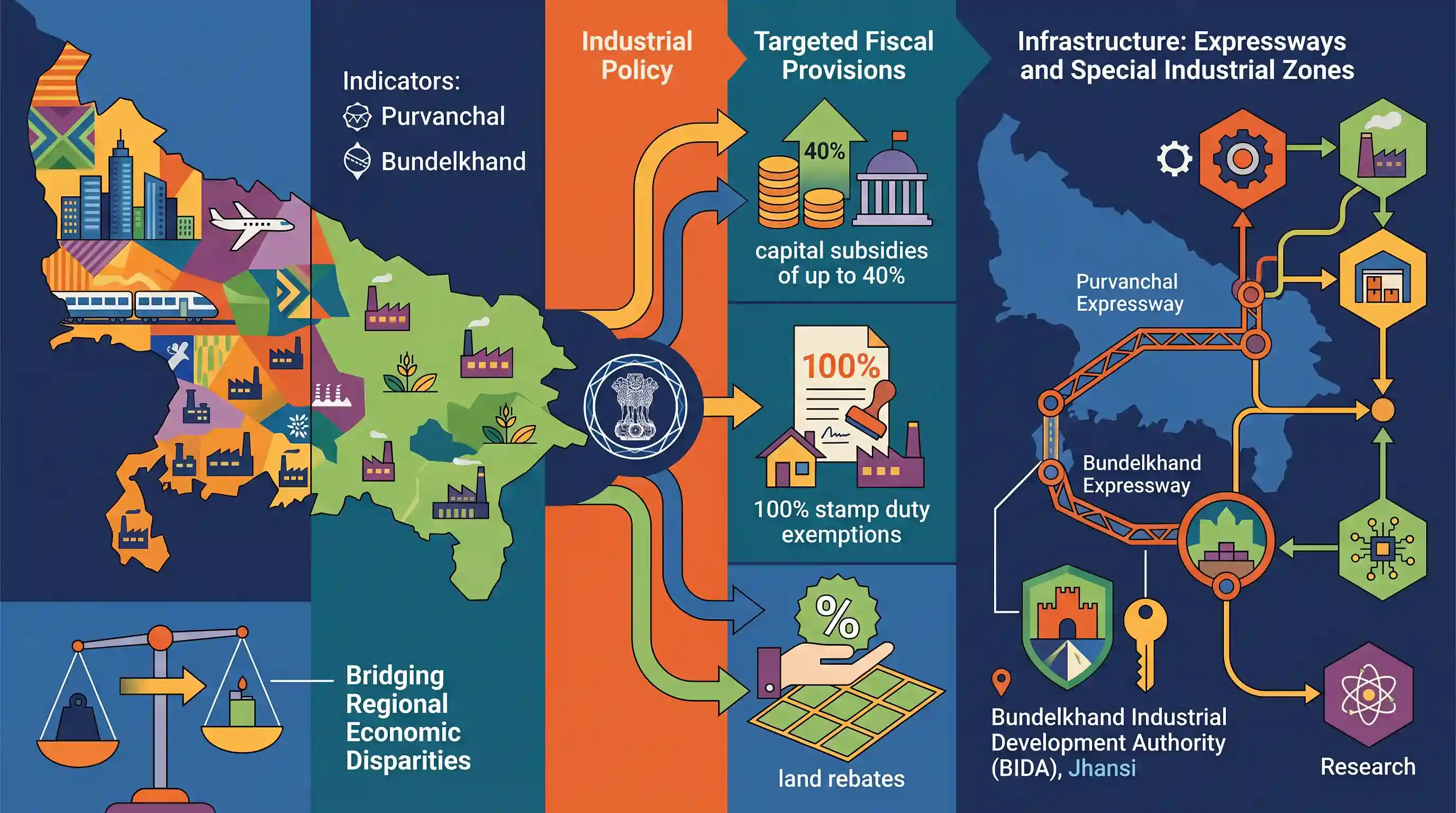
To bridge regional economic disparities and stimulate growth, the Government of Uttar Pradesh has introduced targeted fiscal provisions and higher industrial subsidies for Purvanchal (Eastern UP) and Bundelkhand under its Industrial Investment and Employment Promotion Policy. These measures include 100% stamp duty exemptions, capital subsidies of up to 40%, land rebates, and the development of major manufacturing zones through institutional frameworks like the newly established Bundelkhand Industrial Development Authority (BIDA) in Jhansi and expressway-linked industrial corridors.
Key Points
- Regional Policy Classification: Under UP's industrial policies, the state is categorized into four regions (Paschimanchal, Madhyanchal, Purvanchal, and Bundelkhand) to address regional developmental imbalances.
- Incentive Slabs: Higher fiscal concessions are provided to Bundelkhand and Purvanchal compared to Western (Paschimanchal) and Central (Madhyanchal) Uttar Pradesh to attract investments to backward areas.
- Stamp Duty Exemptions: Eligible industrial projects in Bundelkhand and Eastern UP (Purvanchal) enjoy 100% stamp duty exemption, whereas Central UP offers 75% and Western UP offers 50%.
- Capital Subsidies: Higher investment and capital subsidies (up to 35-40%) are designated for industrial units setup in Eastern UP and Bundelkhand to compensate for geographical and logistical difficulties.
- Bundelkhand Industrial Development Authority (BIDA): Modelled after NOIDA, BIDA has been established in Jhansi across 14,000 hectares of land to serve as a major industrial city and manufacturing hub in Bundelkhand.
- Infrastructure-Led Development: The state leverages major arterial corridors like the Purvanchal Expressway (connecting Lucknow to Ghazipur) and Bundelkhand Expressway to set up dedicated industrial clusters, toy parks, and MSME hubs.
- Defense Corridor: Bundelkhand serves as a critical node (Jhansi and Chitrakoot) for the UP Defence Industrial Corridor, which promotes specialized heavy manufacturing.
Important Terms
Bundelkhand Industrial Development Authority (BIDA)

Established in 2023, BIDA is a statutory body tasked with developing a massive greenfield industrial township in Jhansi, Uttar Pradesh, aimed at replicating Noida's economic success in the water-stressed Bundelkhand region.
UPSC context
GS Paper II & III: Regional development, industrial policies, reducing regional economic disparities, and decentralization of manufacturing infrastructure.
Uttar Pradesh Industrial Investment and Employment Promotion Policy
A policy framework launched in 2022 to attract ₹10 trillion in investments, targeting a $1 trillion state economy through region-linked incentives like stamp duty exemptions, capital subsidies, and private industrial park promotion.
UPSC context
GS Paper III: Indian Economy, industrial growth, employment generation, and state-level policy interventions for socio-economic development.
UP Expressways Industrial Development Authority (UPEIDA)
A statutory authority established in 2007 by the Uttar Pradesh government to acquire land, construct access-controlled expressways, develop industrial corridors, and promote infrastructure investments across the state.
UPSC context
GS Paper III: Infrastructure development, public-private partnerships, and transport connectivity as an economic growth multiplier.
Uttar Pradesh State Industrial Development Authority (UPSIDA)
The premier nodal agency responsible for planning, acquiring land, and developing physical industrial infrastructure, specialized sector parks, and integrated industrial townships across Uttar Pradesh.
UPSC context
GS Paper III: Industrial corridors, ease of doing business, and land bank management for economic growth.
UP Defence Industrial Corridor
An ambitious state-led initiative with six strategic nodes (Aligarh, Agra, Jhansi, Kanpur, Chitrakoot, Lucknow) aimed at promoting self-reliance ('Atmanirbharta') in domestic aerospace and defence manufacturing.
UPSC context
GS Paper III: Internal Security and indigenization of technology, import substitution, and defence manufacturing ecosystems.
Bundelkhand Expressway Project
A 296-km-long, 4-lane access-controlled greenfield expressway connecting Chitrakoot with the Agra-Lucknow Expressway at Etawah, designed to reduce logistics costs and integrate backward regions with the National Capital Region.
UPSC context
GS Paper III: Road transport infrastructure, rural-urban economic integration, and regional development of drought-prone areas.
Purvanchal Expressway Project
A 340.8-km, 6-lane access-controlled expressway connecting Lucknow to Ghazipur, featuring a 3.2-km emergency airstrip and acting as a lifeline for economic development in eastern Uttar Pradesh.
UPSC context
GS Paper III: Infrastructure and balanced regional development, bridging economic disparities between western and eastern sub-regions.
Prelims Trap
Every industrial district in Paschimanchal (Western UP) is eligible for a standard 50% stamp duty exemption.
Highly developed industrial zones like Noida and Ghaziabad within Paschimanchal are explicitly excluded from these state-level policy exemptions.
Static Concepts Connected
What are the indicators and causes of regional economic disparities?
- Measurement Indicators: Measured using per capita State Domestic Product, infrastructure density, credit-deposit ratios, and spatial concentration of foreign direct investment.
- Causal Factors: Driven by historical colonial investments, geographical bottlenecks, uneven infrastructure distribution, and agglomeration economies that pull capital to existing developed clusters.
- Mitigation Tools: Balanced regional development is pursued via fiscal equalization, freight equalization reforms, targeted state capital subsidies, and dedicated industrial corridors.
What is the legal framework for planned industrial townships?
- Statutory Origin: Established under state-specific industrial area development acts (like UP's 1976 Act), creating specialized statutory development authorities.
- Functional Autonomy: These authorities hold unified planning, land acquisition, municipal administration, and single-window clearance powers, bypassing traditional local self-government bodies.
Cross-Topic Patterns
Defense Corridors & Regional Equity
Linking defense manufacturing nodes with backward regions like Bundelkhand leverages national security investments to address chronic spatial economic disparities.
Expressways & Agglomeration Economics
Large-scale expressway networks transform landlocked hinterlands by lowering logistics costs, enabling rural MSMEs to integrate into global value chains.

UP's Defence Corridor nodes and regional infrastructure-led development policies will likely be framed in infrastructure-related questions in 2026.
Linked PYQs · 3
Linked PYQs · 3
- 2008UPPSC_PRELIMSGS1
Which is the most developed region of Uttar Pradesh in terms of industrial development?
- 2018UPPSC_PRELIMSGS1
'Purvanchal Express Way' in Uttar Pradesh will not pass through which of the following cities?
- 2009UPPSC_PRELIMSGS1
UPSIDC has established Industrial Parks for specific industries. Identify the Park whose location is not correctly shown:
