Uttar Pradesh Expands Bioenergy Sector Using Waste Management
Source:theprint ↗
Why It Matters
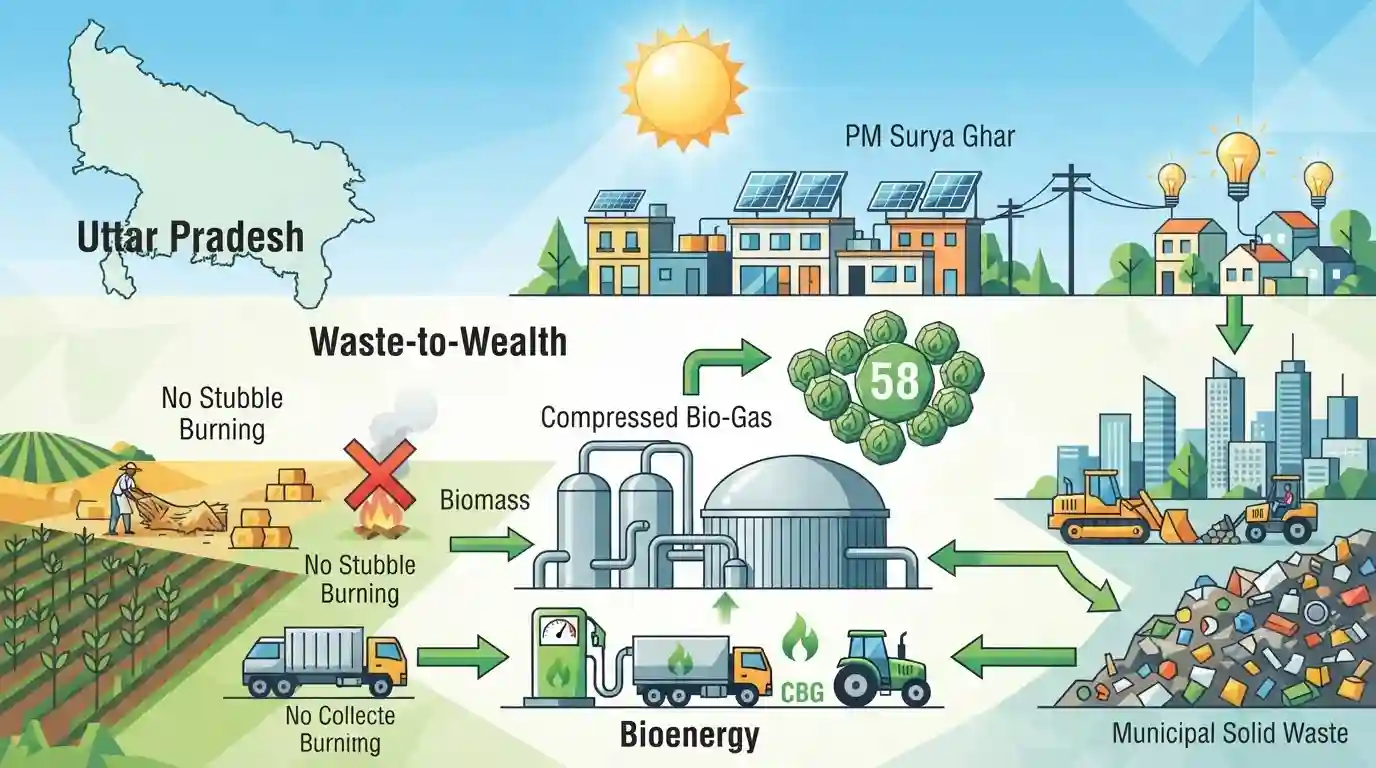
Provides a concrete case study of state-level implementation of renewable energy and waste management schemes, illustrating how the 'Waste-to-Wealth' circular economy model can simultaneously address environmental pollution (stubble burning, urban legacy waste) and agricultural income augmentation.
Summary
The Uttar Pradesh government is heavily investing in the bioenergy sector to transform agricultural and municipal solid waste into wealth. State Energy Minister AK Sharma emphasized that UP currently leads the nation with 58 functional Compressed Bio-Gas (CBG) plants. This strategy aims to boost farmers' incomes by purchasing agricultural residue, thereby tackling the issue of stubble burning and improving urban sanitation by clearing legacy waste. Additionally, UP is a major participant in the PM Surya Ghar rooftop solar scheme, demonstrating its broader commitment to renewable energy transitions.
Key Points
- Uttar Pradesh aims to lead India's bioenergy sector, currently operating 58 Compressed Bio-Gas (CBG) plants.
- The state is promoting private investment to convert agricultural residues and urban municipal legacy waste into bioenergy.
- The bioenergy push serves a dual purpose: increasing farmers' supplementary income and mitigating pollution from crop stubble burning.
- UP is also making strides in solar energy, ranking as the second-largest state for installations under the PM Surya Ghar scheme.
Important Terms
PM Surya Ghar Muft Bijli Yojana

A centrally sponsored scheme launched by MNRE in 2024 to provide up to 300 units of free electricity monthly to one crore households via subsidized residential rooftop solar installations.
UPSC context
GS Paper III (Energy/Environment). Tests knowledge of India's renewable energy targets, household solar adoption, and clean energy subsidy models.
UP New and Renewable Energy Development Agency (UPNEDA)
The designated state nodal agency under Uttar Pradesh's Department of Additional Sources of Energy, responsible for implementing renewable schemes like rooftop solar and expanding bioenergy infrastructure.
UPSC context
GS Paper III (Infrastructure: Energy). Relevant for understanding the state-level execution and governance of national clean energy initiatives.
Government of Uttar Pradesh
The state executive body currently leading India's waste-to-wealth transition. It features 58 functional Compressed Bio-Gas (CBG) plants to tackle stubble burning, manage municipal solid waste, and boost rural incomes.
UPSC context
GS Papers II & III. Highlights the critical role of sub-national governance in achieving decentralized renewable energy and climate goals.
Prelims Trap
"CBG and CNG have different chemical compositions and calorific values, meaning CBG cannot be used in existing CNG vehicles."
Both primarily consist of methane (>90%) with comparable calorific values. The difference is their origin (renewable biomass vs fossil). They are interchangeable in vehicles.
Static Concepts Connected
How does Compressed Bio-Gas (CBG) differ from raw Biogas and fossil CNG?
- Biogas vs CBG: Raw biogas contains roughly 55-60% methane. CBG is created by purifying this biogas to over 90% methane by removing carbon dioxide and hydrogen sulphide.
- CBG vs CNG: Both are highly concentrated methane with similar calorific values. However, CBG is renewable (derived from biomass), whereas CNG is extracted from fossil fuel reserves.
What are the primary outputs of anaerobic digestion of biomass?
- Primary Fuel: The process yields biogas, a combustible mixture of methane and carbon dioxide that can be upgraded to CBG for transport, domestic, or industrial use.
- Valuable Byproduct: The digestion process also generates Fermented Organic Manure (FOM) or digestate, which serves as a nutrient-rich bio-fertilizer, boosting soil health.
Cross-Topic Patterns
Waste-to-Wealth & NCR Smog
Procuring agricultural residue for CBG production monetizes stubble, giving farmers an economic incentive to stop crop burning. This offers a market-based solution to North India's winter air pollution crisis.
SATAT Scheme & Import Substitution
Injecting CBG into the city gas distribution network aligns with the SATAT scheme. This simultaneously lowers India's reliance on imported natural gas and addresses urban municipal legacy waste.

Expect a 2026 multi-statement prelims question comparing the chemical composition, calorific value, and origins of CBG versus CNG and biogas.
Linked PYQs · 3
Linked PYQs · 3
- 2015UPPSC_PRELIMSGS1
Which one of the following can provide both power and manures?
- 2015UPPSC_PRELIMSGS1
CNG is
- 2022UPPSC_PRELIMSGS1
Solar energy is converted into electric energy through
