Uttar Pradesh Bundelkhand Natural Farming Drive Initiative
Source:Indian Express ↗
Why It Matters
It serves as a critical case study for GS-3 (Agriculture) on how state interventions can promote sustainable, low-cost natural farming to address ecological degradation and agrarian distress in water-stressed, drought-prone regions like Bundelkhand.
Summary
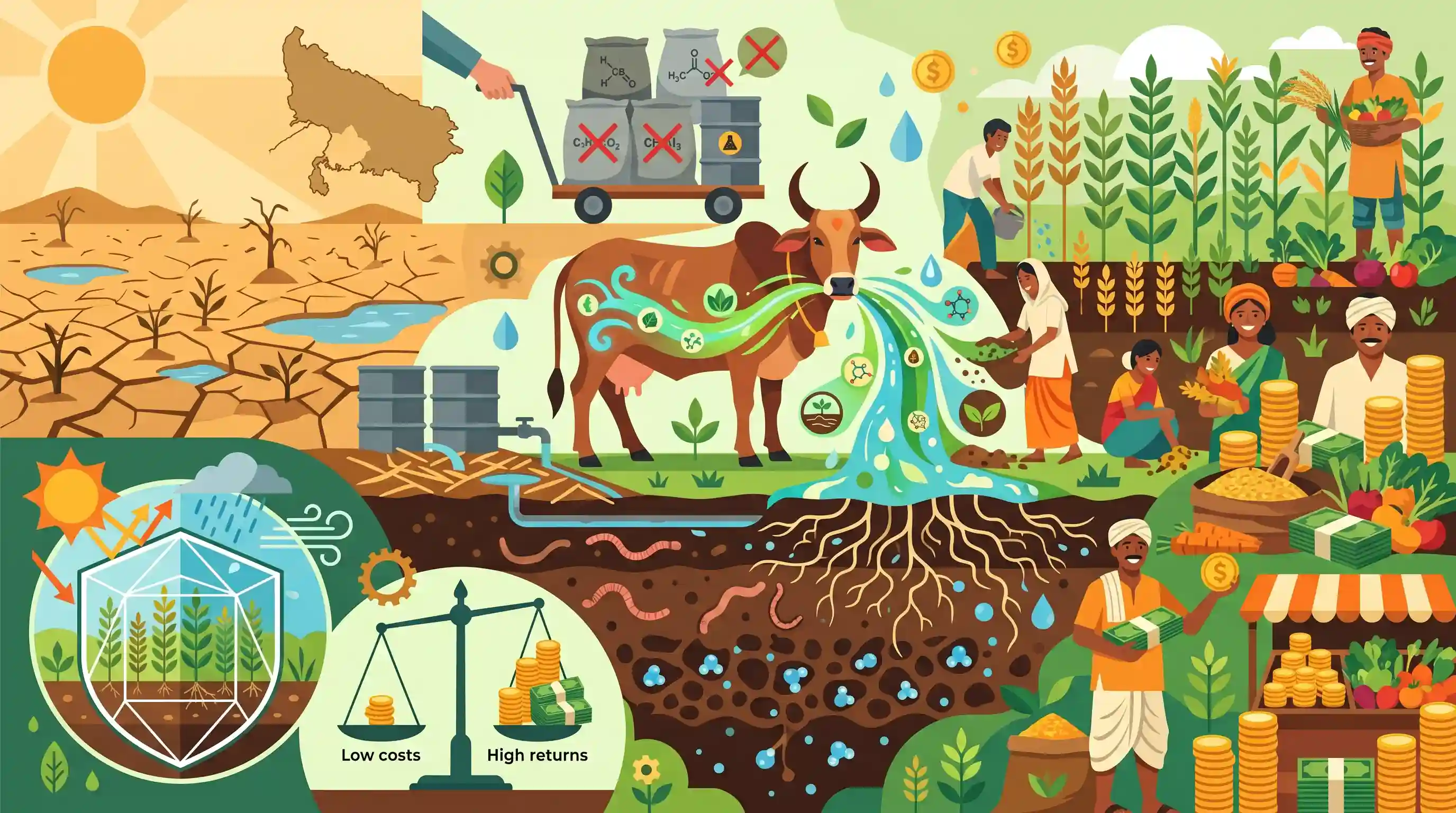
The Uttar Pradesh government has launched a cow-based natural farming drive across 23,500 hectares in the drought-prone Bundelkhand region. Covering seven districts, the initiative seeks to promote sustainable agriculture by completely replacing chemical fertilizers and pesticides with organic, cow-based inputs. Supported by a budget of Rs 57.60 crore, the program aims to reduce input costs, enhance soil fertility and water retention, and ultimately increase farmers' incomes while making agriculture more climate-resilient in water-stressed areas.
Key Points
- The Uttar Pradesh government has initiated a large-scale cow-based natural farming programme covering 23,500 hectares across seven districts of the Bundelkhand region.
- The drive aims to eliminate the use of chemical fertilizers and pesticides, replacing them with organic inputs derived from cow dung and urine to improve soil health and sustainability.
- Aimed at drought-prone and low-rainfall areas, the initiative focuses on enhancing the soil's water retention capacity and reducing the cost of cultivation to improve farm profitability.
- The state has allocated Rs 57.60 crore for the program, which will also facilitate training for farmers and create market linkages for the organic produce.
Important Terms
Natural Farming (Prakritik Kheti)

A chemical-free, livestock-based farming method that integrates crops, trees, and livestock. It relies on on-farm biomass recycling and cow-based formulations like Jeevamrit instead of synthetic fertilizers.
UPSC context
GS Paper III: Sustainable agriculture, soil health, and climate-resilient farming techniques. Essential for questions on doubling farmers' income and environmental conservation.
Bundelkhand Region
A drought-prone geographic region spanning parts of Uttar Pradesh and Madhya Pradesh. It faces acute water scarcity, soil erosion, and high climate vulnerability, making it a focus for sustainable interventions.
UPSC context
GS Paper I & III: Regional geography and agricultural challenges in water-stressed areas. Critical for case studies on disaster management and regional development.
Bharatiya Prakritik Krishi Paddhati (BPKP)
A sub-scheme under the Paramparagat Krishi Vikas Yojana (PKVY) aimed at promoting traditional indigenous practices and reducing farmer dependence on expensive, externally purchased chemical inputs.
UPSC context
GS Paper III: Major government schemes for promoting organic and natural farming. Tests knowledge of institutional frameworks for agricultural sustainability.
Jeevamrit
A fermented microbial culture made from cow dung, urine, jaggery, and pulse flour. It acts as a soil inoculant to enhance microbial activity and improve nutrient availability without chemicals.
UPSC context
GS Paper III: Agricultural techniques and inputs. Relevant for understanding the biological basis of 'Zero Budget' or natural farming models.
Cow-Based Natural Farming Programme
The specific mission by the Uttar Pradesh government to expand cow-based natural farming across all 75 districts, with a priority focus on the 23,500 hectares in Bundelkhand.
UPSC context
GS Paper III: State-level initiatives for agricultural diversification and cattle conservation. Useful for illustrating local applications of national missions.
Prelims Trap
Natural farming is identical to organic farming as both require large additions of external farmyard manure.
Natural farming uses minimal cow dung/urine as microbial stimulants (Jeevamrutha) with no external inputs. Organic farming allows bulk external organic fertilizers like vermicompost.
Static Concepts Connected
What are the four core pillars of Zero Budget Natural Farming (ZBNF)?
- Jeevamrutha: Microbial culture of cow dung, urine, jaggery, and pulse flour applied to stimulate soil biology.
- Bijamrita: Seed treatment formulation using local cow dung and urine to protect young roots from diseases.
- Acchadana: Mulching practice that conserves soil moisture, improves organic humus, and suppresses weed growth.
- Whapasa: Maintenance of proper soil aeration and moisture ratio, which drastically reduces overall irrigation requirements.
What are the key agro-climatic characteristics of the Bundelkhand region?
- Semi-arid climate: Characterized by highly erratic rainfall, extreme summer temperatures, and frequent agricultural droughts.
- Mixed soils: Features a mix of red and black soils (locally: Mar, Kabar, Parwa, Rakar) with varying moisture retention.
- Undulating topography: Part of the Central Plateau and Hills zone, leading to rapid rainwater runoff and poor groundwater recharge.
Cross-Topic Patterns
Natural Farming + NDC targets
Replacing synthetic nitrogen fertilizers with cow-based inputs reduces nitrous oxide emissions, directly aligning with India’s climate mitigation goals and UNFCCC Nationally Determined Contributions (NDCs).
Dryland ecology + Debt traps
In historically distressed, semi-arid regions like Bundelkhand, eliminating external input costs (fertilizers/pesticides) is a structural economic intervention against the chronic small-farmer debt cycle.

Expect a Prelims statement differentiating Natural Farming (zero external inputs, microbial focus) from Organic Farming (bulk manures).
Linked PYQs · 3
Linked PYQs · 3
- 2021PrelimsGS1
How is permaculture farming different from conventional chemical farming? 1. Permaculture farming discourages monocultural practices but in conventional chemical farming, monoculture practices are predominant. 2. Conventional chemical farming can cause increase in soil salinity but the occurrence of such phenomenon is not observed in permaculture farming. 3. Conventional chemical farming is easily possible in semi-arid regions but permaculture farming is not so easily possible in such regions. 4. Practice of mulching is very important in permaculture farming but not necessarily so in conventional chemical farming. Select the correct answer using the code given below.
- 2018MainsGS3
Sikkim is the first 'Organic State' in India. What are the ecological and economical benefits of Organic State?
- 2019MainsGS3
Elaborate the impact of National Watershed Project in increasing agricultural production from water-stressed areas.
