Uttar Pradesh Ban on Caste Based Political Rallies and Public Order
Source:The Hindu ↗
Why It Matters
This development highlights the constitutional friction between the fundamental right to assemble/mobilize and the state's duty to maintain public order. It is crucial for understanding the evolving nature of caste-based identity politics in India and the administrative/judicial attempts to regulate social stratification in the public sphere.
Summary
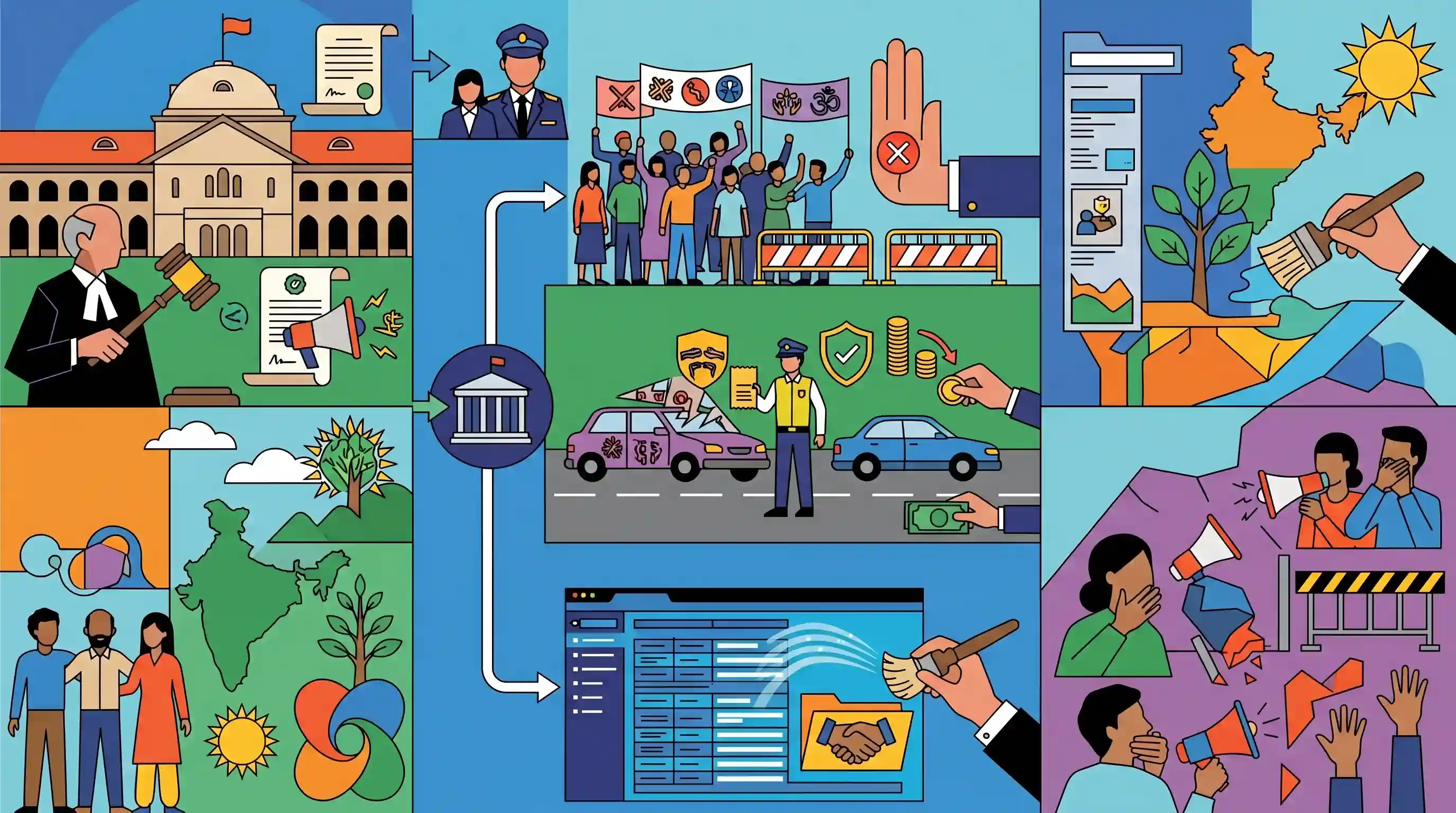
The Uttar Pradesh government has issued a comprehensive order prohibiting caste-based political rallies, modifying police records, and banning caste displays on vehicles. Driven by a September 2025 Allahabad High Court directive to stop the "glorification" of caste, the administration argues that such rallies threaten public order and social cohesion. Consequently, caste details will be scrubbed from the CCTNS portal (except for SC/ST Atrocities Act cases), and vehicles flouting the rule will be fined under the Motor Vehicles Act. While the government frames this as a step toward national unity, opposition parties condemn it as an attempt to stifle the political voice and mobilization of marginalized communities.
Key Points
- The Uttar Pradesh government has banned caste-based political rallies, citing threats to public order, national unity, and social harmony.
- Implementing a September 2025 Allahabad High Court directive, the state ordered the removal of caste details from the CCTNS police portal, except for cases under the SC/ST (Prevention of Atrocities) Act.
- Vehicles displaying caste names or identifiers will face penalties under the Central Motor Vehicles Act, 1988.
- The order directs police to monitor social media for caste-based mobilization and restricts the display of caste identities on signboards and official records.
- Opposition leaders have criticized the ban as hypocritical, arguing it suppresses democratic political mobilization of marginalized groups while ignoring the ruling party's own caste calculus.
Important Terms
SC/ST (Prevention of Atrocities) Act, 1989

1989 legislation enacted to prevent violence and discrimination against Scheduled Castes and Tribes. It requires recording caste details for legal cases, making it the sole exception to UP's new profiling ban.
UPSC context
GS II (Social Justice/Polity); tests understanding of constitutional safeguards, Article 17, and specific legal protections for historically marginalized communities.
Crime and Criminal Tracking Network and Systems (CCTNS)
A Mission Mode Project linking over 17,000 police stations into a national database. The UP order removes non-mandatory caste fields from this portal to eliminate identity profiling.
UPSC context
GS II (Governance) & GS III (Internal Security); tests knowledge of e-governance in policing and digital reforms in the criminal justice system.
National Crime Records Bureau (NCRB)
The nodal agency under the Ministry of Home Affairs responsible for national crime data and CCTNS implementation. It manages the central repository used for tracking criminals across India.
UPSC context
GS II & III; relevant for data-driven governance, police reforms, and internal security tracking.
Central Motor Vehicles Act, 1988
India's primary road transport law. Section 179(1) is being utilized by the UP government to fine vehicle owners displaying caste stickers that allegedly disturb social harmony.
UPSC context
GS II & III; examines the application of regulatory statutes to maintain public order and curb discriminatory public displays.
Allahabad High Court
The judicial body for Uttar Pradesh whose 2025 directives on "caste glorification" compelled the state to ban caste-based rallies and scrub caste details from police records.
UPSC context
GS II (Judiciary); illustrates judicial activism, constitutional morality, and the role of courts in directing executive action through PILs.
Prelims Trap
The Election Commission can unilaterally ban caste-based political rallies at any time under its Article 324 plenary powers.
ECI’s plenary powers under Article 324 and the MCC only apply during active election periods. Outside this window, ECI cannot ban caste rallies, leaving regulation to state laws and courts.
Static Concepts Connected
How does the RPA 1951 penalize appeals to caste or religion?
- Section 123(3): Appealing to voters on grounds of religion, race, caste, community, or language constitutes a "corrupt practice."
- Legal Consequence: Committing a corrupt practice can result in the election being declared void and disqualification from contesting for up to six years.
- Abhiram Singh Case: In 2017, the Supreme Court ruled that an appeal in the name of religion/caste refers to the candidate, agent, AND the voter.
What is the Crime and Criminal Tracking Network and Systems (CCTNS)?
- Nodal Agency: It is implemented by the National Crime Records Bureau (NCRB) under the Ministry of Home Affairs.
- Mission Mode Project: Launched in 2009 under the National e-Governance Plan (NeGP) to digitize and integrate police station records nationwide.
- Core Objective: To create a comprehensive, integrated system for effective policing, sharing intelligence, and improving service delivery to citizens.
Cross-Topic Patterns
Caste Census vs. Scrubbing Identities
Juxtaposes Bihar's push for detailed caste enumeration for targeted welfare against UP's move to scrub caste from police records to prevent identity profiling and social friction.
Article 19(1)(b) vs. Public Order
Connects the ban on caste rallies to wider debates around the right to peaceable assembly, mirroring previous protest restrictions legally justified by the State under "public order" clauses.

Expect a blended prelims question on RPA 1951 "corrupt practices", Art 19(3) public order, and the limits of ECI's Article 324 powers.
Linked PYQs · 3
Linked PYQs · 3
- 2018MainsGS1
Caste system is assuming new identities and associational forms. Hence, caste system cannot be eradicated in India." Comment.
- 2014MainsGS2
What do you understand by the concept "freedom of speech and expression"? Does it cover hate speech also ? Why do the films in India stand on a slightly different plane from other forms of expression ? Discuss.
- 2022MainsGS2
“While the national political parties in India favour centralisation, the regional parties are in favour of State autonomy.” Comment.
