Uttar Pradesh Government Ban on Caste-Based Political Rallies
Source:The Hindu ↗
Why It Matters
This development highlights the constitutional debate surrounding freedom of speech, political mobilization, and the imposition of reasonable restrictions to maintain public order. It is highly relevant for understanding the intersection of judicial activism, caste dynamics, and electoral politics in India.
Summary
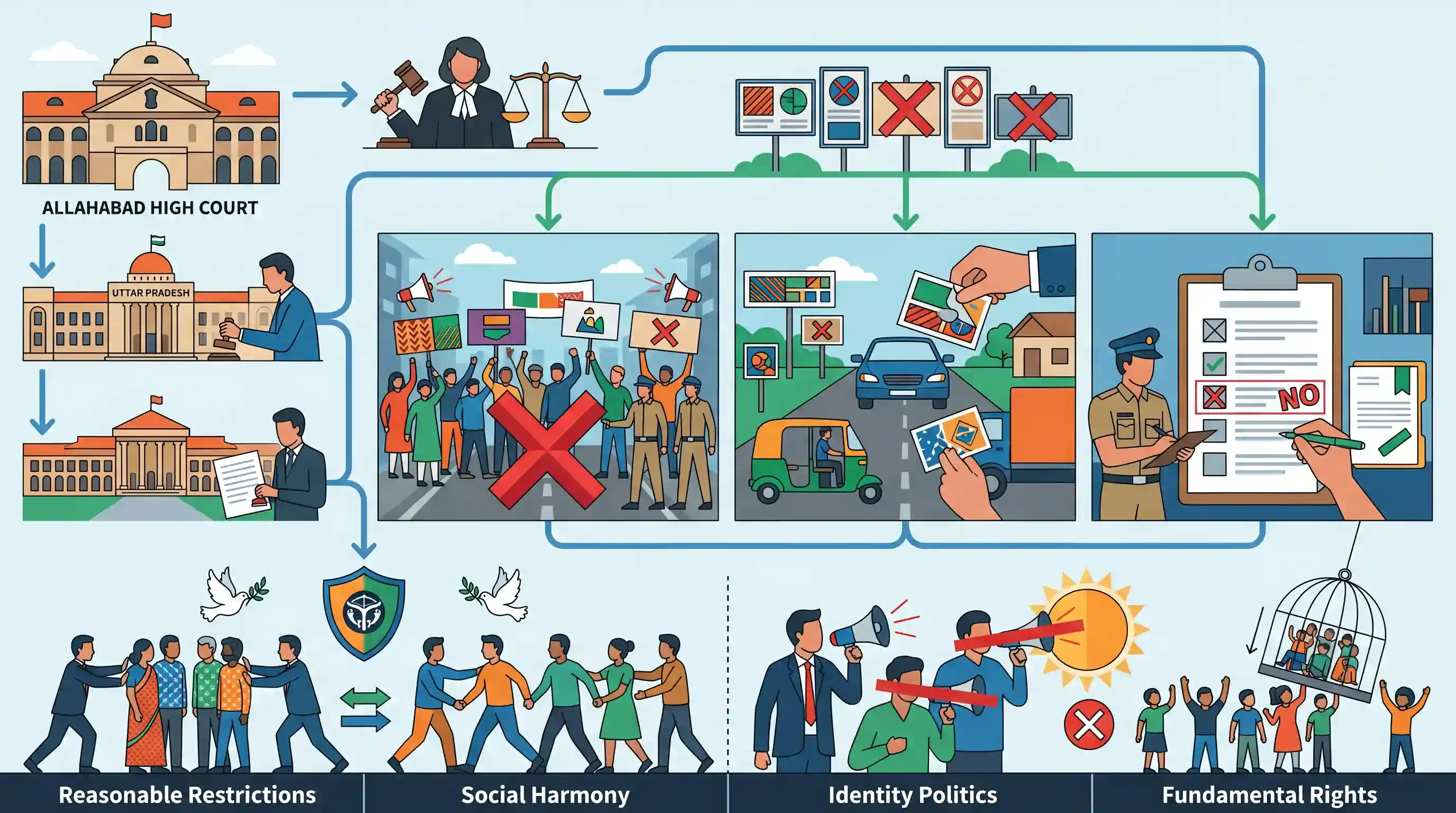
Following a directive from the Allahabad High Court, the Uttar Pradesh government has issued a sweeping order prohibiting caste-based political rallies, the display of caste identities on vehicles and signboards, and the recording of the accused's caste in police files (except in SC/ST Act cases). The administration argues that such displays and mobilizations incite caste hatred and violate public order. However, the opposition has condemned the ban as hypocritical, accusing the ruling party of seeking to silence the political awakening of marginalized communities.
Key Points
- The Uttar Pradesh government banned caste-based political rallies, stating they promote conflict and threaten public order and national unity.
- The notification follows a September 16 directive by the Allahabad High Court to clamp down on caste glorification.
- Police are instructed to stop recording the caste of accused individuals on the CCTNS portal and in case files, except for crimes under the SC/ST (Prevention of Atrocities) Act.
- Vehicles displaying caste names or slogans will face penalties under the Central Motor Vehicles Act, 1988, and public caste signboards will be removed.
- Opposition parties criticize the move as hypocritical, alleging it is a politically motivated attempt to suppress the mobilization of marginalized communities.
Important Terms
Scheduled Castes and the Scheduled Tribes (Prevention of Atrocities) Act, 1989

A stringent law designed to prevent discrimination and crimes against marginalized communities, providing for special courts and enhanced punishments for atrocities committed by non-SC/ST individuals.
UPSC context
GS Paper II (Social Justice/Laws for Vulnerable Sections); critical for understanding exceptions in administrative and police records.
Allahabad High Court
The apex judicial body in Uttar Pradesh whose directives led to the state-wide ban on caste-based political rallies and identity profiling in police documents.
UPSC context
GS Paper II (Judiciary); illustrates judicial intervention in socio-political issues and enforcement of constitutional morality.
Central Motor Vehicles Act, 1988
A parliamentary act regulating road transport and vehicle standards. It provides the legal basis for penalizing caste-based stickers, slogans, or identifiers on vehicles as unauthorized markings.
UPSC context
GS Paper III (Infrastructure/Internal Security); tests knowledge of administrative enforcement of public order through transport regulations.
National Crime Records Bureau (NCRB)
An agency under the Ministry of Home Affairs that manages the Crime and Criminal Tracking Network & Systems (CCTNS) to digitize and standardize police records across India.
UPSC context
GS Paper III (Security/Police Reforms); relevant for technical reforms in criminal justice and data privacy.
Public Order
A constitutional ground under Article 19(2) that allows the state to impose reasonable restrictions on fundamental freedoms to maintain social harmony and prevent communal conflict.
UPSC context
GS Paper II (Indian Constitution); core concept regarding the balance between individual liberties and state authority.
Fundamental Rights (Article 19)
Guaranteed under Article 19, these include the right to freedom of speech, expression, and peaceful assembly without arms, subject to specific reasonable restrictions.
UPSC context
GS Paper II (Polity); central to debates on whether banning political rallies violates the right to associate and express identity.
Prelims Trap
Recording the caste of an accused in police files is legally prohibited across all criminal cases to prevent social profiling.
Identifying the caste of both the perpetrator (non-SC/ST) and victim (SC/ST) is a strict statutory prerequisite for prosecuting offenses under the SC/ST (Prevention of Atrocities) Act, 1989.
Static Concepts Connected
On what grounds can freedom of assembly be restricted under Article 19?
- Sovereignty & Integrity: The state can restrict assemblies to protect the sovereignty and integrity of India (added by the 16th Amendment, 1963).
- Public Order: Assemblies can be restricted to prevent violence or public disturbance, which is the UP government's cited constitutional rationale (Article 19(3)) for banning caste rallies.
How does the Representation of the People Act, 1951 regulate caste in elections?
- Corrupt Practices: Section 123(3) defines appealing for votes on the grounds of religion, race, caste, community, or language as a "corrupt practice."
- Abhiram Singh Judgment: In 2017, a 7-judge Supreme Court bench ruled that any appeal for votes based on the caste of the candidate, agent, or voter invalidates the election.
Cross-Topic Patterns
Caste Census vs Administrative Erasure
While states like Bihar push for caste censuses to target welfare, UP's order to scrub caste from police files and ban caste rallies represents a contrasting administrative approach prioritizing public order over identity counting.
CCTNS & Digital Policing Bias
Removing caste fields from the CCTNS portal limits social profiling in law enforcement, connecting to broader UPSC themes of data privacy, algorithmic bias, and police reforms.

Prelims 2026 could test Sec 123(3) of RPA 1951 (corrupt practices) alongside Article 19 reasonable restrictions regarding caste assemblies.
Linked PYQs · 3
Linked PYQs · 3
- 2023MainsGS1
Why is caste identity in India both fluid and static?
- 2020MainsGS1
Has caste lost its relevance in understanding the multi-cultural Indian Society? Elaborate your answer with illustrations.
- 2014MainsGS2
What do you understand by the concept "freedom of speech and expression"? Does it cover hate speech also ? Why do the films in India stand on a slightly different plane from other forms of expression ? Discuss.
