Special Investigation Team Formed for Temple Donation Inquiry
Source:The Hindu ↗
Why It Matters
UPPSC frequently asks questions about state-constituted committees, administrative actions, and policies concerning cultural and religious heritage sites in Uttar Pradesh, making the administrative details of this SIT crucial for state-specific GS preparation.
Summary
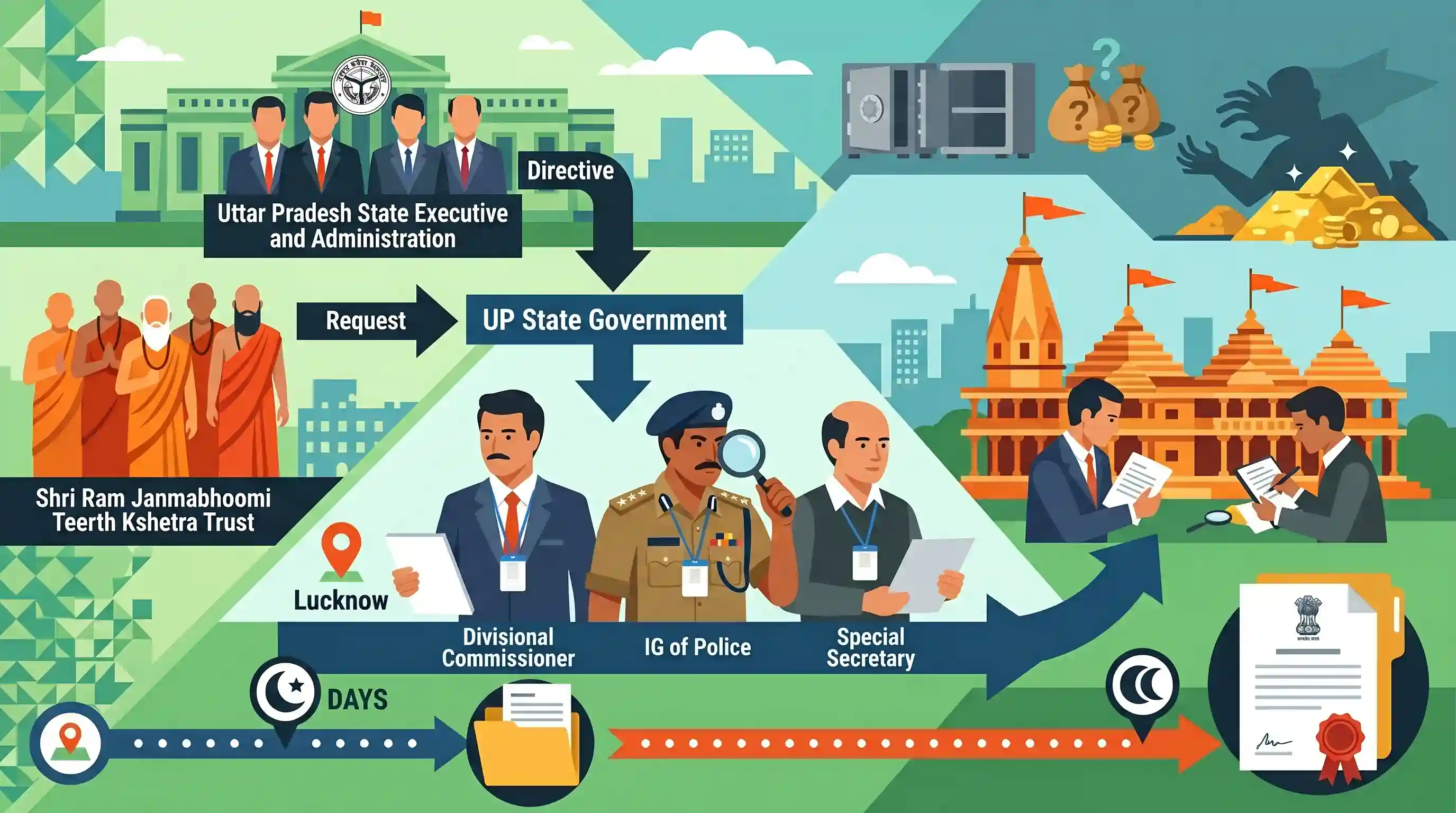
The Uttar Pradesh government has established a three-member Special Investigation Team (SIT) led by Lucknow Divisional Commissioner Vijay Vishwas Pant, along with IG S. Kiran and Special Secretary Neel Ratan, to probe allegations of missing donations at the Ayodhya Ram Temple. The inquiry, requested by the Shri Ram Janmabhoomi Teerth Kshetra Trust, is mandated to deliver a preliminary report within seven days and a final report within fifteen days.
Key Points
- The Uttar Pradesh government has constituted a three-member Special Investigation Team (SIT) to investigate allegations regarding missing donations at the Ram Temple in Ayodhya.
- The SIT was formed in response to a formal request by the Shri Ram Janmabhoomi Teerth Kshetra Trust.
- The SIT is composed of Lucknow Divisional Commissioner Vijay Vishwas Pant, Inspector General of Police S. Kiran, and Special Secretary (Finance) Neel Ratan.
- The investigative body has been directed to submit a preliminary report within 7 days and a final report within 15 days.
- The development follows political allegations from Samajwadi Party President Akhilesh Yadav demanding judicial intervention, while Trust General Secretary Champat Rai stated that internal audits are currently being carried out.
Important Terms
Special Investigation Team (SIT)

An ad hoc, specialized investigative body in India constituted by courts or the government to probe sensitive, high-profile cases when standard police machinery is deemed inadequate.
UPSC context
GS Paper II (Polity & Governance): Tests understanding of judicial oversight, executive accountability, and specialized investigative mechanisms.
Shri Ram Janmabhoomi Teerth Kshetra Trust
A 15-member trust established by the Government of India in 2020, following the Supreme Court's Ayodhya verdict, to oversee the construction and management of the Ram Mandir.
UPSC context
GS Paper II (Polity & Governance): Tests knowledge of statutory/non-statutory bodies, administration of religious trusts, and judicial mandates.
Government of Uttar Pradesh
The sub-national governing authority of the Indian state of Uttar Pradesh, consisting of an executive led by the Governor and Chief Minister, a bicameral legislature, and a judiciary.
UPSC context
GS Paper II (Polity & Governance): Tests understanding of state-level executive structures, legislative processes, and center-state administration in federalism.
Samajwadi Party
A recognized state political party in India, founded in 1992, based largely in Uttar Pradesh, adhering to democratic socialist principles.
UPSC context
GS Paper II (Polity): Tests knowledge of regional political parties, electoral politics, and opposition roles in state governance.
Bharatiya Janata Party
A major national political party in India, founded in 1980, centered on cultural nationalism (Hindutva) and currently serving as the leading ruling party nationally.
UPSC context
GS Paper II (Polity): Tests understanding of political ideologies, party systems, and electoral dynamics in federal governance.
Prelims Trap
A Judicial Magistrate possesses the statutory power to directly constitute a Special Investigation Team (SIT) under the CrPC.
Magistrates can only order routine police investigations under Section 156(3) of the CrPC; they lack the authority to constitute specialized ad-hoc SITs.
Static Concepts Connected
How are religious and charitable endowments governed under the Indian Constitution?
- Concurrent List: Governed under Entry 28 of List III, allowing both Parliament and State Legislatures to enact laws regulating public and religious endowments.
- Article 26 freedom: Grants religious denominations the right to manage their affairs in religion, subject to public order, morality, and health.
- Secular administration: The State can legally regulate the financial and administrative secular aspects of religious institutions without violating freedom of religion.
What is the legal framework governing Special Investigation Teams (SITs) in India?
- No separate statute: SITs are ad-hoc bodies without a dedicated statutory charter, operating under general investigative provisions of the CrPC.
- Constitution powers: They can be constituted by the Supreme Court, High Courts, or State Governments, but not by Judicial Magistrates.
Cross-Topic Patterns
Union trusts vs State law enforcement
Conflicts highlight the intersection where Union-notified trusts operate within State police jurisdictions, necessitating collaborative federal-state investigative mechanisms.
Temple economy and public auditing
Rapid tourism growth at religious sites underscores the need for robust statutory audit frameworks to govern massive public donations and prevent misappropriation.

The 2026 exam may test the constitutional division of powers over religious endowments paired with the legal limits of executive-constituted SITs.
Linked PYQs · 2
Linked PYQs · 2
- 2021UPPSC_PRELIMSGS1
'Uttar Pradesh Swami Vivekanand Etihasik Paryatan Yatra Yojna 2021' was introduced by the U.P. Government for which of the following people for religious travel ?
- 2020UPPSC_PRELIMSGS1
Which of the following cities of Uttar Pradesh is/are covered under the 'Heritage City Development and Augmentation Yojana (HRIDAY)' ? 1. Varanasi 2. Mathura 3. Prayagraj 4. Ayodhya Select the correct answer from the codes given below.
