UP maintains stable power tariffs for seventh consecutive year
Source:opindia ↗
Why It Matters
The decision highlights the balance between populist subsidy policies and the financial viability of state power distribution utilities (DISCOMs). Understanding the regulatory framework of electricity tariff determination (such as the role of UPERC and schemes like UDAY) is crucial for UPPSC aspirants analyzing state economy and infrastructure development.
Summary
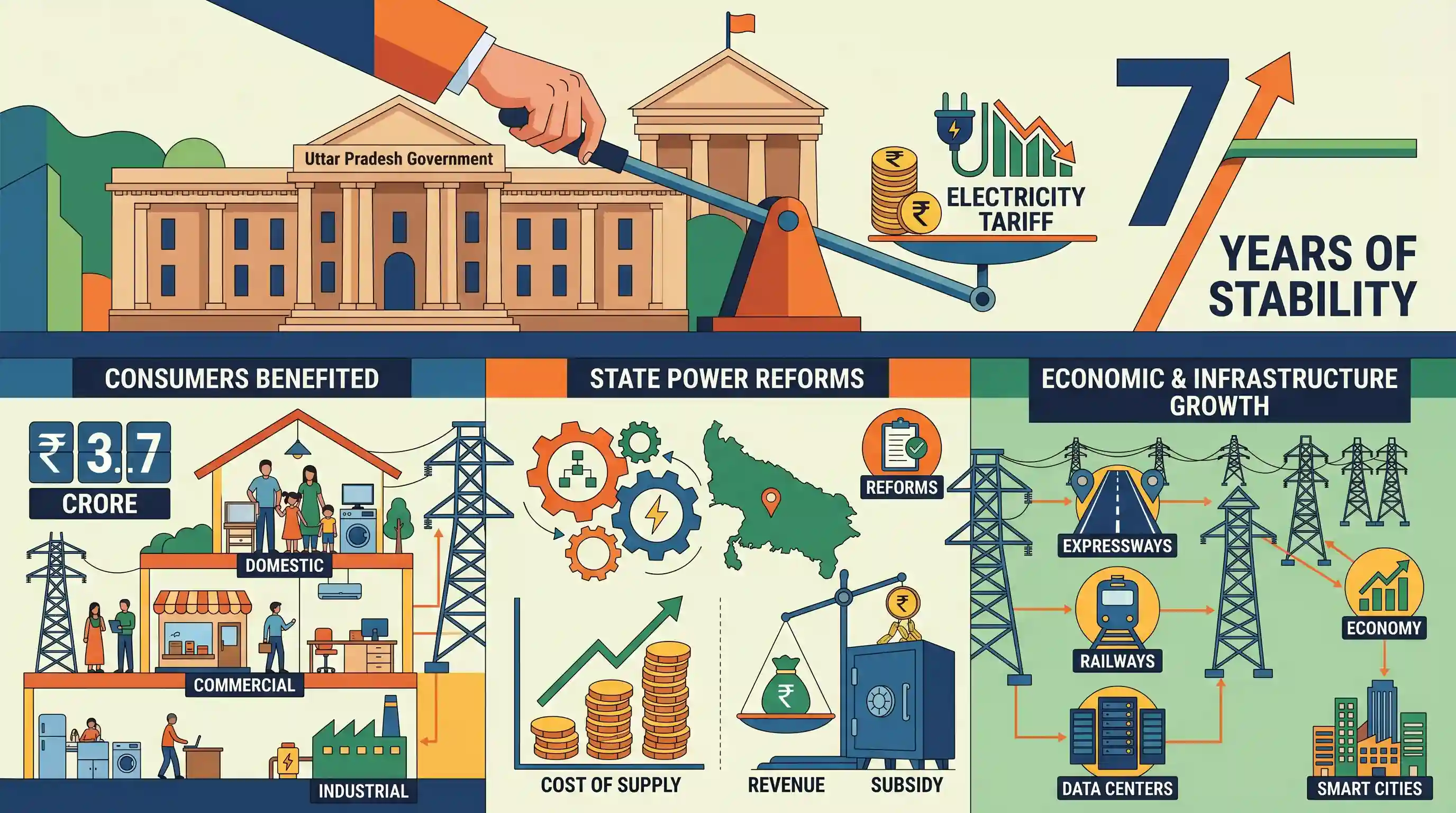
The Yogi Adityanath-led Uttar Pradesh government has announced that electricity tariffs in the state will remain unchanged for the seventh consecutive year. This decision offers significant financial relief to about 3.7 crore electricity consumers, spanning domestic, commercial, and other categories, maintaining price stability despite annual tariff revision reviews.
Key Points
- The Uttar Pradesh government has announced that there will be no increase in electricity tariffs for the seventh consecutive year.
- This relief measure directly benefits approximately 3.7 crore (37 million) electricity consumers across the state.
- The decision ensures that rates remain unchanged across all consumer categories, including domestic (homes), commercial (businesses/shops), and others.
- The state government has maintained this policy of stable electricity prices despite the routine annual tariff revision processes.
- Such measures intersect with power sector reforms and the financial performance of state power distribution companies (DISCOMs).
Important Terms
Electricity Act, 2003

A landmark Central legislation that consolidated India's electricity laws, unbundled state electricity boards, delicensed generation, introduced open access, and established central and state regulatory commissions to promote power sector competition.
UPSC context
GS Paper III (Infrastructure: Energy) — tests understanding of power sector liberalization, structural reforms, and regulatory architecture in India.
Ujwal DISCOM Assurance Yojana (UDAY)
A financial turnaround and operational reform scheme launched in 2015 by the Ministry of Power, enabling state governments to take over 75% of state-owned power distribution companies' debt to reduce interest burdens.
UPSC context
GS Paper III (Indian Economy, Infrastructure) — tests state debt management, fiscal federalism, and structural power reforms.
Uttar Pradesh Electricity Regulatory Commission (UPERC)
An autonomous statutory body corporate established under state law to regulate Uttar Pradesh's power sector, determine consumer electricity tariffs, promote system efficiency, and protect consumer interests.
UPSC context
GS Paper II & III (Statutory Bodies, State Infrastructure) — tests state-level regulatory governance, tariff-setting dynamics, and accountability.
DISCOMs
Utility companies responsible for the final stage of the power supply chain, namely purchasing bulk electricity from generators, distributing it to end-consumers, and collecting revenues.
UPSC context
GS Paper III (Infrastructure: Energy) — tests understanding of last-mile supply challenges, distribution losses, and sector viability.
Prelims Trap
State Electricity Regulatory Commissions are legally bound to comply with all policy directions on tariffs issued by state governments.
Under Section 108 of the Electricity Act 2003, SERCs are only 'guided by' state policy directives. They maintain independent, quasi-judicial autonomy over tariff determination.
Static Concepts Connected
What are 'Regulatory Assets' and the 'ACS-ARR Gap' in DISCOM operations?
- ACS-ARR Gap: Average Cost of Supply minus Average Revenue Requirement; the core metric measuring the structural and commercial viability of a DISCOM.
- Regulatory Assets: Unrecovered revenues deferred by regulators instead of raising tariffs, which artificially inflates DISCOM balance sheets while masking actual cash-flow losses.
- Supreme Court Mandate: The Supreme Court directed SERCs to clear accumulated regulatory assets within four years and capped new creations at 3% of ARR to enforce discipline.
What is the constitutional and statutory framework governing India's electricity sector?
- Concurrent List Status: Positioned in Entry 38 of List III (Concurrent List) of the Seventh Schedule, enabling concurrent legislative powers for Centre and States.
- SERC Autonomy: Established under the Electricity Act, 2003, ensuring independent, quasi-judicial tariff determination away from direct political executive control.
- Section 108 Limitation: States can issue policy directions under Section 108, but courts have clarified these are advisory, preserving the independent regulatory mandate of SERCs.
Cross-Topic Patterns
Tariff Freezes vs FRBM Discipline
Suppressing tariffs creates off-budget liabilities for states, directly undermining the fiscal consolidation targets set under FRBM Acts and Finance Commission guidelines.
Power Subsidies and Ecological Stress
Artificially low agricultural and domestic electricity tariffs lead to inefficient consumption, directly linking cheap power to rapid groundwater depletion in agricultural states.

Expect a 2026 question linking state DISCOM financial metrics (ACS-ARR) with constitutional provisions of federal fiscal borrowing limits.
Linked PYQs · 1
Linked PYQs · 1
- 2017UPPSC_PRELIMSGS1
Which of the following is not correctly matched?
