Kanwar Yatra transit management and safety protocols in Uttar Pradesh
Source:abp-live ↗
Why It Matters
Understanding large-scale administrative planning and transport logistics during massive socio-religious events is crucial for questions on state governance, public security, and tourism management in the UPPSC PCS exam.
Summary
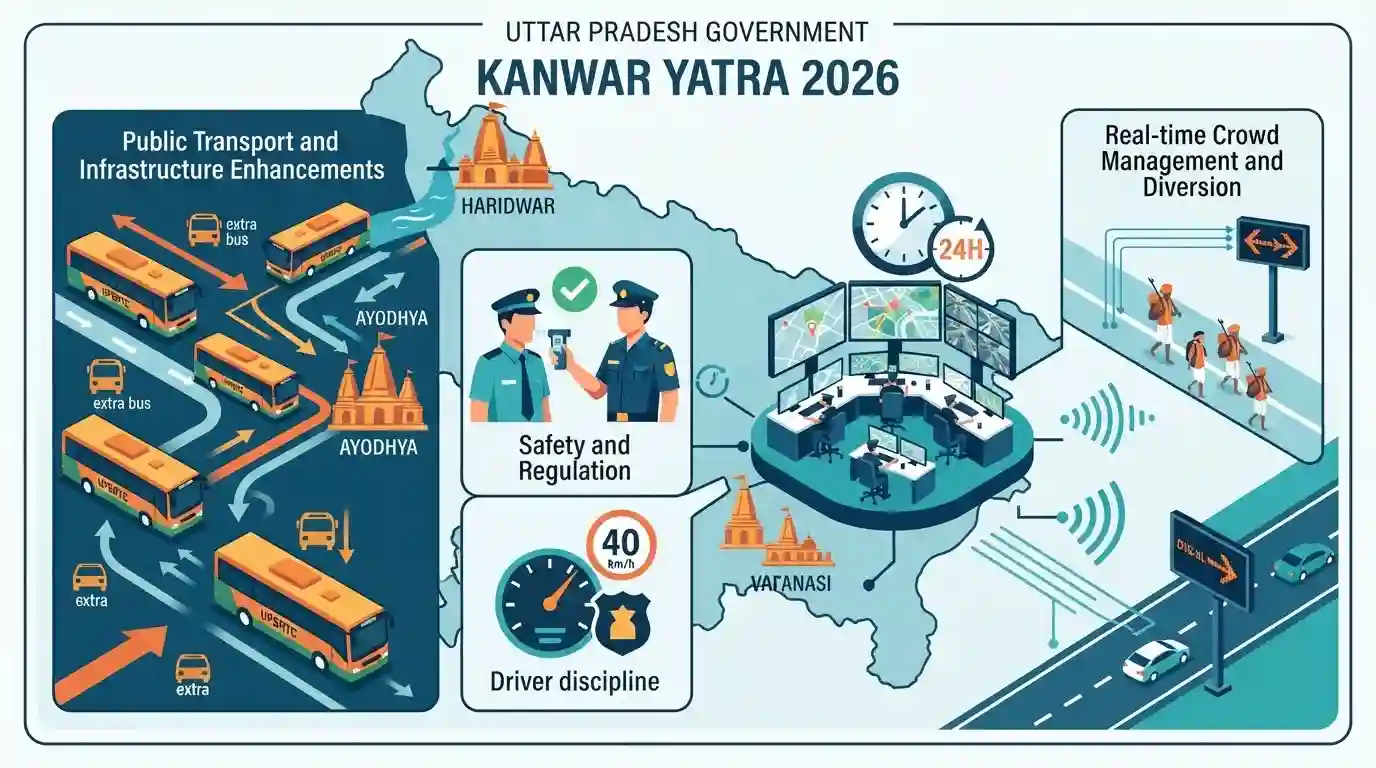
The Uttar Pradesh government has announced major infrastructural and safety plans for the Kanwar Yatra 2026. Handled primarily by the Uttar Pradesh State Road Transport Corporation (UPSRTC), the measures include deploying extra buses on routes leading to major religious centers, setting up 24-hour regional control rooms, and ensuring driver discipline through breathalyser tests and speed limits. Real-time digital communication will be utilized for route diversions to ensure smooth coordination between public transportation and pilgrim pathways.
Key Points
- The Uttar Pradesh government has put in place extensive transit and safety arrangements for the Kanwar Yatra 2026, commencing on July 30, 2026.
- The Uttar Pradesh State Road Transport Corporation (UPSRTC) will run additional buses to cater to pilgrims, specifically focusing on routes to Haridwar, Lucknow, Ayodhya, Gorakhpur, Varanasi, and Prayagraj.
- UPSRTC is establishing 24-hour control rooms at all regional headquarters to monitor transit operations around the clock throughout the pilgrimage.
- Strict safety protocols have been introduced, including mandatory breathalyser tests for UPSRTC drivers and strict adherence to speed limits.
- Real-time route diversion plans will be coordinated with police and district administrations and shared instantly via WhatsApp and other communication networks to minimize transit disruptions.
Important Terms
Kanwar Yatra

An annual Hindu pilgrimage in the Shravana month where Lord Shiva devotees (Kanwariyas) walk barefoot to collect holy Ganga water from Gangetic sites and carry it in decorated slings to offer at Shiva temples.
UPSC context
GS Paper I (Art & Culture) and GS Paper III (Disaster Management); tests preparation and crowd management during religious mass gatherings.
Uttar Pradesh State Road Transport Corporation (UPSRTC)
A government-owned public sector undertaking established in 1972 that manages passenger road transport services in Uttar Pradesh and neighboring states, operating one of North India's largest public bus fleets.
UPSC context
GS Paper II (Governance) and GS Paper III (Infrastructure); tests state PSU role in service delivery and logistical infrastructure.
Crowd Management
The systematic planning, monitoring, and orderly guidance of large gatherings to ensure safety, prevent stampedes, and regulate flow, heavily guided by NDMA frameworks and the Disaster Management Act, 2005.
UPSC context
GS Paper III (Disaster Management); tests administrative planning, standard operating procedures, and inter-agency coordination during large public events.
Prelims Trap
Ayodhya and Prayagraj were among the heritage cities selected from Uttar Pradesh under the HRIDAY scheme.
Only Varanasi and Mathura were selected from UP under the central HRIDAY scheme; Ayodhya and Prayagraj were not part of the 12 cities.
Static Concepts Connected
What are the key NDMA guidelines for managing mass gatherings?
- Crowd Flow Control: Recommends 'snake line' zig-zag queueing and physical barricading to control crowd velocity and prevent sudden surges.
- Emergency Corridors: Mandates clearly marked, unobstructed emergency exit tracks and dedicated medical corridors for rapid response.
- Capacity Monitoring: Requires estimating venue carrying capacity and using real-time technology like UAVs/CCTVs for dynamic crowd monitoring.
What is the geographical course of River Ganga within Uttar Pradesh?
- Entry and Exit: Enters Uttar Pradesh through the Bijnor district in the north and exits into Bihar via the Ballia district in the east.
- Territorial Coverage: Traverses approximately 28 districts of the state, serving as the lifeline of UP's agricultural plains.
- Tributary Network: Receives major tributaries like the Ramganga, Yamuna, and Ghaghara within the state boundaries.
Cross-Topic Patterns
Pilgrimage Tourism + Social Welfare
State-subsidized schemes like the Swami Vivekanand Yatra Yojna merge labor welfare with cultural tourism, creating new socioeconomic dynamics in state planning.
Disaster Management + Public Infrastructure
Integrating NDMA mass-gathering guidelines into transport logistics highlights how administrative preparedness prevents high-density crowd disasters.

NDMA crowd management guidelines and Ganga's UP hydrology are highly likely to feature in multi-statement GS Prelims questions.
Linked PYQs · 3
Linked PYQs · 3
- 2021UPPSC_PRELIMSGS1
'Uttar Pradesh Swami Vivekanand Etihasik Paryatan Yatra Yojna 2021' was introduced by the U.P. Government for which of the following people for religious travel ?
- 2023UPPSC_PRELIMSGS1
Which of the following Scheme/Programme is not the Central Government Programme and it is Uttar Pradesh Government's Programme?
- 2020UPPSC_PRELIMSGS1
Which of the following cities of Uttar Pradesh is/are covered under the 'Heritage City Development and Augmentation Yojana (HRIDAY)' ? 1. Varanasi 2. Mathura 3. Prayagraj 4. Ayodhya Select the correct answer from the codes given below.
