Uttar Pradesh introduces solar hour tariff discount for EV charging
Source:indianmasterminds ↗
Why It Matters
The UP government's solar-hour tariff discount and stable power pricing showcase state-level interventions for accelerating renewable energy adoption, managing unprecedented electricity demand, and expanding EV infrastructure, which are core topics in UPPSC and UPSC infrastructure, economic development, and environmental conservation papers.
Summary
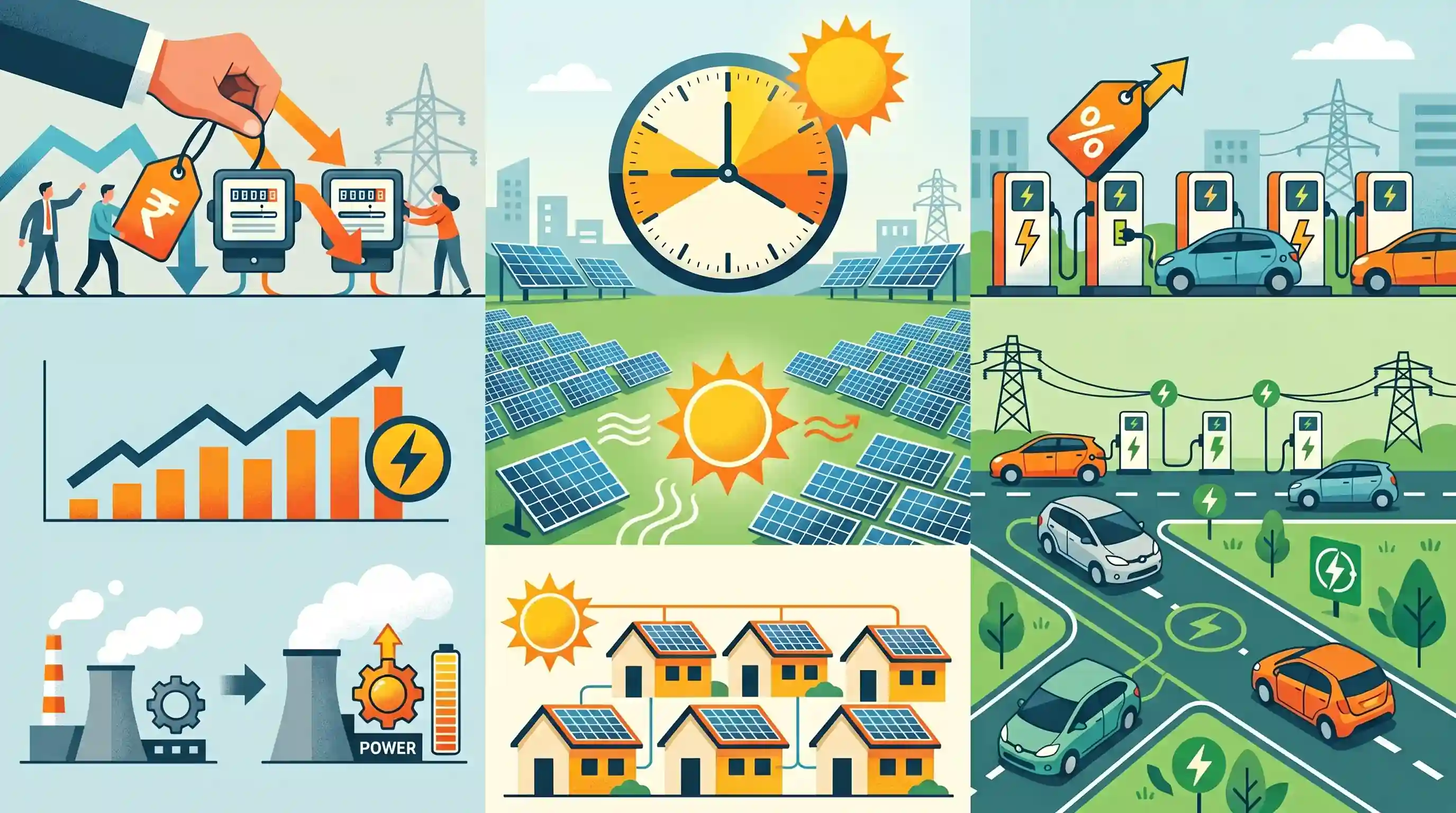
The Uttar Pradesh government has announced a 20% electricity tariff discount during solar hours (9 AM to 4 PM) to boost public EV charging infrastructure and green energy usage. Under Chief Minister Yogi Adityanath, the state has avoided tariff hikes for seven consecutive years, achieved a record-breaking peak power demand of 32,673 MW, and significantly expanded its solar and thermal power capabilities. This includes over 4,000 MW in solar parks, 2,500 MW under the PM Surya Ghar scheme, and an increase in thermal plant efficiency (PLF) from 65% to 85%.
Key Points
- The Uttar Pradesh government has introduced a 20% tariff discount during designated 'solar hours' (9 AM to 4 PM) to incentivize EV charging and the adoption of green energy.
- The state has kept electricity tariffs stable with no hikes across any consumer categories for seven consecutive years.
- Uttar Pradesh successfully met a record-breaking peak electricity demand of 32,673 MW, showcasing enhanced distribution and infrastructure capacity.
- UP has developed over 4,000 MW of capacity through solar parks, with an additional 2,500 MW under development through the PM Surya Ghar: Muft Bijli Yojana.
- The efficiency of thermal power plants in regions like Mirzapur and Meja has significantly improved, raising the Plant Load Factor (PLF) from 65% to nearly 85%.
Important Terms
PM Surya Ghar: Muft Bijli Yojana

A Central Sector Scheme launched in 2024 to provide up to 300 units of free monthly electricity to one crore Indian households through subsidized rooftop solar installations.
UPSC context
GS Paper III (Energy/Infrastructure) – tests solar energy policies, central schemes, and India’s net-zero transition targets.
Time-of-Day (ToD) Tariff
An electricity pricing mechanism that varies rates across the day, offering lower tariffs during off-peak/solar hours and higher rates during peak hours to manage grid demand.
UPSC context
GS Paper III (Infrastructure/Energy Reforms) – tests demand-side management, pricing strategies, and smart grid technology adoption.
Plant Load Factor (PLF)
A key operational efficiency metric measuring a power plant's capacity utilization, calculated as the ratio of actual energy produced to its maximum potential output.
UPSC context
GS Paper III (Energy Infrastructure) – tests understanding of thermal power efficiency, utility performance, and grid economics.
Uttar Pradesh Power Corporation Limited (UPPCL)
The state-owned power utility responsible for electricity planning, transmission, and retail distribution through regional distribution companies across Uttar Pradesh.
UPSC context
GS Paper II/III (State Infrastructure & Administration) – tests regional utility reforms, power procurement, and distribution challenges.
Prelims Trap
Time of Day solar-hour discounts are optional state initiatives rather than federally mandated rules under central electricity guidelines.
The ToD tariff framework is mandated nationally by the Union Ministry of Power via the Electricity Rules, 2020, rather than being an isolated, optional state-level policy initiative.
Static Concepts Connected
What is a Time of Day (ToD) tariff, and how does it aid grid management?
- Basic Mechanism: ToD tariffs charge varying electricity rates based on the time of day, aligning consumption costs with real-time grid generation costs.
- Solar-hour Incentives: Reduced daytime tariffs (10-20% lower) incentivize heavy power-use activities, like EV charging, during peak solar generation hours.
- Grid Stability: Flattening the load curve reduces reliance on expensive peak-power sources, supporting smoother renewable energy integration into the national grid.
What are Plant Load Factor (PLF) and Ultra-Supercritical Technology in power generation?
- Plant Load Factor: PLF measures the output efficiency of a power plant, indicating the ratio of actual energy generated to its maximum potential output over time.
- Ultra-supercritical Technology: Operates at water pressures and temperatures above the thermodynamic critical point, significantly improving conversion efficiency and lowering per-unit coal consumption.
Cross-Topic Patterns
ToD Tariffs as EV Mobility Accelerators
Aligning solar power peaks with public EV charging discounts creates a self-sustaining ecosystem, solving grid-balancing challenges while lowering the running costs of electric mobility.
Cooperative Federalism in Renewable Deployment
State-level implementation of central schemes like PM Surya Ghar highlights how sub-national power reforms are crucial to achieving India's national COP carbon-reduction commitments.

The integration of ToD tariffs with EV infrastructure under the national Electricity Rules is a prime target for a 2026 grid-policy question.
Linked PYQs · 3
Linked PYQs · 3
- 2020UPPSC_PRELIMSGS1
In which of the following districts of U.P. a major solar power plant was established in collaboration with France in 2018 ?
- 2020UPPSC_PRELIMSGS1
Which of the following Indian States/Union Territories launched Electric Vehicle Policy on 7th August, 2020 ?
- 2022UPPSC_PRELIMSGS1
The first airport powered by solar energy in India is
