UP announces financial aid for students and medical cover for teachers
Source:indiatoday ↗
Why It Matters
Understanding state-level initiatives is highly relevant for the UPPSC Prelims, especially schemes concerning basic education (DBT for school essentials) and healthcare coverage for private sector educators. Questions frequently target beneficiary details and state welfare policies.
Summary
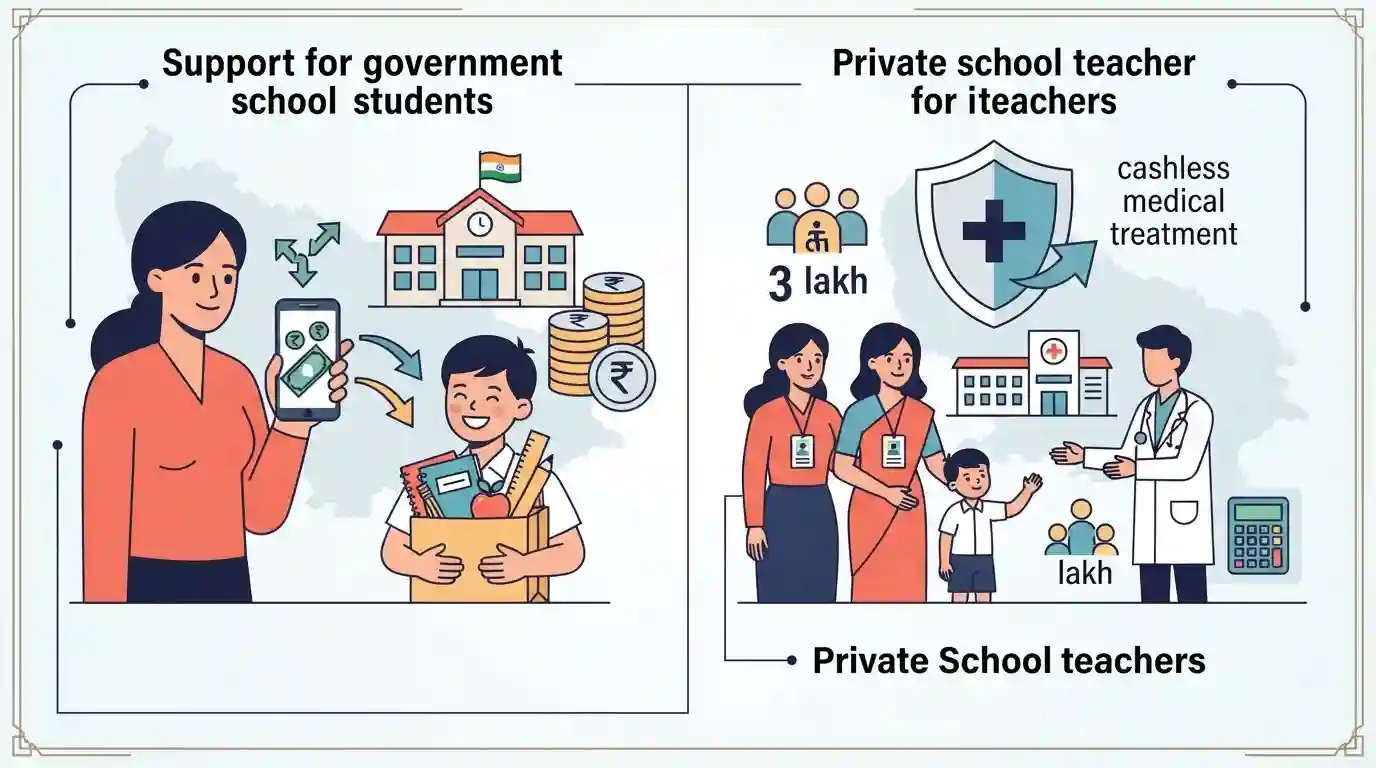
The Uttar Pradesh government has announced welfare measures targeting both the public and private education sectors. It plans to provide Rs 1,200 through Direct Benefit Transfer (DBT) to parents of government school students for school supplies, and aims to extend cashless medical treatment benefits to approximately 3 lakh private-school teachers and their dependants.
Key Points
- The Uttar Pradesh government will provide Rs 1,200 via Direct Benefit Transfer (DBT) to about 10 lakh newly enrolled students in government primary and upper primary schools.
- The financial aid is intended for purchasing essential school supplies like uniforms, shoes, and socks, and covers a total target of 1.35 crore students (with 1.10 crore already covered).
- The government is simultaneously preparing a scheme to offer cashless medical treatment to around 3 lakh teachers in 35,000 private schools across the state.
- This medical scheme will also cover the private-school teachers' dependants, expanding healthcare support beyond government-school teachers.
Important Terms
Direct Benefit Transfer (DBT)

A governance mechanism that directly transfers government subsidies and financial assistance into the bank accounts of beneficiaries, reducing leakages and eliminating middlemen.
UPSC context
Vital for GS Paper 2 and 3; tests knowledge of governance transparency, e-governance, and welfare scheme implementation.
Mukhyamantri Shikshak Cashless Chikitsa Yojana
A state-level health initiative in Uttar Pradesh offering cashless medical treatment up to Rs 5 lakh annually to educators, including private and aided school teachers, and their dependants.
UPSC context
Relevant to GS Paper 2 (Social Justice). Showcases state-level adaptations of health insurance models similar to Ayushman Bharat.
Universal Health Coverage (UHC)
A healthcare framework ensuring that all individuals have access to essential health services—including prevention, treatment, and rehabilitation—without suffering financial hardship.
UPSC context
Core topic in GS Paper 2 (Health). Used to evaluate government health schemes and the reduction of out-of-pocket expenditure.
Prelims Trap
"The Right to Education (RTE) Act specifically mandates Direct Benefit Transfers (DBT) to parents for purchasing school uniforms."
RTE mandates free entitlements (books, uniforms), but the delivery mechanism (DBT vs. in-kind) is decided by the State Government. The Act itself does not mandate cash transfers.
Static Concepts Connected
How does the Direct Benefit Transfer (DBT) mechanism function in Indian governance?
- JAM Trinity: Jan Dhan bank accounts, Aadhaar biometric authentication, and Mobile numbers form the foundational digital infrastructure for targeted welfare delivery.
- Primary Objective: It aims to eliminate ghost beneficiaries, reduce leakages, and bypass middlemen to ensure precision and speed in subsidy distribution.
- Nodal Agency: The DBT Mission, currently functioning under the Cabinet Secretariat, coordinates and implements the mechanism across various Central and State ministries.
What is Out-of-Pocket Expenditure (OOPE) in India's healthcare system?
- Definition: Direct payments made by individuals to healthcare providers at the time of service use, which are not covered by insurance or state provisions.
- Economic Impact: High OOPE (historically over 45% of total health expenditure in India) is a primary factor pushing millions of vulnerable families into poverty annually.
- Universal Health Coverage: Expanding cashless schemes to uncovered groups (like private teachers) aligns with UHC goals to reduce catastrophic health expenditures and lower OOPE.
Cross-Topic Patterns
RTE Entitlements + Direct Benefit Transfers
The shift from in-kind distribution (uniforms, bicycles) to direct cash transfers reflects evolving governance models in education, balancing administrative efficiency against the risk of fund diversion by parents.
Universal Health Coverage + Unaided Sectors
Extending state-funded health insurance to private-school teachers mirrors recent legislative trends (like Rajasthan's Gig Worker Act) aiming to bring unregulated or unaided sector employees under a formal social security net.

Expect a GS-2 question evaluating how shifting from in-kind education welfare to DBT impacts actual RTE compliance and learning.
Linked PYQs · 2
Linked PYQs · 2
- 2025UPPSC_PRELIMSGS1
Which of the following Department prepares the National Indicator Framework Progress Report related to Sustainable Development Goals in Uttar Pradesh? 1. Department of Finance 2. Department of Education 3. Department of Planning Select the correct answer from the code given below:
- 2023UPPSC_PRELIMSGS1
Which of the following Scheme/Programme is not the Central Government Programme and it is Uttar Pradesh Government's Programme?
