UP Government Clears Free Scooty Scheme for Female Students
Source:abplive ↗
Why It Matters
State-specific welfare schemes, especially those focused on women and education, are high-yield topics for UPPSC Prelims. Specific details like eligibility criteria (e.g., income limits, target demographics) and naming conventions (Rani Lakshmibai Scooty Yojana) are standard targets for factual MCQs.
Summary
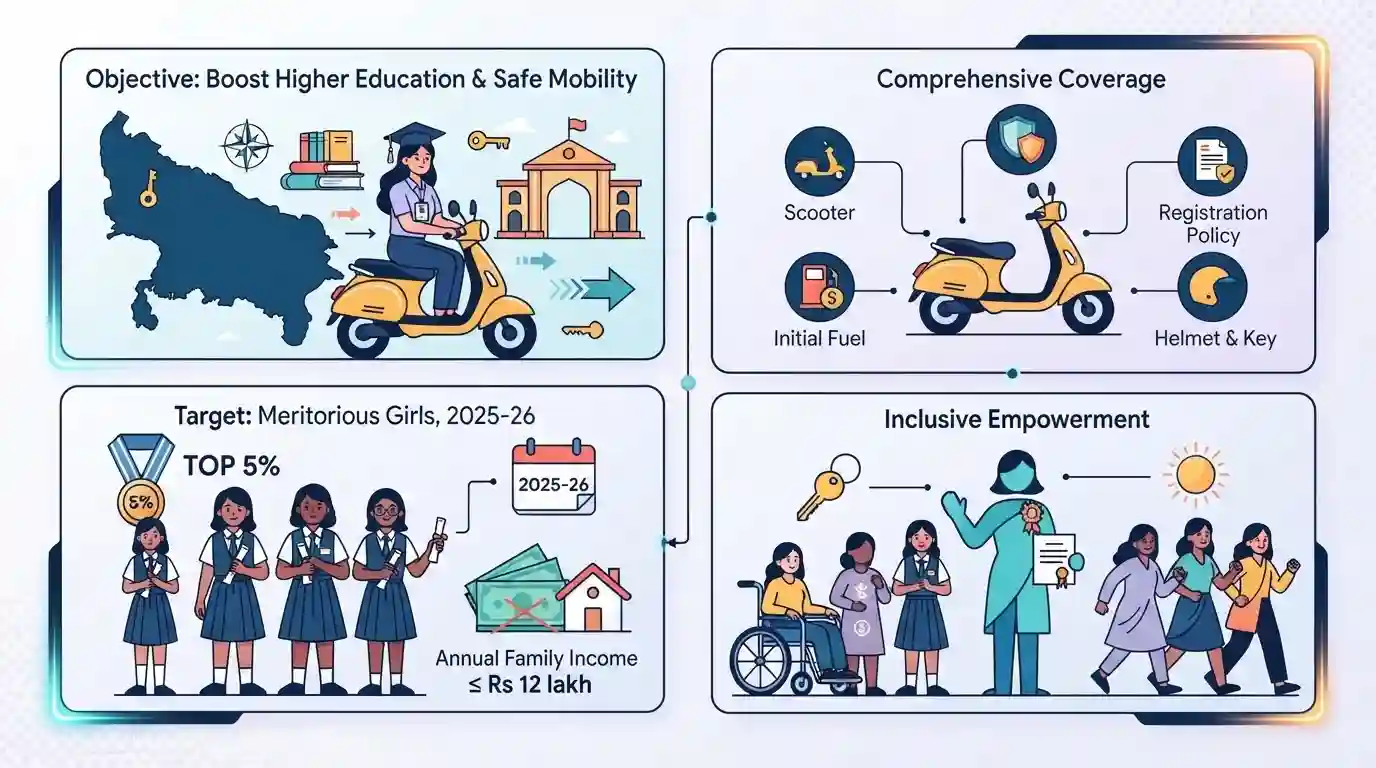
The Uttar Pradesh cabinet has greenlit the 'Rani Lakshmibai Scooty Yojana', a welfare scheme offering free scooters to meritorious undergraduate college-going girls. Spearheaded to boost higher education and ensure safe mobility among women, the scheme targets girls falling in the top 5% merit list of the 2025-26 academic session, provided their annual family income does not exceed Rs 12 lakh. The initiative includes comprehensive provisions covering the cost of the scooter, registration, insurance, helmet, and initial fuel. Exemptions from the merit requirement have been established for vulnerable groups, ensuring inclusive women empowerment.
Key Points
- The UP Government has approved the 'Rani Lakshmibai Scooty Yojana' to distribute free scooters to eligible college-going girls.
- Around 50,000 girl students who are in the top five per cent of undergraduate examinees for the 2025-26 academic session will benefit this year.
- Eligibility criteria include an annual family income of less than Rs 12 lakh and a valid driving licence.
- Exemptions from the merit criterion are granted to girls from families of martyrs, destitute families, and those with disabilities.
- The provision includes a petrol-powered scooty, helmet, accessories, and 5 litres of petrol, with the government covering registration and insurance.
- The scheme aims to ensure safe mobility for women, promote women empowerment, and encourage girls to pursue higher education.
Prelims Trap
"Provides free electric scooters exclusively to BPL category girls to promote green mobility."
The scheme provides petrol-powered scooters (not EVs) and targets the top 5% merit list with an income cap of 12 lakh, not exclusively BPL.
Static Concepts Connected
How do mobility interventions impact female Gross Enrolment Ratio (GER)?
- Distance as barrier: Transport costs and safety concerns during long commutes are primary drivers of female dropout rates at the higher education level.
- Asset transfer success: Pioneered by Bihar's Cycle Yojana, providing targeted transport assets directly correlates with narrowing the gender gap in secondary and tertiary enrollment.
- Empowerment multiplier: Independent mobility enhances female agency, leading to higher participation in vocational skilling, internships, and eventually the workforce.
What is Gross Enrolment Ratio (GER) in Higher Education?
- Definition: It calculates total enrollment in higher education as a percentage of the eligible official population, typically the 18-23 age group.
- AISHE Tracking: Tracked by the MoE's All India Survey on Higher Education (AISHE). Recent reports show female GER has been steadily catching up to or marginally surpassing male GER in certain states.
Cross-Topic Patterns
Safe Mobility and Female Labor Force
Mobility interventions for women directly link GS2 (education/welfare) with GS3 (economic growth). Bridging transport safety gaps is a proven catalyst for improving Female Labor Force Participation (FLFP).
Affirmative Action in Asset Transfers
The policy balances meritocracy (top 5% requirement) with social justice by granting blanket exemptions to PwDs and destitute families. Excellent case study for GS2 policy design questions.

Expect GS-2 Mains questions analyzing how targeted mobility assets (cycles/scooters) overcome patriarchal and infrastructure barriers.
Linked PYQs · 3
Linked PYQs · 3
- 2023UPPSC_PRELIMSGS1
Which of the following scheme/s is/are related to Uttar Pradesh? (1) Anuthee Uphar Scheme (2) Matra Shakti Udyamita Scheme (3) Kaushalya Matritva Scheme (4) Stree Nidhi Scheme Select the 'correct' answer using the code given below -
- 2021UPPSC_PRELIMSGS1
Which of the following Schemes in Uttar Pradesh were introduced in Budget of 2021-22? I. Atmanirbhar Krishak Samanvit Vikas Yojna II. Mukhya Mantri Saksham Suposhan Yojna III. Mukhya Mantri Pravasi Shramik Udyamita Vikas Yojna IV. Yuva Udyamita Vikas Abhiyan Select the correct answer from the codes given below.
- 2023UPPSC_PRELIMSGS1
Which of the following Scheme/Programme is not the Central Government Programme and it is Uttar Pradesh Government's Programme?
