Uttar Pradesh Food Safety Inspection and Adulteration Drive
Source:timesofindia ↗
Why It Matters
Understanding the enforcement of food safety regulations, state administration powers under the FSS Act of 2006, and issues relating to chemical food adulterants (like synthetic dyes) is highly relevant for both GS Paper II (Regulatory Bodies) and GS Paper III (Food Processing & Public Health) in the UPPSC PCS Prelims.
Summary
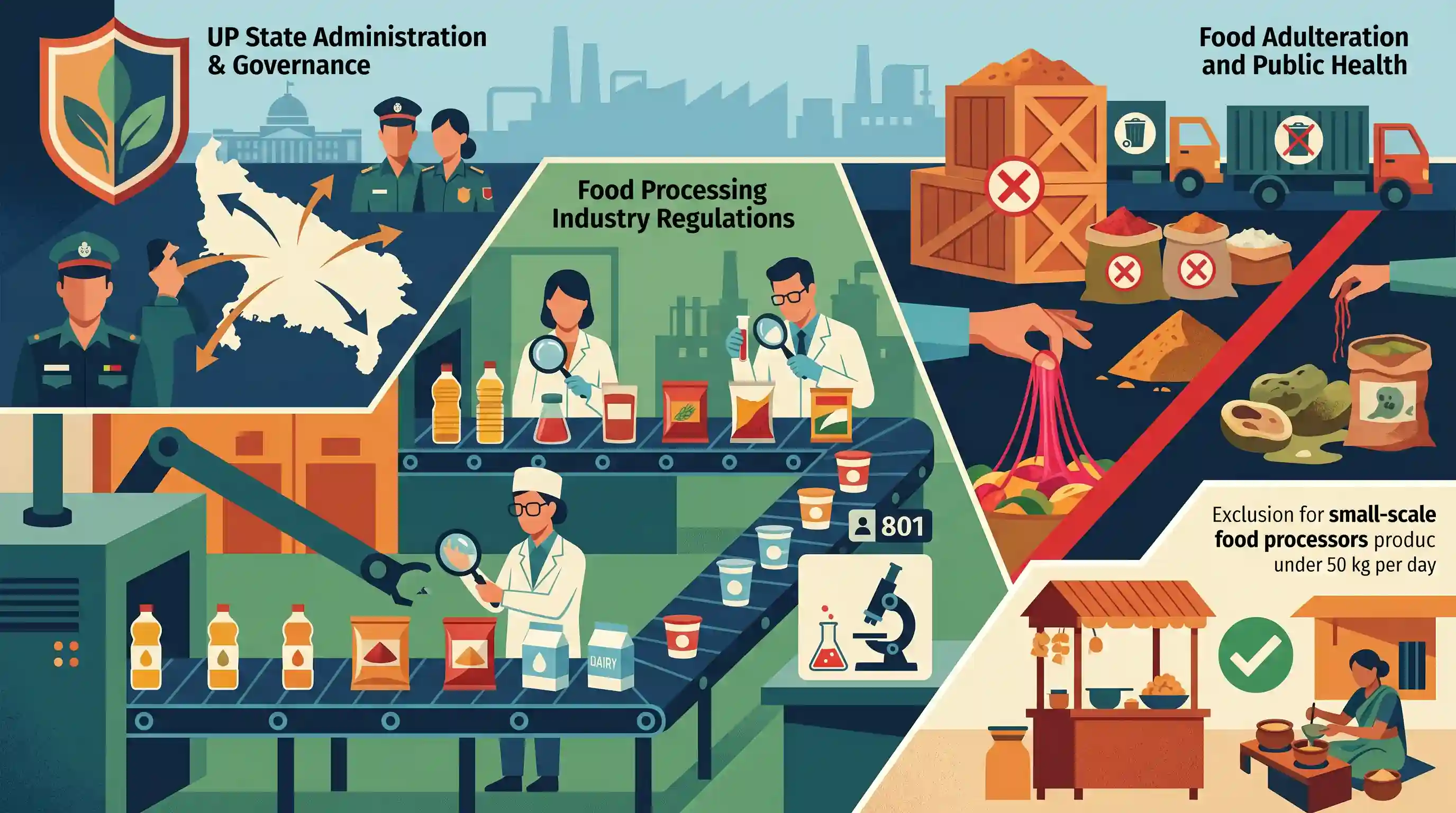
The Uttar Pradesh Food Safety and Drug Administration (FSDA) executed a state-wide enforcement and inspection campaign targeting processed food manufacturers and distributors. Over the course of the drive, 801 samples were sent for laboratory chemical analysis, and large quantities of adulterated or unhygienic foods, including synthetic dye-adulterated items, were seized or destroyed. Small-scale food processors producing under 50 kg per day were excluded from this inspection drive.
Key Points
- The Food Safety and Drug Administration (FSDA) of Uttar Pradesh launched a massive food safety drive across 496 establishments, collecting 801 food samples for laboratory testing.
- The enforcement drive seized 338.61 quintals of food products (valued at Rs 27.77 lakh) and destroyed 259.33 quintals of unfit/unhygienic food items (valued at Rs 17.56 lakh).
- FIRs were filed in Shahjahanpur (for selling spoiled fennel seeds colored with synthetic dye) and Unnao (for manufacturing fake sauce with synthetic colors).
- The operations targeted manufacturers and distributors of processed foods like sauces, jams, jellies, mayonnaise, and chutneys, while excluding small retailers producing less than 50 kg of food per day.
- Inspections and seizures took place across multiple key industrial and commercial districts in UP, including Lucknow, Kanpur, Ghaziabad, Mathura, Hathras, and Muzaffarnagar.
Important Terms
Food Safety and Standards Act, 2006

A comprehensive Indian legislation that consolidated multiple legacy laws to establish a unified framework regulating food manufacture, storage, distribution, sale, and import, ensuring safe and wholesome food for public consumption.
UPSC context
GS Paper II & III: Essential statutory framework governing regulatory bodies, agricultural processing standards, and consumer safety rights.
Food Safety and Standards Authority of India (FSSAI)
An autonomous statutory body under India's Ministry of Health and Family Welfare responsible for setting science-based food standards, licensing food businesses, and promoting food safety and hygiene nationwide.
UPSC context
GS Paper II: Represents a critical statutory regulatory body testing health governance, safety compliance mechanisms, and institutional accountability.
Food Safety and Drug Administration (FSDA), Uttar Pradesh
The state-level executive department in Uttar Pradesh responsible for implementing and enforcing food safety regulations and pharmaceutical standards to protect public health.
UPSC context
GS Paper II: Focuses on state-level administrative machinery, center-state coordination, and governance challenges in local regulatory enforcement.
Food Business Operator (FBO)
Any individual or entity carrying out a food business at any stage of production, processing, storage, distribution, or sale, legally responsible for ensuring compliance with food safety norms.
UPSC context
GS Paper III: Key economic stakeholder in food processing, regulatory ease of doing business, and compliance frameworks.
Prelims Trap
Adulteration of foodstuffs is a State List (List II) subject, given that state-level bodies conduct the raids and licensing.
It actually falls under Entry 18 of the Concurrent List (List III), giving both Central and State governments jurisdiction to legislate and enforce.
Static Concepts Connected
Under which constitutional provisions and ministry does food safety regulation in India operate?
- Constitutional division: Under Entry 18 of List III (Concurrent List), both Center and States hold legislative jurisdiction over food adulteration.
- Statutory consolidation: The FSSA 2006 consolidated multiple legacy laws to establish FSSAI as a single, unified national authority.
- Nodal ministry: FSSAI is an autonomous body under the Ministry of Health and Family Welfare, not the Ministry of Consumer Affairs.
What are the biological and chemical public health hazards targeted by food safety inspections?
- Toxic synthetic dyes: Industrial synthetic dyes like Rhodamine B and Auramine O are strictly banned in food due to cytotoxic, mutagenic, and carcinogenic properties.
- Pathogenic anaerobic bacteria: An anaerobic bacterium, Clostridium botulinum, produces lethal neurotoxins in improperly canned or unhygienically stored foods, causing paralytic botulism.
Cross-Topic Patterns
Concurrent List overlap in public health
Center sets uniform FSSAI standards while state-level FSDAs handle ground enforcement and prosecution, showcasing cooperative federalism in consumer protection.
Regulatory ease for micro-enterprises
Excluding micro-scale food processors from aggressive inspections reflects a policy balancing public health mandates with ease of doing business for the unorganized sector.

FSSAI's updated 2026 licensing thresholds combined with food adulteration's Concurrent List status are prime targets for a 2026 prelims MCQ.
Linked PYQs · 2
Linked PYQs · 2
- 2021UPPSC_PRELIMSGS1
Botulism is
- 2019UPPSC_PRELIMSGS1
With reference to the National Food Security Act, which of the following statements is/are correct? I. It will cover upto 75 percent rural and 50 percent urban population. II. Special focus on nutritional support to women and children. III. Eldest woman of above 18 years age will be head of household. Select the correct answer using the codes given below:
