Uttar Pradesh implements drone surveys to ensure zero river discharge
Source:The Hindu ↗
Why It Matters
Crucial for UPPSC aspirants tracking state-specific environmental governance, pollution abatement policies, and technological interventions like drone surveys used in natural resource management.
Summary
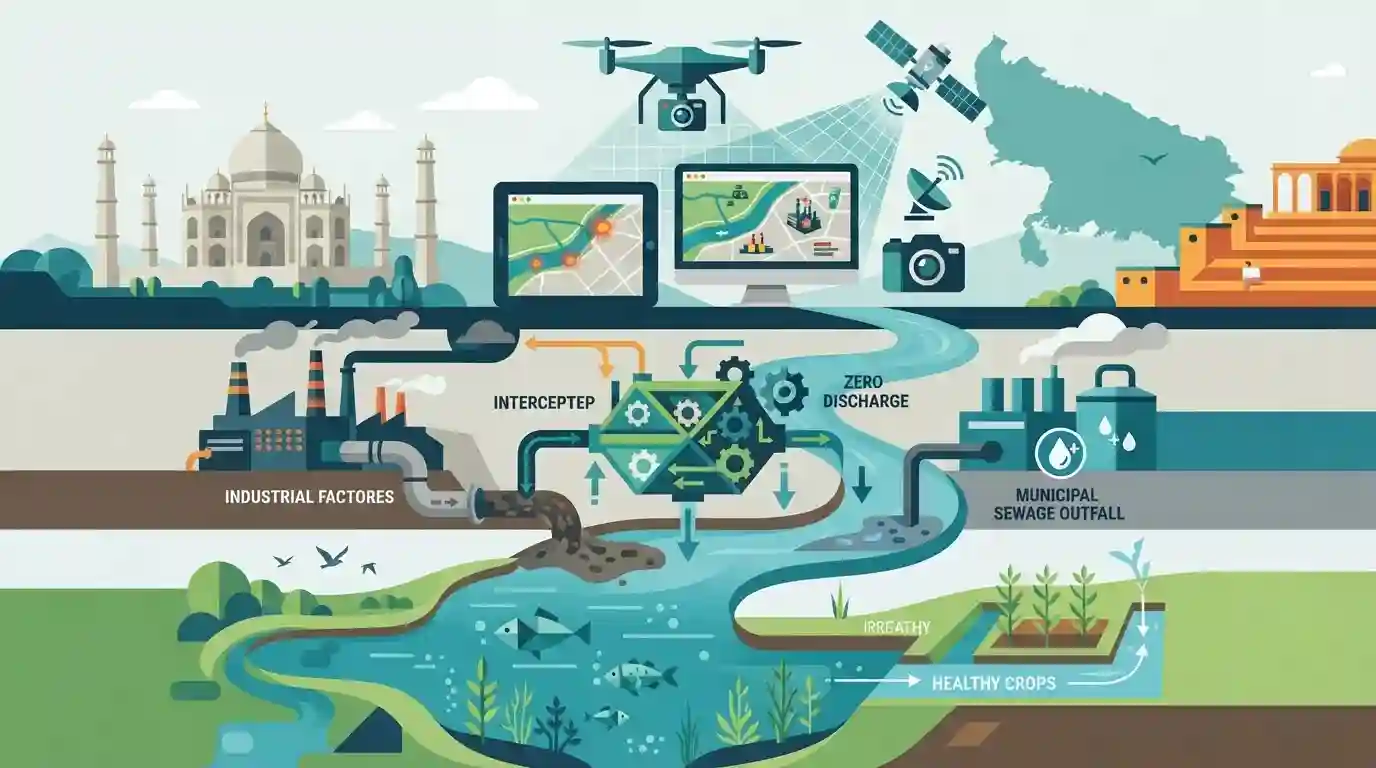
The Uttar Pradesh government has initiated a rigorous multi-layered framework, integrating drone surveys, digital mapping, and strict surveillance, to attain 'zero discharge' of industrial and municipal waste into its river systems, thereby addressing severe ecological challenges plaguing water bodies like the Ganga and Yamuna.
Key Points
- Uttar Pradesh has adopted a multi-layered approach involving drone surveys and real-time tracking to ensure 'zero discharge' of untreated sewage and industrial effluents into rivers.
- The initiative targets major river basins in the state to check clandestine discharge points and improve water quality parameters like BOD and DO.
- Combating industrial and domestic pollution aligns with state and national commitments to rejuvenate critical rivers such as the Ganga and Yamuna.
Important Terms
Safe Reuse of Treated Water Policy

A policy framework by the Uttar Pradesh government targeting the treatment and reuse of wastewater to curb freshwater extraction, aiming to reuse 50% of treated wastewater by 2030 and 100% by 2045.
UPSC context
Crucial for UPPSC Mains (GS Paper III - Environment, Pollution Control, and Uttar Pradesh Specific Developments). Tests understanding of state-level circular economy and water conservation strategies.
GIS-based Drain Dashboard
A centralized spatial tool utilizing high-resolution aerial and LiDAR surveys to map river conditions, track municipal and industrial drain outflows, and monitor pollution basin-wide in real time.
UPSC context
Important for UPPSC Mains (GS Paper III / General Studies relating to UP) on e-governance, application of technology in environmental management, and pollution surveillance.
National Green Tribunal
A statutory body established under the National Green Tribunal Act, 2010, for effective and expeditious disposal of cases relating to environmental protection, forest conservation, and pollution control.
UPSC context
Vital for UPPSC Mains (GS Paper II - Statutory Bodies / GS Paper III - Environmental Governance). Frequently questions judicial enforcement against polluting state agencies.
Ganga Action Plan
India's first major river conservation mission launched in 1986 to abate pollution in the Ganga River through sewage interception, diversion, and treatment plants, later integrated into broader frameworks.
UPSC context
Essential for UPPSC Prelims and Mains (Environment and Ecology, Historical evolution of river cleaning schemes in India and Uttar Pradesh).
Static Concepts Connected
What are the key statutory bodies and Acts governing water pollution control in India?
- Water Act 1974: The Water (Prevention and Control of Pollution) Act, 1974 was enacted to provide for the prevention and control of water pollution and the maintenance or restoration of wholesomeness of water.
- CPCB and SPCBs: The Central Pollution Control Board (CPCB) and State Pollution Control Boards (SPCBs) were constituted under this Act to execute its mandates.
- NGT Act 2010: The National Green Tribunal (NGT) Act, 2010 provides a specialized fast-track tribunal for effective implementation of environmental laws and compensation.
Cross-Topic Patterns
GIS Technology in Environmental Governance
UPPSC frequently tests the intersection of emerging technologies (GIS mapping, drone surveys) with traditional environmental governance frameworks like the Water (Prevention and Control of Pollution) Act.
Namami Gange and NGT Mandates
River rejuvenation initiatives like Namami Gange connect local municipal administration with national ecological conservation targets under NGT mandates.

UPPSC Mains GS-5/GS-3 may test UP's technological interventions (drone surveys, GIS Drain Dashboards) in river pollution control.
Linked PYQs · 3
Linked PYQs · 3
- 2018UPPSC_PRELIMSGS1
Which of the following rivers of Uttar Pradesh has been declared a 'Biological Disaster' due to environmental pollution?
- 2022UPPSC_PRELIMSGS1
The main purpose of 'Ganga Action Plan' project, launched in 1985, was
- 2023UPPSC_PRELIMSGS1
Which of the following statement is correct? (1) Ram Ganga river joins the Ganga at Kannauj. (2) River Betwa joins the Yamuna near Prayagraj. Select the correct answer using the code given below –
