UP Adopts Multi-Layered Approach for Zero Discharge into Rivers
Source:The Hindu ↗
Why It Matters
Crucial for understanding Uttar Pradesh's environmental governance policies, ecological restoration initiatives for major river networks like Ganga and Yamuna, and technology-driven administrative monitoring.
Summary
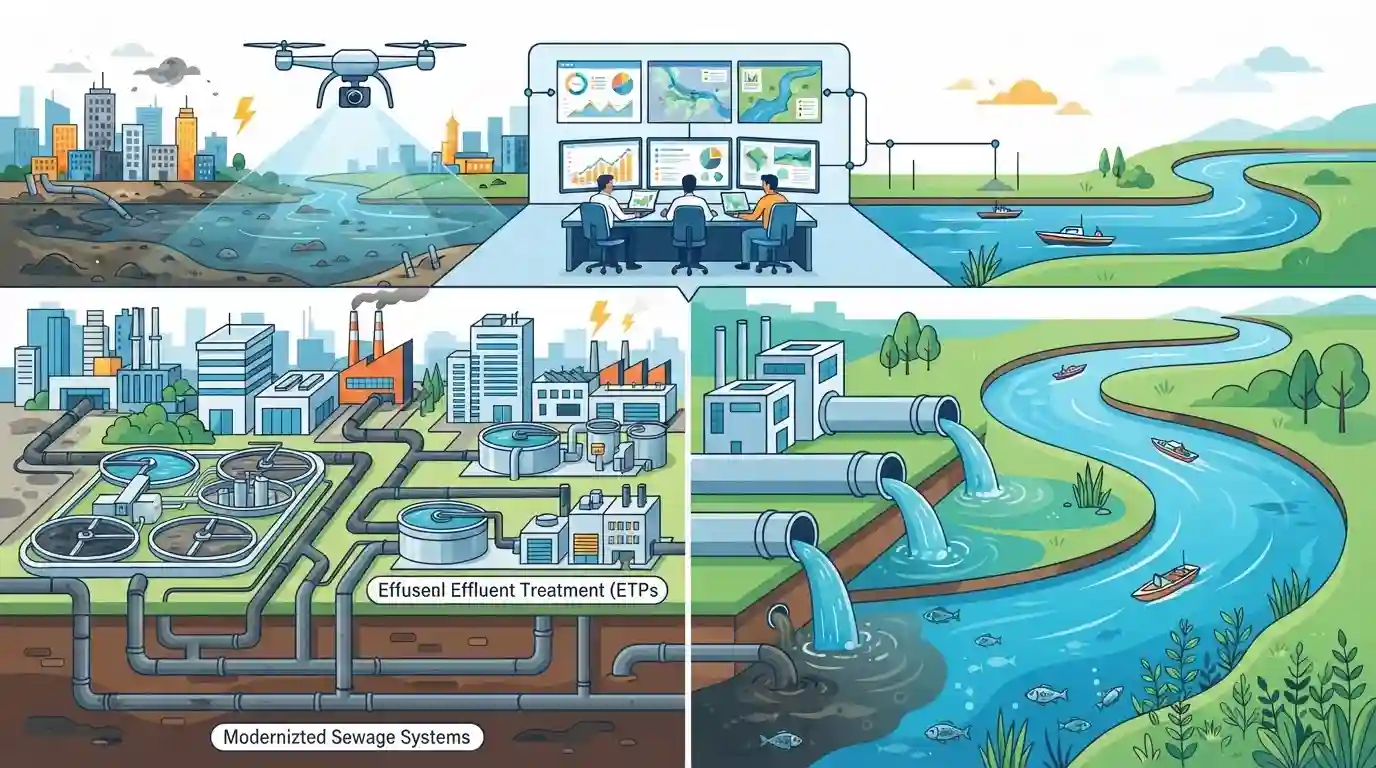
The Uttar Pradesh government has initiated a comprehensive, multi-layered strategy aiming for 'zero discharge' of untreated waste into its rivers. By deploying advanced technologies such as drone surveys alongside enhanced sewage and industrial effluent treatment infrastructure, the state targets chronic water pollution issues plaguing river systems like the Ganga and Yamuna.
Key Points
- Uttar Pradesh has adopted a multi-layered approach to achieve zero discharge of untreated sewage and industrial effluents into state rivers.
- The strategy integrates modern technologies including drone surveys for real-time monitoring and mapping of drainage and discharge points.
- Efforts are focused on upgrading Sewage Treatment Plants (STPs) and Common Effluent Treatment Plants (CETPs) to prevent river pollution in vital river basins like the Ganga and Yamuna.
Important Terms
Namami Gange

An integrated conservation mission approved as a flagship program by the Union Government in 2014 to accomplish the twin objectives of abatement of pollution, conservation, and rejuvenation of the National River Ganga.
UPSC context
Important for GS Paper III (Environment, Conservation) and UPPSC Prelims/Mains regarding river rejuvenation schemes and state-level policy execution.
National Green Tribunal
A specialized judicial body established in 2010 under the National Green Tribunal Act for effective and expeditious disposal of cases relating to environmental protection and conservation of forests and other natural resources.
UPSC context
Vital for GS Paper II (Polity/Statutory Bodies) and GS Paper III (Environmental Pollution and Judicial Intervention).
Static Concepts Connected
What are the primary statutory bodies and laws governing water pollution in India?
- Water Act: Water Act 1974: The Water (Prevention and Control of Pollution) Act was enacted to prevent and control water pollution and maintain or restore wholesomeness of water.
- Regulatory Bodies: CPCB & SPCB: Central Pollution Control Board and State Pollution Control Boards enforce effluent standards and monitor compliance under the environmental acts.
- NGT Role: NGT Act 2010: National Green Tribunal handles expeditious disposal of cases relating to environmental protection and conservation of forests and other natural resources.
Cross-Topic Patterns
GIS Monitoring & Namami Gange Mission
UP's municipal governance model combines high-tech GIS and drone surveillance with central funds under the Namami Gange mission, blending state execution with central river basin management.
Industrial Effluents & Tannery Clusters
Industrial effluent oversight at Jajmau (Kanpur) links State Pollution Control Board mandates with international export standards for tanneries facing zero-discharge rules.

UPPSC frequently asks multi-statement questions on UP environmental initiatives: expect a match between technology (drone/GIS) and target.
Linked PYQs · 3
Linked PYQs · 3
- 2018UPPSC_PRELIMSGS1
Which of the following rivers of Uttar Pradesh has been declared a 'Biological Disaster' due to environmental pollution?
- 2024UPPSC_PRELIMSGS1
Consider the following statements with reference to Upper Gangetic agro-climatic region: 1. This region encompasses central and western Uttar Pradesh. 2. This region has more than 130% irrigation intensity and 140% cropping intensity. Which of the above statements is/are correct?
- 2025UPPSC_PRELIMSGS1
Which of the following Ramsar wetland site is/are NOT situated in Uttar Pradesh? 1. Sarsai Nawar Jheel 2. Samaspur Bird Sanctuary 3. Rudrasagar Lake 4. Sultanpur National Park Select the correct answer from the code given below:
