Uttar Pradesh Multi-Layered Approach for Zero River Discharge
Source:The Hindu ↗
Why It Matters
This initiative directly addresses critical environmental challenges in Uttar Pradesh regarding river pollution (such as in the Ganga and Yamuna basins), making it highly relevant for UPPSC questions on state environmental governance and geography.
Summary
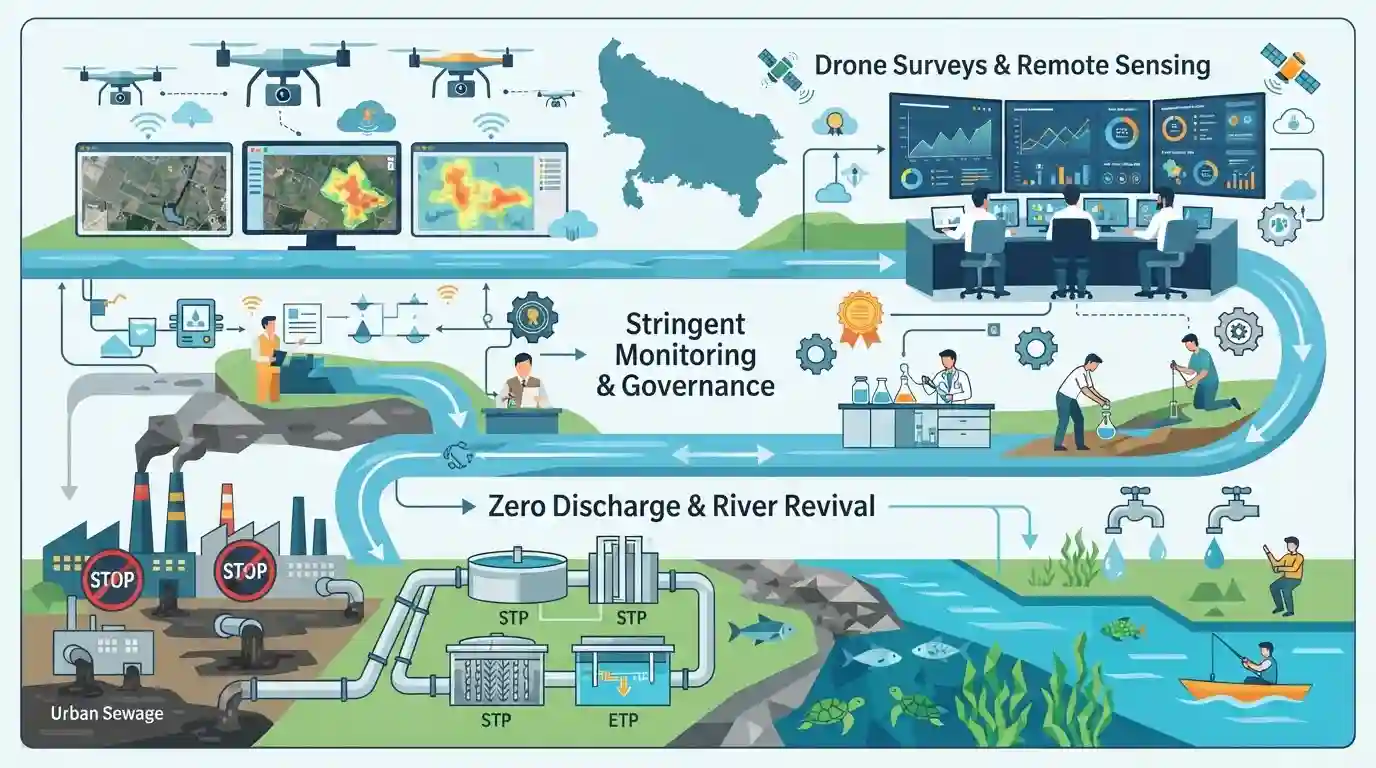
The Uttar Pradesh government has adopted a comprehensive multi-layered approach, including drone surveys and stringent monitoring, to achieve zero discharge of untreated sewage and industrial effluents into rivers, aiming to curb water pollution and revive river ecosystems across the state.
Key Points
- Uttar Pradesh government implements a multi-layered approach to ensure zero discharge of untreated wastewater into rivers.
- The strategy incorporates modern surveillance technology, including drone surveys, to monitor drains and industrial discharge points.
- Focus is placed on improving water quality and ecological health of major river systems in the state, such as the Ganga and Yamuna.
Important Terms
Namami Gange

An integrated central government program aimed at abating pollution, conserving, and rejuvenating the National River Ganga and its tributaries through sewage treatment, afforestation, and public awareness.
UPSC context
Important for UPPSC GS Paper III (Environment, Pollution, and River Conservation Schemes) and GS Paper V (UP Specific Schemes).
Uttar Pradesh government
The provincial executive body of Uttar Pradesh, responsible for state governance, implementation of environmental policies, and state-level river rejuvenation initiatives.
UPSC context
Crucial for UPPSC GS Paper V & VI regarding governance, policy execution, and administrative initiatives in Uttar Pradesh.
Prelims Trap
zero discharge of untreated sewage applies exclusively to the Ganga basin under Namami Gange
Aspirants might assume zero discharge applies only to the Ganga river, overlooking its implementation across multiple UP rivers like Gomti, Yamuna, Varuna, and Pandu.
Static Concepts Connected
What are the key institutional bodies and frameworks governing river pollution and conservation in India?
- CPCB Act: Central Pollution Control Board (CPCB) operates under the Water (Prevention and Control of Pollution) Act, 1974.
- Namami Gange: Namami Gange Programme is an integrated conservation mission approved in 2014 as a flagship program to accomplish twin objectives of abatement of pollution and conservation of the national river Ganga.
- NGT Role: National Green Tribunal (NGT) established in 2010 handles effective and expeditious disposal of cases relating to environmental protection and conservation of forests.
Cross-Topic Patterns
GIS Mapping + River Pollution Control
Integration of high-tech geospatial mapping with water pollution control links administrative governance reforms directly with national river rejuvenation initiatives like Namami Gange.

UP’s innovative drone-based GIS drain monitoring model for zero discharge will likely be tested in Prelims via multi-statement formats.
Linked PYQs · 2
Linked PYQs · 2
- 2018UPPSC_PRELIMSGS1
Which of the following rivers of Uttar Pradesh has been declared a 'Biological Disaster' due to environmental pollution?
- 2022UPPSC_PRELIMSGS1
The main purpose of 'Ganga Action Plan' project, launched in 1985, was
