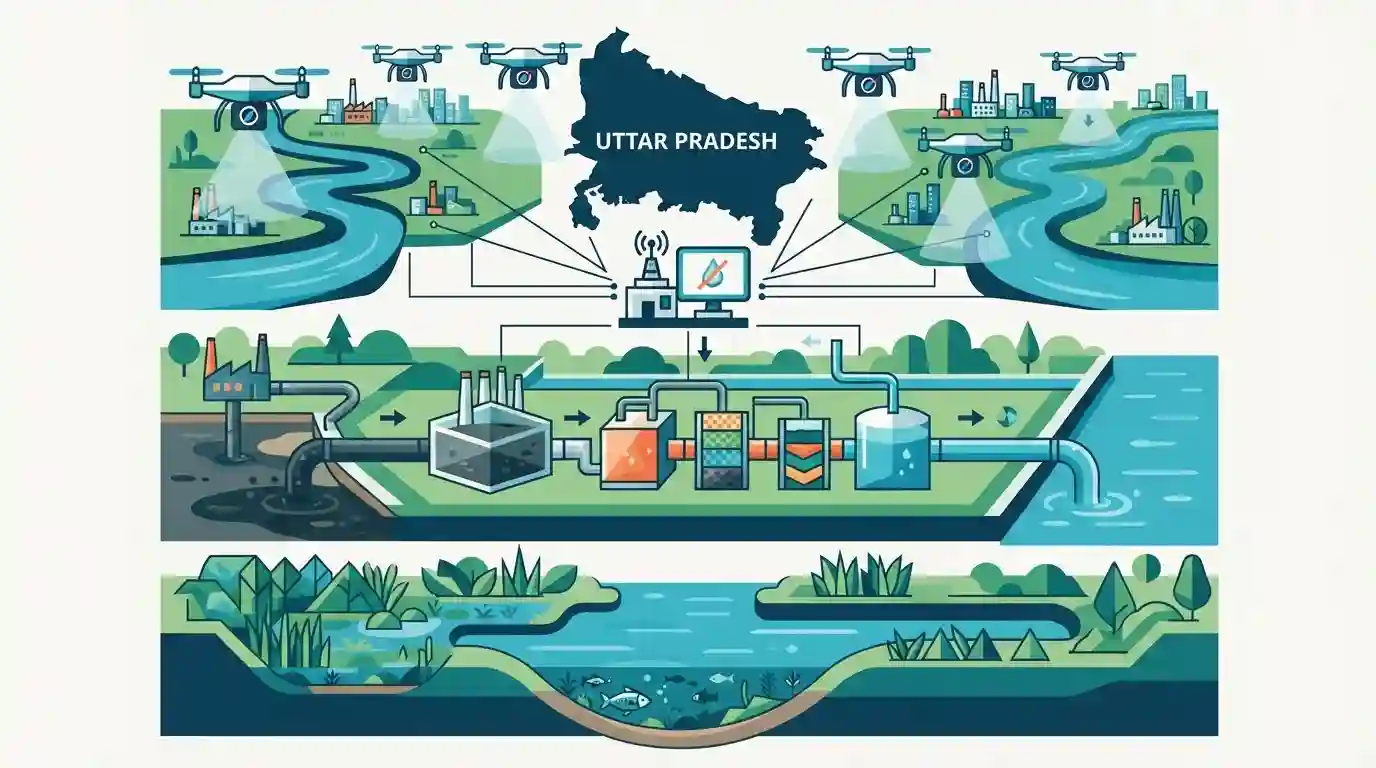
Uttar Pradesh implements drone surveillance for zero river discharge
Source:The Hindu ↗
Why It Matters
Crucial for UPPSC aspirants tracking Uttar Pradesh's environmental governance, state initiatives on river rejuvenation (Ganga/Yamuna), and the application of technology (drones) in pollution abatement.
Summary
The Uttar Pradesh government has initiated a multi-layered approach, including drone surveillance, to ensure zero discharge of untreated waste into rivers, boosting state-level water conservation and pollution control efforts.
Key Points
- Uttar Pradesh is implementing a multi-layered approach, including drone surveys, to achieve zero discharge of untreated sewage and industrial effluents into rivers.
- The initiative forms part of the state's broader environmental management strategy to rejuvenate river ecosystems like the Ganga and Yamuna.
- Advanced technological tools such as drone monitoring help track illegal discharge points, drains, and industrial polluters dynamically.
Important Terms
Namami Gange

An integrated conservation mission launched by the Union government in 2014 to abate pollution and rejuvenate the Ganga and its tributaries using a river-basin approach.
UPSC context
Important for GS Paper III (Environment, Conservation & Pollution Control) and UPPSC Prelims schemes/governance questions.
River Drone Survey Model
An innovative governance model utilizing high-resolution LiDAR and visual drone data to map drain discharge points, monitor pollution, and ensure zero discharge into rivers.
UPSC context
Tests e-governance, technological applications in pollution control, and UPPSC-specific environmental initiatives for GS Paper III and UP-specific sections.
Safe Reuse of Treated Water Policy
A state-level policy formulated to target the significant reuse of treated wastewater by 2030 and scaling up to 100% by 2045, curbing pollutant loads in rivers.
UPSC context
Relevant for GS Paper III (Water Conservation, Circular Economy) and UPPSC mains questions on state-specific environmental policies.
Prelims Trap
zero discharge of untreated sewage and industrial effluents
Aspirants often assume 'zero discharge' means zero water flow or complete closure of industries, whereas it refers strictly to untreated sewage and industrial effluent discharge into water bodies.
Static Concepts Connected
What are the key institutional bodies responsible for water pollution prevention in Uttar Pradesh?
- UPPCB Role: UPPCB enforces water pollution control acts and monitors industrial effluent standards across state river basins.
- National Mission: Namami Gange coordinates integrated basin management, sewage infrastructure creation, and riverfront development.
- Urban Bodies: ULBs manage local municipal sewage networks and small-scale domestic wastewater treatment plants.
Cross-Topic Patterns
River pollution control & smart urban governance
UP's tech-driven river monitoring links directly to urban governance reforms under AMRUT and National Urban Livelihoods Mission standards.
GIS mapping meets state environmental management
Integration of GIS dashboards with real-time drone tracking bridges environmental monitoring with digital governance frameworks (Digital India).

UPPSC often asks statement-based questions on specific state policies like the Safe Reuse of Treated Water Policy and drone initiatives.
Linked PYQs · 2
Linked PYQs · 2
- 2018UPPSC_PRELIMSGS1
Which of the following rivers of Uttar Pradesh has been declared a 'Biological Disaster' due to environmental pollution?
- 2022UPPSC_PRELIMSGS1
The main purpose of 'Ganga Action Plan' project, launched in 1985, was
